

Google Home’s October 14 update brings local Matter control to existing Philips Hue bridges, alongside fixes for Gemini voice commands and camera playback. Google says the Hue change happens in the background without pairing your lights again.
For people already using Google Home, the practical question is whether everyday controls become more dependable. A light that responds promptly is more useful than another menu of features. This update focuses on that daily experience, although Google has not supplied a measured speed improvement.
What changes in the October 14 update
According to Google’s release notes, compatible Matter devices gain local control through a compatible hub. Lights, plugs and switches also get redesigned controls, while a swipe-up panel on most full-screen device controllers exposes more settings.
Gemini for Home, still labeled early access in these notes, gets a fix for “stop” commands being mistaken for ending a conversation instead of stopping media, timers or alarms. On iOS, camera tiles retry when stuck on an old snapshot. Android fixes address paused-video scrubbing and errors when selecting snapshot events.
Google warns that features can arrive gradually even with the latest app installed. The notes do not give every household a firm completion date.
Why local control matters for smart lights
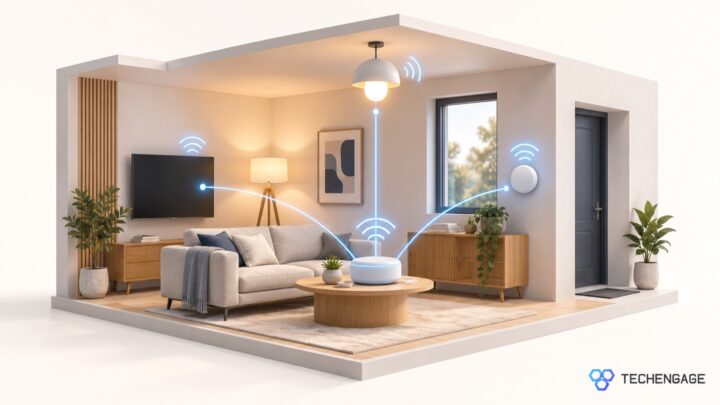
In Google’s explanation of Matter, a cloud-connected lighting command can travel from your home to Google’s services, onward to the manufacturer’s cloud, and back to the light. Matter can send the device command across your home network instead.
That shorter route is the reason to care about local control. It removes a cloud round trip from the device-control path. It should not be read as a promise that every Google Home feature, remote connection or voice conversation works without internet access.
The hardware requirement matters too. Google lists Nest Audio, Nest Mini and the first-generation Nest Hub among its Matter-over-Wi-Fi hubs. Thread devices need a hub with Thread border-router support, such as the second-generation Nest Hub, Nest Hub Max, Nest Wifi Pro or Google TV Streamer. Owning a Google speaker does not automatically mean it supports both connection types.
What to check before changing your setup
Start with the equipment you already own. Check the exact hub model and the connection type your accessory uses before buying another device. A compatibility logo is useful, but it is not a substitute for checking the specific product and the controls you want to use.
Google’s Matter setup instructions require a Google Account, home Wi-Fi, a compatible hub and accessory, and IPv6 enabled on the home router. For a new accessory, the app’s setup flow uses its Matter QR code or pairing code. Those are setup requirements for adding devices, not an instruction to remove an existing Hue setup.
Keep a note of any problem you are trying to solve: a delayed light, an unresponsive timer or a camera preview that stops refreshing. After an update reaches your household, repeat that same action. This makes it easier to tell whether the problem has improved without changing several settings at once.
If you are choosing new equipment, our smart ceiling-light buying advice explains why model-specific controls matter. For cameras, our video doorbell guide separates hardware choices from recording and subscription needs.
An update for existing homes, not a reason to replace them
The strongest reason to pay attention is that these changes target equipment and routines people already rely on. There is no need to rebuild a working home just to chase a release note. Check compatibility, let the rollout arrive, and judge it by the controls you actually use.




Share Your Thoughts