

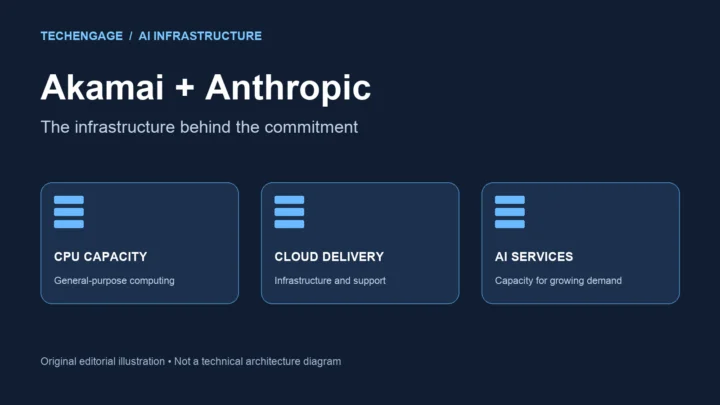
Akamai has announced a seven-year, $11.6 billion cloud agreement with Anthropic, putting general-purpose computing capacity at the center of a major new AI infrastructure commitment. The September 24 announcement concerns growing CPU workloads on Akamai Cloud, rather than the purchase of a newly announced AI model or consumer service.
The arrangement also allows up to $9 billion in additional commitments. That expansion is potential business, not part of the amount already committed. Akamai describes the package in its official announcement.
For readers following the infrastructure behind Claude, the useful questions go beyond the headline price: what kind of computing is being bought, when it becomes available, and what the agreement does—and does not—establish about future service improvements.
Why CPUs matter in an AI infrastructure agreement
A CPU handles general-purpose computing, including operating-system tasks, application logic and coordination with memory and other components. A GPU uses a more parallel architecture that is particularly useful for running many mathematical operations together, including machine-learning workloads. AWS’s technical explanation of CPUs and GPUs describes these complementary roles.
An AI service is a larger system than the processor executing a model. General-purpose servers and specialized accelerators can work together; buying more CPU capacity does not, by itself, establish that a company is replacing its AI accelerators.
That distinction matters when interpreting this announcement. It would be premature to turn a CPU infrastructure agreement into a claim about a particular future Claude model, its benchmark performance or a change in the chips used to train it. Those are separate technical questions requiring separate evidence.
The spending arrives before most of the revenue
Akamai’s September 24 investor presentation estimates approximately $5.5 billion in related capital expenditure. Its schedule places initial service delivery in late second-quarter 2027, with the full contracted revenue run rate expected by the end of 2028.
| Period | Estimated capital spending | Expected revenue from the agreement |
|---|---|---|
| Fourth quarter 2026 | $1.7 billion | None |
| 2027 | $3.1 billion | $150 million–$300 million |
| 2028 | $700 million | Ramping during the year |
| Thereafter | None in the presented schedule | Approximately $1.7 billion annually through the remaining term |
The presentation associates the initial spending with securing components, including memory. It says equipment depreciation begins when equipment enters service. These figures describe management’s plan, not completed deployment or revenue already earned.
What the contract filing adds
Akamai’s September 24 Form 8-K dates the new project plans to September 18. Each has an initial seven-year term starting from its respective service commencement date. Payment commitments are subject to delivery and availability requirements and the agreement’s termination provisions.
The filing describes termination rights involving uncured breaches and, under specified conditions, material outages. It also records a roughly $1.7 billion authorization for Jabil to procure memory components. The fuller services agreement is expected as an exhibit to Akamai’s quarterly filing for the period ending September 30.
This is why a contract announcement should not be read as a completed cash transfer. It establishes obligations between the parties, while delivery, service quality and the passage of time remain relevant to realizing the planned business.
The stock warrant is conditional, too
The announcement includes a warrant for non-voting convertible preferred shares equivalent to approximately 5% of Akamai’s outstanding common stock. A portion equivalent to about 2% is expected to vest with the announced commitment; the balance is tied to expansion. The common-share-equivalent exercise price is $111.33.
The filing further specifies that the first 40% of the warrant vests upon the first payment under Project Plan 3, subject to its terms. Three further 20% tranches depend on additional $3 billion commitments. Issuing the warrant is therefore different from all of it vesting or being exercised.
How this fits alongside Anthropic’s Amazon relationship
Anthropic’s April 20 announcement with Amazon provides important context. At that time, Anthropic said it would commit more than $100 billion over ten years to AWS technologies and secure up to five gigawatts of capacity for training and deploying Claude. It identified AWS as its primary training and cloud provider.
That earlier announcement covered both Trainium accelerators and Graviton CPUs. It illustrates why infrastructure relationships should be compared by workload and scope, rather than by treating every capacity contract as interchangeable.
The Akamai announcement does not establish that the Amazon relationship is being replaced. Nor should the two headline amounts simply be added together and presented as a newly disclosed annual AI budget: the agreements span different periods and describe different commitments.
TechEngage analysis: what customers should watch
For a business building on Claude, the practical test is delivered service. A large infrastructure commitment can be relevant to long-term planning without changing the application a customer uses today. Buyers should continue to evaluate the availability, latency, rate limits, support and contractual terms of the particular service they purchase.
The distinction is especially important for teams making purchasing decisions. A future capacity plan is not a substitute for a current service-level agreement. Developers should test their own workloads and retain appropriate fallback arrangements rather than assuming a supplier announcement removes operational risk.
Three follow-up questions will make this story more useful over time:
- Delivery: Does the provider report that the planned capacity has entered service, rather than merely being ordered?
- Commercial progress: Are additional commitments actually signed, and are they clearly separated from previously announced business?
- Customer impact: Do subsequent product announcements or measured service results demonstrate a change that users can experience?
Those questions keep the focus on execution. The most meaningful next evidence will be operational milestones and subsequent disclosures, not a larger restatement of the possible deal value.
Reporting note: This article is based on the companies’ linked primary-source announcements, Akamai’s regulatory filing and investor presentation, and AWS technical documentation. The analysis section is TechEngage’s interpretation; projected delivery and financial figures are company estimates, not independently verified outcomes.



Share Your Thoughts