Disclosure: TechEngage is a participant in the Amazon Services LLC Associates Program, an affiliate advertising program designed to provide a means for sites to earn fees by linking to Amazon.com and affiliated sites. We may earn a commission when you buy through links on this page, at no extra cost to you. Our editorial picks are made independently of these partnerships.
I used to haul a spinning 2TB external hard drive between my desk, a co-working space, and weekend shoots. It clicked like a dying hard drive should, took forever to clear a camera card, and once died after a three-foot drop onto concrete. Portable SSDs fixed all three problems: they are silent, several times faster, and survive backpack life that would kill a platter drive.
The category got confusing in 2025–2026. Marketing banners scream 2,000 MB/s, but that only shows up on USB 3.2 Gen 2×2 or Thunderbolt hosts. Plenty of “USB-C” laptops top out at 10 Gbps, which means a flagship drive behaves like a fast 1,000 MB/s unit. Rugged IP65 shells matter outdoors; bare metal sticks are fine on a desk. Encryption, cables, and format (exFAT vs APFS/NTFS) still trip people up on day one.
I narrowed this list to eight drives that earn a spot in a real kit — from the Samsung T9 for most people, to Shield and Extreme models for weather, to pocket rockets like the Kingston XS2000. If you are also moving phone photo libraries, pair this with our iPhone-to-external-drive guide and Android storage cleanup tips.
Quick Comparison: Best Portable SSDs
| Drive | Interface | Rated Speed | Durability | Best For |
|---|---|---|---|---|
| Samsung T9 1TB | USB 3.2 Gen 2×2 | Up to 2,000 MB/s | Drop-rated shell | Best overall |
| Samsung T7 Shield 1TB | USB 3.2 Gen 2 | Up to 1,050 MB/s | IP65 | Rugged travel |
| Samsung T5 1TB | USB 3.1 | Up to 540 MB/s | Compact metal | Classic value |
| Kingston XS2000 1TB | USB 3.2 Gen 2×2 | Up to 2,000 MB/s | IP55 sleeve | Pocket speed |
| SanDisk Extreme PRO 1TB | USB 3.2 Gen 2×2 | Up to 2,000 MB/s | IP65 + aluminum | Sustained pro dumps |
| Samsung T7 1TB | USB 3.2 Gen 2 | Up to 1,050 MB/s | Slim metal | Everyday classic |
| SanDisk Extreme 1TB | USB 3.2 Gen 2 | Up to 1,050 MB/s | IP65 | Budget rugged |
| Samsung T7 Touch 2TB | USB 3.2 Gen 2 | Up to 1,050 MB/s | Fingerprint lock | Secure high capacity |
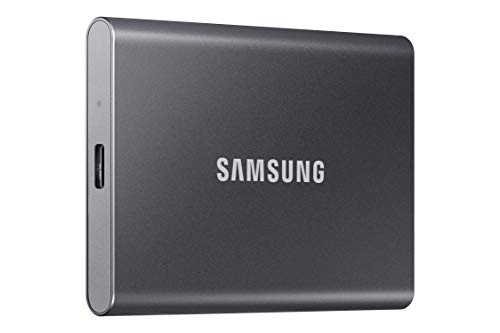
1. Samsung T9 Portable SSD 1TB — Best Overall
| Ease Table | |
|---|---|
| Price | $259.99 |
| Discount | – 10% |
| Rating on Amazon | 4.6 out of 5 stars – Out of 2,928 Reviews. |
| Brand | Samsung |
| Buy on Amazon |
The T9 is the drive I point most people toward in 2026. Rated up to 2,000 MB/s over USB 3.2 Gen 2×2, it clears camera cards and project folders fast when your laptop actually exposes a 20 Gbps port — and it still falls back cleanly to roughly 1,000 MB/s on ordinary USB-C. Samsung Magician handles firmware, health checks, and optional password locks without feeling like adware.
The rubberized shell survives backpack abuse better than bare aluminum sticks, though it lacks a formal IP water rating. Capacities stretch from 1TB to 4TB; the 1TB black SKU is the sweet spot for price-per-gigabyte. If you edit 4K, dump cards daily, or keep a bootable spare image, this is the drive that stops being the bottleneck.
Why it stands out: Up to 2,000 MB/s on Gen 2×2, Magician software, strong drop tolerance, and the best balance of speed and everyday usability.
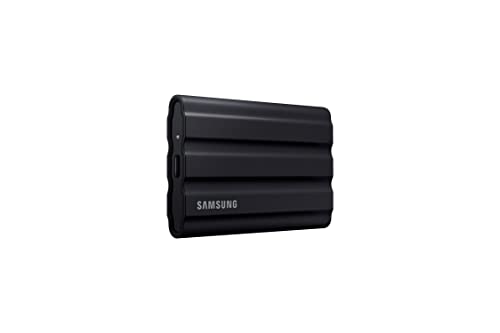
Buy on Amazon2. Samsung T7 Shield 1TB — Best for Rugged Travel
| Ease Table | |
|---|---|
| Price | |
| Discount | – |
| Rating on Amazon | out of 5 stars – Out of . |
| Brand | Samsung |
| Buy on Amazon |
Photographers who shoot in weather keep coming back to the T7 Shield. IP65 dust and water resistance plus a thick rubber shell make it the drive you are least afraid to clip to a camera bag in drizzle. Sequential speeds land around 1,050 / 1,000 MB/s — half the T9 on a Gen 2×2 host, but identical to the T9 on many older USB-C laptops that never offered Gen 2×2.
AES hardware encryption and Magician support carry over from the rest of the T7 family. Choose Shield when the drive will see rain, dust, or drops; choose T9 when it lives mostly indoors and you have a 20 Gbps port.
Why it stands out: IP65 sealing, rubber armor, ~1,050 MB/s transfers, and field-proven reliability for outdoor kits.
Buy on Amazon3. Samsung T5 Portable SSD 1TB — Best Classic Value
| Ease Table | |
|---|---|
| Price | $229.99 |
| Discount | – |
| Rating on Amazon | out of 5 stars – Out of . |
| Brand | Samsung |
| Buy on Amazon |
The T5 is the previous-generation portable that still shows up heavily on sale pricing. At up to about 540 MB/s it is slower than the T7/T9 class, but it remains a reliable USB 3.1 pocket drive with Magician support, AES encryption, and wide host compatibility. When street prices dip, it is often the cheapest way to get a trustworthy 1TB Samsung portable.
Skip the T5 if you move 4K timelines daily — buy a T7 or T9 instead. Choose it when you need dependable overflow storage for documents, photo libraries, and console archives without paying for silicon you will not saturate on older USB ports.
Why it stands out: Proven Magician stack, sale-friendly pricing, and enough speed for everyday backups on older USB ports.
Buy on Amazon4. Kingston XS2000 1TB — Best Pocket Speed
| Ease Table | |
|---|---|
| Price | $245.58 |
| Discount | – |
| Rating on Amazon | out of 5 stars – Out of . |
| Brand | Kingston |
| Buy on Amazon |
The XS2000 is tiny — roughly a stack of coins — yet pushes up to 2,000 MB/s on USB 3.2 Gen 2×2. The removable rubber sleeve and IP55 rating make it more travel-ready than bare metal nano drives without the bulk of a Shield. Content creators who live out of a sling bag tend to prefer this form factor once they try it.
Caveats: small drives are easier to misplace, and peak speed still requires a Gen 2×2 host. On ordinary USB-C it behaves like a fast T7-class drive. For pocketability plus flagship bandwidth, nothing else on this list is as compact.
Why it stands out: Coin-sized chassis, Gen 2×2 speeds, IP55 sleeve, and genuine pocket portability.
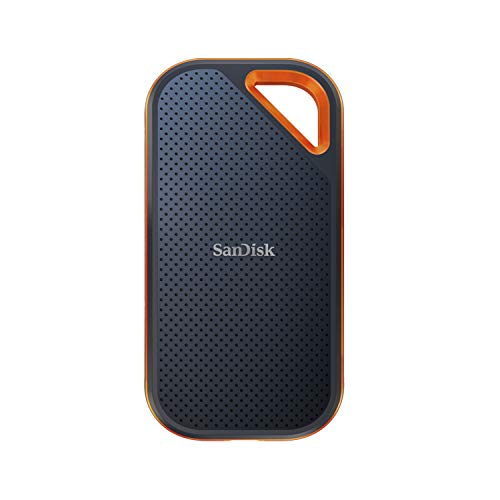
Buy on Amazon5. SanDisk Extreme PRO Portable SSD 1TB — Best for Sustained Pro Transfers
| Ease Table | |
|---|---|
| Price | $228.13 |
| Discount | – |
| Rating on Amazon | 4.5 out of 5 stars – Out of 17,039 Reviews. |
| Brand | SanDisk |
| Buy on Amazon |
SanDisk’s Extreme PRO pairs 2,000 MB/s ratings with a forged aluminum core that acts as a heatsink, which helps keep sequential writes from throttling as quickly during long dumps. IP65 sealing, a carabiner loop, and AES-256 password protection explain why it remains a staple on set.
Earlier Extreme-generation firmware drama made some editors cautious; current Extreme PRO units with updated firmware are the ones to buy. If you move multi-terabyte project folders between an edit bay and a laptop every day, the aluminum thermal mass is a practical advantage over plastic shells.
Why it stands out: Aluminum heatsink chassis, IP65, carabiner loop, and sustained write behavior that holds up on long dumps.
Buy on Amazon6. Samsung T7 Portable SSD 1TB — Best Everyday Classic
| Ease Table | |
|---|---|
| Price | $244.99 |
| Discount | – 11% |
| Rating on Amazon | out of 5 stars – Out of . |
| Brand | Samsung |
| Buy on Amazon |
The original T7 (non-Shield) is still an excellent daily driver: about 1,050 MB/s, slim metal body, Magician software, and deep compatibility. It is lighter and less bulky than the Shield, and usually cheaper than the T9. Choose it when the drive sits on a desk or in a padded sleeve and you do not need Gen 2×2 speeds.
It lacks an IP rating, so skip it for wet locations. For office backups, game libraries, and student workloads it remains one of the most boringly reliable options you can buy — which is a compliment.
Why it stands out: Slim metal body, ~1,050 MB/s, Magician support, and a refined everyday form factor.
Buy on Amazon7. SanDisk Extreme Portable SSD 1TB — Best Budget Rugged
| Ease Table | |
|---|---|
| Price | $219.99 |
| Discount | – |
| Rating on Amazon | 4.6 out of 5 stars – Out of 91,630 Reviews. |
| Brand | SanDisk |
| Buy on Amazon |
The non-PRO Extreme sits in the ~1,050 MB/s class with IP65 sealing and a carabiner-friendly shell at a lower price than Extreme PRO or T7 Shield. It is the right answer when you want weather resistance without paying for 2,000 MB/s silicon you cannot saturate anyway.
Verify the model listing before buying in bulk — some pages label older generations. For a single travel drive at street prices, it is hard to beat the ruggedness-per-dollar.
Why it stands out: IP65 weather sealing, carabiner-ready shell, and rugged protection without PRO pricing.
Buy on Amazon8. Samsung T7 Touch 2TB — Best Fingerprint Lock
| Ease Table | |
|---|---|
| Price | |
| Discount | – |
| Rating on Amazon | out of 5 stars – Out of . |
| Brand | Samsung |
| Buy on Amazon |
The T7 Touch adds a fingerprint sensor on top of T7-class speeds, which is useful for consultants and journalists who carry sensitive archives. The 2TB capacity covers larger photo and video libraries without jumping to desktop docks. Authentication is optional — you can still use a password or leave it unlocked.
Fingerprint readers add a failure point and a slightly thicker chassis; most people are better served by T9 or Shield plus a strong software password. If biometric unlock is a hard requirement, Touch is the mature option that still uses Samsung’s familiar software stack.
Why it stands out: Fingerprint unlock, 2TB capacity, T7-class speeds, and optional password fallback.
Buy on AmazonWhat Actually Matters When Buying a Portable SSD
Match the drive to your real USB port
USB 3.2 Gen 2 (10 Gbps) tops out near 1,000–1,050 MB/s. USB 3.2 Gen 2×2 (20 Gbps) unlocks the 1,800–2,000 MB/s class. Thunderbolt goes higher still, but only when both enclosure and host speak Thunderbolt. Many Windows laptops advertise USB-C without Gen 2×2; on those ports a T9 behaves like a fast Gen 2 drive. Our USB-C standards explainer helps decode the labels.
IP ratings and drop claims
IP65 means dust-tight and resistant to water jets — useful for outdoor shoots. IP55 is milder but still better than a bare stick. Drop ratings of two to three meters matter more than brochure photos when the drive lives on a carabiner. If the drive stays on a desk, skip the armor and buy capacity.
Encryption, cables, and format
Hardware AES-256 locks on Samsung and SanDisk models are worth enabling for client deliverables. Most drives ship exFAT for cross-platform use; reformat to APFS or NTFS only if you are locking into one ecosystem. Keep both USB-C–C and USB-C–A cables in the kit — losing the cable is how people “brick” a perfectly good SSD.
How to Choose the Right Portable SSD
| Your situation | Best pick | Why |
|---|---|---|
| Fastest everyday drive with modern USB-C | Samsung T9 | 2,000 MB/s class + Magician |
| Rain, dust, drops on location | Samsung T7 Shield | IP65 + rubber armor |
| Cheapest trustworthy Samsung portable | Samsung T5 | Sale pricing, proven stack |
| Smallest fast drive | Kingston XS2000 | Pocket size + Gen 2×2 |
| Long sustained writes / on-set dumps | SanDisk Extreme PRO | Aluminum heatsink + IP65 |
| Desk / backpack, no weather needs | Samsung T7 | Slim, proven, affordable |
| Budget rugged | SanDisk Extreme | IP65 without PRO pricing |
| Biometric unlock + 2TB | Samsung T7 Touch | Fingerprint + capacity |
Also confirm your host port before chasing peak numbers. For laptop-heavy setups, our gaming laptop guide and laptops for writers roundup help map which machines expose faster controllers.
Final Thoughts
Buy for the port you have and the abuse the drive will see. Most people with a modern USB-C laptop should start with the Samsung T9; field shooters should start with the T7 Shield; budget buyers should look at the T5 on sale or SanDisk Extreme. Avoid spinning hard drives unless you need archival multi-terabyte cold storage at the lowest dollar-per-gigabyte — for anything you touch weekly, a portable SSD pays for itself in time saved and fewer mechanical failures.
Prices move weekly on Amazon. Use the Ease Tables above for live pricing, and stick to 1TB or larger if you shoot RAW or 4K — 500GB fills faster than most first-time buyers expect. For manufacturer specs beyond Amazon listings, Samsung’s portable SSD pages and SanDisk’s Extreme PRO product docs are solid primary sources.
FAQs
Is a portable SSD worth it over an external hard drive?
Yes for almost every daily-use case. Portable SSDs are several times faster, far more shock-resistant, and silent. Mechanical external HDDs only win on raw dollar-per-terabyte for cold archival storage you rarely touch.
Will a 2,000 MB/s SSD actually reach that speed on my laptop?
Only if your computer has a USB 3.2 Gen 2×2 (20 Gbps) or Thunderbolt port and you use a quality cable. Many USB-C ports are Gen 2 (10 Gbps) and will top out near 1,000 MB/s even with a T9 or XS2000 attached.
Do these drives work with iPhone 15/16 and Android phones?
Most modern portable SSDs work with USB-C iPhones and Android devices when you use a data-capable USB-C cable. Some phones need more power than bus power provides for large sustained writes; a powered hub can help. Format remains exFAT for the widest compatibility.
What does IP65 mean on a portable SSD?
IP65 means the enclosure is dust-tight and protected against water jets from any direction. It is not a submarine rating — do not submerge the drive. IP55 is a milder water/dust resistance level still useful for travel.
What capacity should I buy in 2026?
1TB is the practical minimum for photo/video work and game libraries. 2TB is the sweet spot if you edit 4K or keep multiple device backups. Step to 4TB only when you already know 2TB fills within a few months.


Share Your Thoughts