

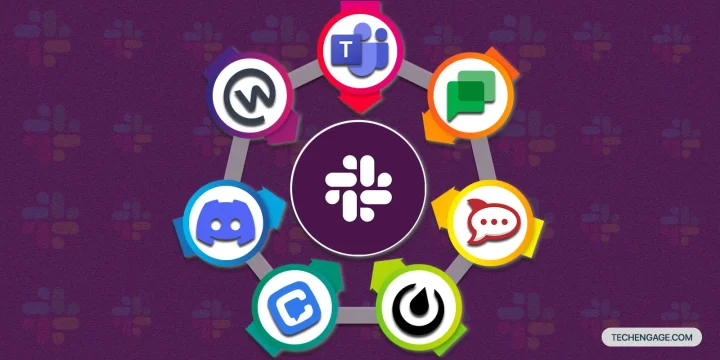
Slack works well enough for most teams. But pricing, feature gaps, or company-wide tooling decisions push plenty of organizations toward alternatives that fit their workflow better.
Slack changed how teams communicate. Channels replaced endless email threads, integrations connected tools that never talked to each other, and async messaging became the default rhythm for distributed teams. But Slack’s free plan limits message history to 90 days, the Pro plan costs $8.75 per user per month, and the interface can feel bloated once a workspace grows past a few hundred people. Some teams need deeper video integration. Others want to self-host everything on their own servers. A few just want something simpler and cheaper.
The alternatives below cover different needs: enterprise ecosystems, open-source self-hosting, budget-friendly options, and community-focused platforms. Each one has a genuine reason to exist beyond just being “not Slack.”
Microsoft Teams
Best for: Organizations already using Microsoft 365
Platforms: Windows, macOS, Linux, iOS, Android, Web
Microsoft Teams is the default communication tool for most enterprises. It ships bundled with every Microsoft 365 subscription, which means organizations paying for Office apps already have Teams at no additional cost. That bundling alone explains why Teams has over 320 million monthly active users.
The tight integration with SharePoint, OneDrive, Outlook, and the rest of the Microsoft ecosystem is the real selling point. Documents shared in a Teams channel live in SharePoint automatically. Calendar invites from Outlook create Teams meetings without extra steps. For companies built on Microsoft infrastructure, nothing else connects this seamlessly.
The downsides are real, though. Teams can feel sluggish on older hardware, the notification system takes some tuning before it stops being overwhelming, and the channel/team/chat structure confuses new users who are accustomed to Slack’s more straightforward workspace model. The free version supports up to 100 participants in meetings and includes 5 GB of team storage.
Google Chat
Best for: Teams running on Google Workspace
Platforms: Web, iOS, Android (also accessible within Gmail)
Google Chat replaced Google Hangouts and sits inside Google Workspace alongside Gmail, Drive, Meet, and Calendar. The pitch is identical to Teams but for the Google ecosystem: everything connects without additional setup. Share a Google Doc in a Chat Space, and everyone in that space can edit it without leaving the conversation.
Spaces (Google’s version of channels) support threaded conversations, shared files, and task assignments. Google Meet handles video calls directly from Chat. The whole experience lives inside Gmail for users who prefer a single browser tab over a dedicated app.
Google Chat works best for teams already paying for Google Workspace. As a standalone messaging tool outside that ecosystem, it lacks the third-party integration depth that Slack offers. The free tier through a personal Google account is functional for casual use but limited compared to the Workspace version.
Discord
Best for: Communities, creative teams, startups with informal culture
Platforms: Windows, macOS, Linux, iOS, Android, Web
Discord started as a gaming communication platform and has since expanded into a general-purpose community tool. Plenty of startups, open-source projects, and creator-led businesses run their internal communication on Discord servers because the free tier is remarkably generous: unlimited message history, voice channels with no time limits, screen sharing, and support for servers with hundreds of thousands of members.
Voice channels are where Discord stands apart from every other tool on this list. Instead of scheduling a call and sending a link, team members simply join a persistent voice channel when they want to talk. It creates a virtual office atmosphere that scheduled meetings cannot replicate. Screen sharing and streaming within those voice channels work well for quick demos or pair programming sessions.
Discord is not built for enterprise use. It lacks formal compliance certifications, audit logs for regulated industries, and the kind of admin controls that IT departments demand. But for small teams, communities, and organizations where formality is not a priority, the free plan offers more than Slack’s paid tier in several areas.
Mattermost
Best for: Developer teams and organizations that need self-hosted messaging
Platforms: Windows, macOS, Linux, iOS, Android, Web
Mattermost is an open-source Slack alternative designed specifically for technical teams. The interface looks and feels similar to Slack, with channels, direct messages, threads, and file sharing. The critical difference is deployment: Mattermost can run entirely on company-owned servers, giving organizations full control over their data.
That self-hosting capability matters enormously for companies in regulated industries (healthcare, finance, defense) where data residency and compliance requirements prevent the use of third-party cloud services. Mattermost supports end-to-end encryption, LDAP and SAML authentication, and granular permission controls.
The free edition covers messaging for unlimited users. Paid plans add features like persistent playbooks, incident collaboration workflows, and enterprise-grade admin tools. Setting up a self-hosted Mattermost instance requires a sysadmin comfortable with Linux servers and database management. A cloud-hosted option exists for teams that want the product without the infrastructure work.
Rocket.Chat
Best for: Organizations wanting open-source messaging with omnichannel support
Platforms: Windows, macOS, Linux, iOS, Android, Web
Rocket.Chat occupies similar territory to Mattermost as an open-source, self-hostable messaging platform. Where it differentiates is omnichannel capability: Rocket.Chat can funnel messages from WhatsApp, Instagram, Facebook Messenger, email, and live chat widgets into a single interface. That makes it popular with customer support teams and organizations that need to manage both internal communication and external customer conversations in one place.
The platform supports channels, direct messages, threads, video conferencing, and end-to-end encryption. A marketplace of apps and integrations extends functionality, and the API allows custom integrations for teams with development resources. Rocket.Chat also offers federation, meaning separate Rocket.Chat instances can communicate with each other across organizations.
The community edition is free for self-hosted deployments. The enterprise plan and cloud-hosted options carry subscription fees. Like Mattermost, deploying Rocket.Chat on your own servers demands technical know-how, but the reward is complete data ownership.
Zoom Team Chat
Best for: Teams that live in Zoom meetings and want messaging in the same app
Platforms: Windows, macOS, Linux, iOS, Android, Web
Zoom Team Chat is built into the Zoom desktop and mobile app. Anyone with a Zoom account already has access to it. The messaging experience includes channels, group chats, file sharing, and threaded replies. Jumping from a text conversation to a Zoom call happens in one click since both features live in the same application.
The advantage here is consolidation. Teams that rely heavily on Zoom for meetings can reduce their tooling by using Team Chat instead of paying for a separate Slack workspace. Zoom Whiteboard and Zoom Docs integrate directly into chat conversations. The free Zoom plan includes Team Chat with no message history limits.
As a pure messaging platform, Team Chat is less mature than Slack. The third-party integration library is smaller, channel organization is less refined, and the search functionality does not match Slack’s precision. It works best as an add-on for existing Zoom users rather than a standalone messaging solution.
Pumble
Best for: Budget-conscious teams that need unlimited message history for free
Platforms: Windows, macOS, Linux, iOS, Android, Web
Pumble directly targets the gap Slack created when it started limiting free-plan message history. Pumble’s free tier includes unlimited users, unlimited message history, and 10 GB of shared storage. For small teams and startups watching every dollar, that is a hard offer to ignore.
The interface is clearly inspired by Slack. Channels, threads, direct messages, mentions, and file sharing all work the way a Slack user would expect. The learning curve for teams migrating from Slack is essentially zero. Pumble also includes voice and video calling, screen sharing, and guest access on the free plan.
Pumble is made by CAKE.com, the same company behind Clockify (time tracking) and Plaky (project management). The paid Pro plan adds custom roles, advanced permissions, and admin analytics. The integration ecosystem is limited compared to Slack’s massive app directory, which is the main trade-off for the price savings.
Element
Best for: Privacy-focused organizations and teams needing decentralized communication
Platforms: Windows, macOS, Linux, iOS, Android, Web
Element is built on the Matrix protocol, an open standard for decentralized, encrypted communication. Every message is end-to-end encrypted by default. The platform can be self-hosted, and because Matrix is a federated protocol, separate Element servers can communicate with each other the same way different email servers exchange messages.
Several European governments, including France and Germany, have adopted Element-based platforms for internal government communication specifically because of the data sovereignty guarantees. The French government runs its own Matrix server for inter-ministerial messaging. That level of institutional adoption speaks to the security credentials.
For everyday team messaging, Element supports rooms (channels), threads, voice and video calls, file sharing, and bridging to other platforms (Slack, IRC, Discord, Microsoft Teams). The experience is functional but rougher around the edges than Slack. Setup requires more effort, and the interface lacks the polish that commercial products invest in. Element is the right pick when privacy and data control are non-negotiable requirements.
Chanty
Best for: Small teams that want built-in task management alongside chat
Platforms: Windows, macOS, Linux, iOS, Android, Web
Chanty combines team messaging with a built-in task manager called Teambook. Any message can be converted into a task with a due date, assignee, and priority level. That eliminates the need for a separate project management tool for teams with straightforward task workflows.
The free plan supports up to 5 members with unlimited message history. Paid plans start at $4 per user per month and unlock audio/video calls with screen sharing, role-based permissions, and integrations with tools like Trello, Asana, Jira, and Google Drive. Chanty’s pricing model charges only for active users, which saves money for organizations with members who log in occasionally.
Chanty is not trying to compete with Teams or Slack at enterprise scale. It targets small businesses and teams under 50 people who want chat and task tracking in a single, affordable app without the complexity of larger platforms.
Which One Should You Pick?
The right choice depends on what is already in the toolkit. Microsoft 365 shops should try Teams before paying for anything else. Google Workspace teams have the same logic with Google Chat. If budget is the primary constraint and the team is small, Pumble or Chanty offer the most functionality at zero cost. Developer teams and regulated industries that require data control should evaluate Mattermost, Rocket.Chat, or Element. Discord fits communities and informal teams that value persistent voice channels over corporate features.
Switching from Slack is not difficult mechanically. The harder part is getting everyone on the team to actually use the new tool consistently. Whichever alternative gets chosen, committing to it fully matters more than picking the theoretically perfect option.
Frequently Asked Questions
Is Microsoft Teams really free?
Microsoft Teams offers a free version that includes unlimited chat, 60-minute group meetings with up to 100 participants, and 5 GB of team storage. The free plan lacks some enterprise features like meeting recordings, larger meeting capacity, and advanced admin controls. Organizations already paying for Microsoft 365 Business Basic or higher get the full version of Teams included in their subscription at no extra charge.
What is the best free Slack alternative with unlimited message history?
Pumble offers unlimited message history on its free plan along with unlimited users and 10 GB of shared file storage. Chanty also provides unlimited history but limits the free plan to 5 team members. Discord keeps all message history indefinitely on its free tier with no user limits. Among these, Pumble is the closest to Slack in terms of interface and functionality while maintaining a fully free core product.
Can you self-host a Slack alternative?
Mattermost, Rocket.Chat, and Element all support self-hosted deployment. Mattermost and Rocket.Chat are open-source and can be installed on company-owned Linux servers. Element runs on the Matrix protocol and can be deployed as a federated server. Self-hosting gives organizations full control over their data, which is a requirement for industries with strict data residency and compliance regulations. All three offer free community editions for self-hosted use.
Is Discord suitable for business use?
Discord works well for small teams, startups, open-source communities, and creator businesses that do not require formal compliance features. Its free plan includes unlimited messaging, persistent voice channels, screen sharing, and video calls. However, Discord lacks enterprise audit logs, HIPAA or SOC 2 compliance, and advanced admin controls that regulated industries require. For informal teams that value flexibility over corporate governance, Discord is a strong and completely free option.
What happened to Workplace from Meta?
Meta discontinued Workplace (formerly Workplace from Facebook) and fully shut down the platform in 2025. Organizations that were using Workplace needed to migrate to alternative communication tools. Meta recommended Workvivo by Zoom as the official migration path, though many Workplace users moved to Microsoft Teams, Slack, or Google Chat instead.





Share Your Thoughts