

In this guide
Disclosure: TechEngage is a participant in the Amazon Services LLC Associates Program, an affiliate advertising program designed to provide a means for sites to earn fees by linking to Amazon.com and affiliated sites. We may earn a commission when you buy through links on this page, at no extra cost to you. Our editorial picks are made independently of these partnerships.
For hiking, start with the Rocky Talkie Mountain Radio; for GMRS repeater access, choose the Rocky Talkie Expedition. The Cobra RX680 is a practical family-camping option, while the floating Motorola T600 H2O suits trips near water. Choose around your terrain, group and radio service, not the biggest mileage claim on the box.
Muhammad Abdullah personally used and tested all ten radios in this guide. The recommendations explain who each model suits, its useful features and the trade-offs to consider. Manufacturer range and durability ratings are specifications, not guaranteed results on your route.
Before buying: This guide covers US-market radios. FRS units do not require an individual FCC license; GMRS radios require appropriate authorization. Check local rules before using a US radio abroad. No handheld radio guarantees contact across hills or through buildings.
Compare the 10 walkie-talkies
| Radio | Best suited to | US service | Protection |
|---|---|---|---|
| Rocky Talkie Mountain Radio | Hiking and climbing without a GMRS license | FRS | IP56, not submersible |
| Rocky Talkie Expedition | GMRS repeater users and wet outdoor conditions | GMRS | IP67 |
| Midland GXT1000VP4 | A GMRS pair for direct group communication | GMRS | JIS4 splash resistance |
| Motorola Talkabout T600 H2O | Keeping a group together near water | FRS | IP67; floating design |
| Cobra RX680 | Family camping with weather alerts | FRS | IP54 splash resistance |
| BaoFeng GT-18 | Equipping three people for simple outings | FRS, US version | No immersion claim |
| Oxbow Renegade 2.0 | Backpack-mounted communication | FRS | Rain and snow protection |
| Motorola Talkabout T800 | App-linked group location and messaging | FRS | IPX4 splash resistance |
| Retevis RT628 | Supervised children’s activities | FRS, US version | Keep dry |
| DEWALT DXFRS800 | A durable FRS pair for a worksite | FRS | IP67 |
Compare the pack size as well as the price. Both linked Rocky Talkie offers contain two radios; the BaoFeng GT-18 offer contains three. The product tables show Amazon data for the exact linked offer. If a price is unavailable, use the availability button rather than assuming the product is in stock.
1. Rocky Talkie Mountain Radio: hiking and climbing without a GMRS license

| Price & Details | |
|---|---|
| Price | $240.00 |
| Rating on Amazon | 4.6 out of 5 stars |
| Brand | Rocky Talkie |
| Buy at Amazon | Check availability on Amazon |
Product data updated: 19 October 2026 - 10:38
Best for: A secure pack attachment and straightforward controls for trail groups.
Keep in mind: No NOAA weather reception or repeater support.
The Mountain Radio is the best fit here for hikers who want a radio attached securely to a pack or harness. Its carabiner and backup leash are useful when a belt clip would be awkward, while the simple controls keep the focus on talking to your group. The linked offer is a two-pack, so compare its price with other two-radio bundles.
Rocky Talkie specifies 2-watt output, USB-C charging and IP56 protection against dust and water jets. That protection suits rain and snow, but it does not make the radio suitable for immersion. Choose the Expedition instead if you need a submersible body and repeater capability.
Pros: Carabiner and backup leash; USB-C charging; no individual FRS license in the US.
Cons: No weather channels; no repeater access; higher cost than basic family radios.
2. Rocky Talkie Expedition: GMRS repeater users and wet outdoor conditions

| Price & Details | |
|---|---|
| Price | $390.00 |
| Rating on Amazon | 4.8 out of 5 stars |
| Brand | Rocky Talkie |
| Buy at Amazon | Check availability on Amazon |
Product data updated: 19 October 2026 - 10:38
Best for: A waterproof GMRS radio with weather alerts and repeater support.
Keep in mind: US GMRS authorization is required. A repeater must be reachable and you need permission to use it.
The Expedition is the strongest match in this list for someone specifically seeking repeater access. It combines 5-watt output, a removable antenna, eight repeater channel pairs and NOAA weather alerts. The linked offer contains two radios, not one.
Its IP67 rating and USB-C charging make it a practical outdoor option, but extra power does not guarantee contact across a ridge or canyon. Before a trip, configure the repeater frequency and tones, obtain access permission and test the route. For ordinary direct conversations with nearby friends, the simpler Mountain Radio avoids GMRS licensing paperwork.
Pros: Repeater support; removable antenna; IP67 protection; NOAA alerts.
Cons: Requires GMRS authorization; more setup than FRS; repeater coverage is not universal.
3. Midland GXT1000VP4: a GMRS pair for direct group communication

| Price & Details | |
|---|---|
| Price | $89.99 |
| Rating on Amazon | 4.4 out of 5 stars |
| Brand | Midland |
| Buy at Amazon | Check availability on Amazon |
Product data updated: 19 October 2026 - 10:44
Best for: A two-radio kit with weather scanning and included charging accessories.
Keep in mind: It does not support repeaters. Its extra channel presets are not extra repeater frequencies.
The GXT1000VP4 suits a licensed household that wants two radios for direct communication around a campsite or property. NOAA weather scanning and alerts are useful when local broadcasts are receivable. The standard kit includes rechargeable packs and a desktop charger.
Midland’s 50-channel description includes preset combinations beyond the standard channels; it does not give this model repeater access. Its JIS4 protection is for splashes rather than immersion. Choose the Expedition for repeaters or the Motorola T600 for a floating design. Check availability before committing to this older kit.
Pros: Two-radio kit; weather scan and alerts; rechargeable packs and charger.
Cons: No repeater support; splash resistance only; GMRS authorization required.
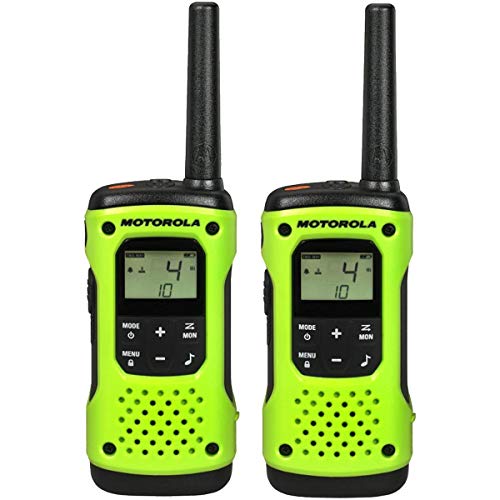
4. Motorola Talkabout T600 H2O: keeping a group together near water
| Price & Details | |
|---|---|
| Brand | Motorola Solutions |
| Buy at Amazon | Check availability on Amazon |
Product data updated: 19 October 2026 - 10:44
Best for: Paddlers and waterside campers who value a floating radio.
Keep in mind: It is not a marine VHF radio or a way to contact emergency services automatically.
The T600 H2O is the water-focused pick. Its floating design and water-activated light make a dropped radio easier to find, while IP67 protection covers the specified temporary immersion conditions. Motorola notes that flotation depends on the battery configuration; use the specified rechargeable pack and follow the manual.
This link is for the T600 two-pack, not a promise of every feature on newer T600 revisions. Check the charging connector and included accessories on the exact listing. Weather reception and a local emergency alert can help your group, but neither replaces marine communications or an emergency beacon.
Pros: Floating design; water-activated flashlight; weather reception; IP67 protection.
Cons: Bulkier than basic family radios; flotation depends on batteries; no marine distress channel.
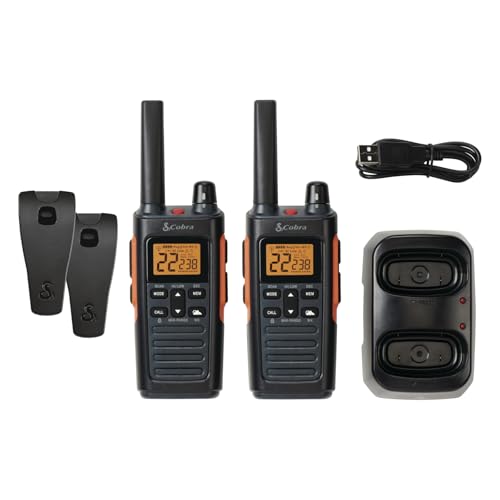
5. Cobra RX680: family camping with weather alerts
| Price & Details | |
|---|---|
| Price | $96.26 |
| Rating on Amazon | 4.2 out of 5 stars |
| Brand | Cobra |
| Buy at Amazon | Check availability on Amazon |
Product data updated: 19 October 2026 - 10:44
Best for: Campers who want a rechargeable pair, weather alerts and vibrating notifications.
Keep in mind: Splashproof rather than submersible. The 60 presets use 22 FRS frequencies.
The RX680 is a practical starting point for family camping when you want weather alerts without a GMRS license. The pair includes a charging dock, and vibrating call notifications offer another way to notice a call. A built-in light can help with small tasks around camp.
Cobra’s 60 presets consist of 22 standard FRS channels plus 38 channel-and-code combinations. They do not provide 60 independent frequencies or private conversations. Its IP54 rating handles splashes, so choose the T600 instead if dropping a radio in water is a likely concern.
Pros: NOAA alerts; vibrating notifications; included charging dock; license-free FRS operation.
Cons: Not submersible; micro-USB charging setup; presets do not prevent others hearing you.
6. BaoFeng GT-18: equipping three people for simple outings
| Price & Details | |
|---|---|
| Price | $28.99 |
| Discount | 19% |
| Rating on Amazon | 4.2 out of 5 stars |
| Brand | BaoFeng |
| Buy at Amazon | Check availability on Amazon |
Product data updated: 12 October 2026 - 21:36
Best for: A three-person group that wants small rechargeable radios.
Keep in mind: Choose the US FRS version. The PMR446 version sold in other regions is different.
The GT-18 three-pack makes sense for nearby family communication when everyone needs a handset. Its display, flashlight and rechargeable battery cover the basics without requiring a separate radio for each purchase. Buy it for convenience and pack size, not a guaranteed multi-mile connection.
The US version has 22 FRS channels. BaoFeng also sells a PMR446 variant, so confirm the region before ordering or mixing radios. The GT-18 does not provide NOAA weather channels, and it is not a substitute for a rugged waterproof radio on an exposed trip.
Pros: Three radios in the linked pack; rechargeable batteries; simple display and controls.
Cons: No NOAA weather channels; region variants need care; not the pick for immersion exposure.
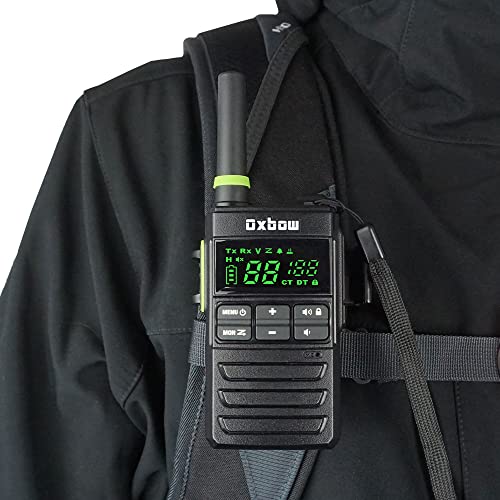
7. Oxbow Renegade 2.0: backpack-mounted communication
| Price & Details | |
|---|---|
| Rating on Amazon | 4.3 out of 5 stars |
| Brand | Oxbow Gear |
| Buy at Amazon | Check availability on Amazon |
Product data updated: 19 October 2026 - 10:44
Best for: A shoulder-mounted radio for outdoor use with gloves.
Keep in mind: The Renegade 2.0 does not have the Renegade X’s Bluetooth feature.
The Renegade 2.0 is worth considering if convenient placement matters more than a long feature menu. Its shoulder-strap mount keeps the controls accessible on a backpack, and the large push-to-talk button suits gloved use. The removable battery is useful for planning longer outings.
Keep the model distinction clear: Renegade 2.0 and Renegade X are different products, and the 2.0 lacks Bluetooth. Choose it for the mounting arrangement rather than assuming it has the longest range or best audio of every radio here. Check the exact offer and available accessories before buying.
Pros: Shoulder-strap mounting; large push-to-talk control; removable battery.
Cons: No Bluetooth on the 2.0; not a floating radio; older-model availability varies.
8. Motorola Talkabout T800: app-linked group location and messaging

| Price & Details | |
|---|---|
| Brand | Motorola Solutions |
| Buy at Amazon | Check availability on Amazon |
Product data updated: 19 October 2026 - 10:44
Best for: Groups prepared to pair compatible phones and radios before a trip.
Keep in mind: This is the original T800, not the newer T802/T803. App features need compatible phones and setup.
The original T800 adds a phone connection to ordinary push-to-talk. The TALKABOUT app can use paired radios to exchange location information and messages within radio range. That is useful when your group wants more context than voice alone, provided everyone has the compatible setup ready.
Its Bluetooth connection does not turn it into a satellite messenger or provide internet access. The original model has micro-USB charging and IPX4 splash protection. Check app availability and phone compatibility before purchasing for that feature; do not assume newer T802/T803 Bluetooth accessory support applies to this model.
Pros: App-linked messaging and location features; standalone voice communication; weather alerts.
Cons: Phone setup and battery use for app functions; splash resistance only; older micro-USB design.
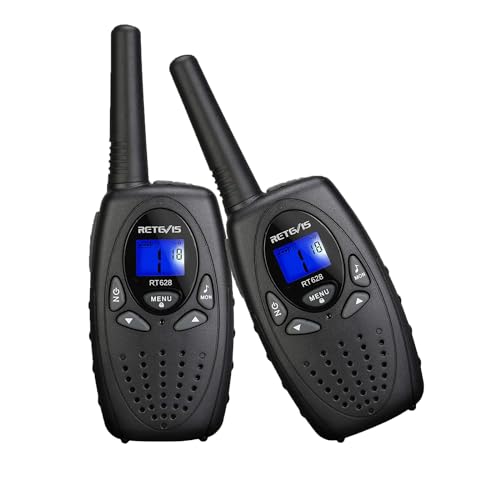
9. Retevis RT628: supervised children’s activities
| Price & Details | |
|---|---|
| Price | $18.89 |
| Discount | 10% |
| Brand | Retevis |
| Buy at Amazon | Check availability on Amazon |
Product data updated: 19 October 2026 - 10:44
Best for: Children learning push-to-talk around a campsite or backyard.
Keep in mind: A radio is not a child-tracking device. Privacy codes do not make conversations private.
The RT628 is the simplest children-focused option here. The keypad lock helps prevent accidental setting changes, and the small body is easier to carry than a larger outdoor radio. An adult can use a compatible FRS radio after matching the channel and tone settings.
Each unit takes three AA batteries, so include batteries and spares in the cost of the pair. Practice taking turns with push-to-talk before relying on VOX, which may respond to background sound. Keep children within agreed boundaries and explain that other people can hear or join radio conversations.
Pros: Keypad lock; compact size; replaceable AA batteries; compatible US FRS channels.
Cons: Batteries add cost; no location tracking; not intended for demanding wet conditions.
10. DEWALT DXFRS800: a durable FRS pair for a worksite

| Price & Details | |
|---|---|
| Price | $147.00 |
| Rating on Amazon | 4.6 out of 5 stars |
| Brand | DEWALT |
| Buy at Amazon | Check availability on Amazon |
Product data updated: 19 October 2026 - 10:44
Best for: Teams needing rugged handsets and a drop-in charging routine.
Keep in mind: Building coverage depends on the site. It is not a substitute for a purpose-designed safety communications system.
The DXFRS800 focuses on handling and durability: an anti-slip body, swivel holster, IP67 protection and a manufacturer-rated two-meter drop resistance. That makes it a better match for a workshop or worksite than the children’s radios in this guide. The linked kit is a two-pack.
The advertised 18-hour runtime uses a 90% standby, 5% talk and 5% listen duty cycle, not continuous conversation. Likewise, floor-count and square-foot coverage claims should not determine whether it will reach through your building. Test all work areas, including stairs and enclosed rooms, before making it your team’s routine system.
Pros: IP67 protection; drop-resistant design; swivel holster; charging dock.
Cons: No repeater access; shared FRS channels; advertised runtime assumes mostly standby.
How much range can you actually expect?
There is no dependable mileage figure for every forest, city or campsite. Hills, buildings, vegetation, antenna placement and interference all affect whether two people can hear each other. A high advertised range describes favorable conditions, not a coverage radius you can plan around.
More transmitter power can help, but it cannot remove a large obstruction. Try a safer, clearer position, hold the radio upright and keep its antenna unobstructed. Test communication along the actual route and agree on meeting points and check-in times before separating. Do not climb into a dangerous position just to recover a signal.
Carry charged batteries or appropriate spares. Runtime depends on how much you transmit, temperature and battery condition; a battery percentage alone does not establish a fixed reduction in transmitting power. Our Android battery-saving guide can help you preserve a phone as a separate communication option.
FRS or GMRS: which service should you choose?
For uncomplicated US family use, FRS is usually the easier choice. Certified FRS radios have fixed antennas and operate on 22 channels, with power limits that depend on the channel. GMRS is useful when you want a compatible repeater-capable model, but not every GMRS handset supports repeaters: the Midland GXT1000 does not.
A US individual GMRS license lasts ten years and can cover qualifying immediate family members. It does not cover every friend or coworker who borrows a handset. Apply through the FCC and wait for authorization before transmitting; do not assume submitting an application is the same as receiving a license. GMRS does not require an amateur-radio exam.
An amateur radio such as a UV-5R or GT-5R is not a substitute for a certified FRS unit simply because it can be programmed to a similar frequency. Buy the correct service and regional version from the start. When traveling, do not assume US FRS or GMRS permissions apply in another country.
Match channels, protect your gear and plan for emergencies
Different brands can communicate on compatible shared channels. Match the actual frequency and CTCSS/DCS tone, or turn receive tones off while troubleshooting. Code numbers and extra presets may differ between brands. Privacy codes filter what you hear; they do not encrypt conversations or stop other people listening.
Choose water protection for the activity. Splash resistance is different from immersion protection. IP67 claims apply to specified test conditions and properly closed covers, not unlimited underwater operation. A floating design is a separate feature. Follow the manual for batteries, accessory sockets and drying after exposure.
Weather reception is useful when coverage is available. NOAA alerts depend on reception and correct settings. For listening to broadcasts at home or camp, compare our AM radio picks and FM and digital radio guide; broadcast receivers and two-way radios serve different purposes.
A local SOS button is not a rescue-service connection. It may alert nearby compatible radios, but does not automatically call 911 or reach the Coast Guard. For remote trips, choose a separate emergency communication plan suited to the location. Radios also do not replace avalanche equipment, navigation or a marine VHF system where those are needed.
Frequently asked questions
Which walkie-talkie is best for hiking?
The Rocky Talkie Mountain Radio suits hikers who want a secure pack attachment and straightforward US FRS operation. Choose the Expedition instead when you need GMRS repeater support and IP67 protection, with appropriate GMRS authorization.
Will a 35-mile walkie-talkie work 35 miles through a forest?
Do not plan on it. Advertised maximum distances depend on favorable conditions. Trees, terrain, buildings and antenna placement can reduce range substantially. Test your route and establish a fallback plan.
Does the Midland GXT1000VP4 work with repeaters?
No. Its additional presets are not repeater channels. Choose a model explicitly supporting GMRS repeaters, such as the Rocky Talkie Expedition, and arrange permission to use the intended repeater.
Do privacy codes stop strangers listening?
No. They filter received calls rather than encrypting speech. Another radio on the same frequency can hear you with its receive filtering disabled.
Can I use these radios without a cell signal?
Direct radio-to-radio voice communication does not need cellular service, but both radios must be within usable radio range and set correctly. App-linked features can require a compatible phone and setup. None of these radios provides automatic satellite rescue contact.




Share Your Thoughts