

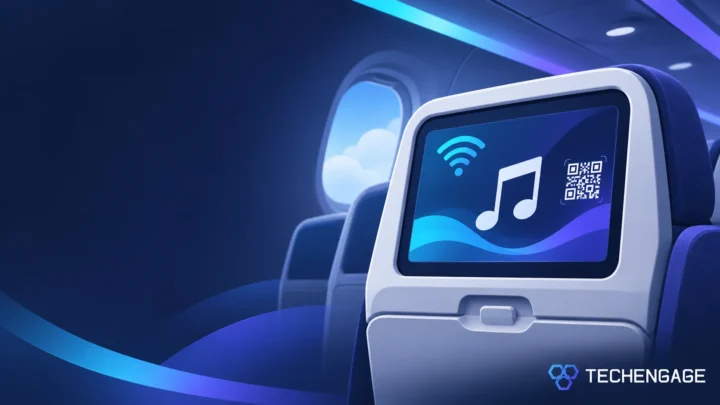
United Airlines is adding personal Spotify accounts to seatback screens on flights equipped with Starlink. On eligible aircraft, passengers can scan a QR code, sign in on their phones and bring their own playlists, saved music, podcasts, audiobooks and videos to the screen in front of them. The feature was announced on November 5 and is rolling out rather than appearing on every flight at once.
The difference from United’s earlier Spotify offering is the account connection. Since June 2025, some seatback screens have carried a curated collection of Spotify content. The new app can show a passenger’s own library and recommendations, so a podcast or album can continue from where it stopped on another device.
How the seatback sign-in works
According to United’s announcement, passengers open Spotify on a supported seatback screen and scan its QR code with a phone. Someone already signed in to Spotify on that phone can approve the pairing with one tap. Others can sign in on the phone, after which their library appears on the seatback display.
Once connected, passengers can browse their saved content and recommendations, resume playback and save new favorites. The phone can also serve as an optional remote for choosing a title or adjusting playback. That is useful when the screen is awkward to reach, although United has not described it as a replacement for the seatback controls.
United says passengers may log out during a flight and will be logged out automatically when it ends. The QR flow keeps the account sign-in on the passenger’s phone. As with any shared screen, it still makes sense to check that your account is disconnected before leaving your seat.
Which flights and Spotify features qualify?
The app needs a Starlink-enabled seatback screen, so seeing Starlink Wi-Fi on an aircraft does not by itself confirm that your seat has the new Spotify app. United has not provided a flight-by-flight list for this feature in its announcement. It says the Spotify rollout should reach half of its fleet by next spring. That is a target, not a guarantee for a particular booking.
United says Starlink is already available on more than half of its daily flights. It aims to complete the fleetwide installation before the end of 2027. The airline also reports more than 181,000 seatback screens today and expects more than 219,000 by the end of 2027. Those figures describe the broader hardware rollout; they should not be read as the number of screens with personal Spotify access right now.
Content and features vary by Spotify plan and market. An account holder should therefore expect the catalog and available playback options to follow the terms of their own plan and location, rather than assume every advertised title will play on every flight.
Why this is more useful than a built-in playlist
A shared entertainment catalog gives passengers a selection chosen by the airline. Personal sign-in removes the need to find something familiar in that selection: saved albums, unfinished podcasts and the user’s recommendations follow them onto the aircraft. United says more than 2.3 million passengers used its earlier Spotify collection for more than 1.9 million hours of listening and viewing. Those are United’s figures for the previous curated offering, not usage of the new personal-account app.
The main limitation is reach. A traveler cannot count on the feature until the rollout reaches the aircraft and seatback screen assigned to the flight. For now, downloading content to a phone remains a sensible backup, particularly when a flight changes aircraft. Readers comparing other music options can see our guide to free music apps; our streaming services guide explains how broader video subscriptions compare.


Share Your Thoughts