

In this guide
As an Amazon Associate, TechEngage earns from qualifying purchases.
Before every flight: Check your operating airline’s power-bank rules, including quantity, capacity, storage and onboard use; they can be stricter than the general US limits. Keep power banks in your carry-on bag only. If that bag is gate-checked or checked at planeside, remove every power bank and keep it with you in the cabin. Protect terminals from short circuits. See FAA PackSafe guidance (updated August 11, 2026; checked September 27, 2026). A rating below 100 Wh is not universal airline approval.
A travel power bank helps when you cannot reach an outlet. Choose one with enough capacity for your trip and the charging output your phone or laptop needs, then check its size and airline restrictions.
Choose capacity and charging output for your devices, then check the bank’s printed watt-hour rating and your operating airline’s policy. Capacity alone does not establish permission to fly.
Compare capacity, charging power and port layout against the devices you carry. The six options below cover different charging needs; the separate recall section explains which Anker model numbers need attention. If you also need offline files on the road, pair any of these with one of our best portable SSDs; for connectivity away from hotel Wi-Fi, see mobile WiFi hotspots.
Quick Comparison: Best Power Banks for Travel
| Exact product / listing | Maximum single-port output | Total simultaneous output | Port-sharing combinations | Maximum charging input |
|---|---|---|---|---|
| Anker Prime 27,650mAh / A1340 | 140W USB-C | 250W total | Two USB-C: up to 240W combined; third port shares remaining budget. Consult port-allocation diagram. | 140W single USB-C; up to 170W dual input |
| Anker 25,000mAh / A1695 | 100W USB-C port or cable | 165W with two devices; 130W with three/four | Two USB-C: 165W combined; USB-C + USB-A: 133W; three/four: 100W + 30W shared | 100W USB-C |
| UGREEN Nexode 20,000mAh / 130W | 100W USB-C1; 30W USB-C2; 22.5W USB-A | 130W maximum | C1+C2: 100W+30W; C1+A: 100W+22.5W; C2+A: 15W shared; all: 100W+15W shared | 65W USB-C1 |
| Baseus Blade Travel 20,000mAh / B0DK8V9LSV | 100W USB-C advertised | Check the manual for the connected-port combination | Do not add individual port ratings; confirm the included manual before buying for two laptops | Listing states 60W; confirm exact revision |
| Anker Nano 10,000mAh / A1638 | 45W USB-C; 22.5W USB-A | 24W combined rating | Shared budget falls below single-port peak; check the manual for each port combination | 30W USB-C |
| INIU BI-B61 / B09176JCKZ | 22.5W USB-A; 20W USB-C (9V × 2.22A) | Check the manual for the connected-port combination | For multiple devices, check the shared output rating in the supplied manual | 20W USB-C (9V × 2.22A), per BI-B61 manual |
Output ratings describe peak supported power, not a sustained test result. A laptop receives only what its charging protocol, cable and the selected port negotiate. Connecting another device can redistribute power. Input is the rate used to recharge the bank. The Baseus and INIU entries should not be chosen for a required multi-device power budget until their exact included manuals confirm it.
1. Anker Prime Power Bank (27,650mAh, 250W): high-capacity laptop charging

| Price & Details | |
|---|---|
| Rating on Amazon | 4.3 out of 5 stars |
| Brand | Anker |
| Check availability on Amazon |
The Anker Prime lists 27,650mAh / 99.54 Wh and up to 250W combined output. That capacity is below the FAA’s general 100 Wh threshold, but check your operating airline’s restrictions before travel.
The soda-can form factor is not pocketable, and that is fine: it belongs in a backpack next to your portable SSD and charger brick. Dual USB-C plus a USB-A port cover modern and legacy cables, the smart display shows real wattage instead of guessing with four LEDs, and the Anker app adds locate/sound and charge-limit tweaks for long-haul battery health.
Recharge is the underrated travel feature. Dual USB-C input can refill this bank far faster than old 18W bricks, so a short hotel layover can restore the pack before the next flight. It is heavier than phone-only banks: expect roughly 1.5 lb: but nothing else on this list matches the combination of near-100 Wh capacity and laptop-class output.
Why it stands out: 99.54 Wh rated capacity, 250W multi-port output, laptop-capable PD, smart display/app controls, and enough capacity for a full workday away from outlets.
2. Anker Laptop Power Bank (25,000mAh, 165W): built-in cables
| Price & Details | |
|---|---|
| Price | $119.98 |
| Discount | 11% |
| Rating on Amazon | 4.4 out of 5 stars |
| Brand | Anker |
| Check availability on Amazon |
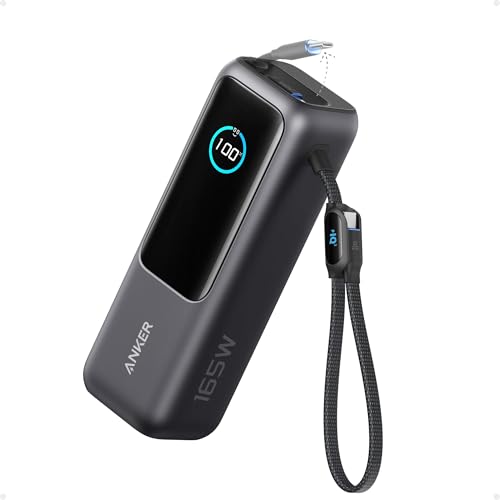
Built-in cables are the travel feature you appreciate only after you have left a USB-C cord in a hotel drawer. This Anker 25,000mAh pack pairs high capacity with dual built-in USB-C cables: including a longer retractable run: plus open ports so you are not limited to one device.
165W total output is enough for most ultrabooks while a phone charges on a second cable. Check its printed Wh rating against your airline’s current policy, and the display takes the mystery out of remaining juice on long connection days. Pair it with a compact USB-C hub when your laptop only exposes one port and you still need HDMI.
Trade-offs are predictable: retractable mechanisms add bulk versus a bare brick, and you still need a wall charger that can feed high-wattage input if you want fast self-recharge. For airport lounges and cafe work blocks where cables get lost, the integrated cord strategy is worth the size.
Why it stands out: Dual built-in USB-C cables, 25K capacity, subject to airline rules, 165W multi-device output, and fewer loose cords in a travel pouch.
3. UGREEN Nexode 20,000mAh 130W: for a laptop and phone

| Price & Details | |
|---|---|
| Price | $59.99 |
| Discount | 33% |
| Rating on Amazon | 4.5 out of 5 stars |
| Brand | UGREEN |
| Check availability on Amazon |
The UGREEN Nexode 20,000mAh has 100W maximum output from its primary USB-C port. The 130W name means combined output: 100W from USB-C1 plus 30W from USB-C2. It cannot deliver 130W to one laptop. Its maximum charging input is 65W through USB-C1. Compare the live offer against other 100W laptop-capable banks, not against their combined marketing wattage.
With all three outputs connected, USB-C1 can supply up to 100W while USB-C2 and USB-A share 15W. If both secondary devices need fast charging, use the two-port combination or a bank with a suitable allocation. These are manufacturer limits; temperature, remaining charge and device demand can reduce actual power.
You give up some raw capacity versus the 27K Prime and you do not get Anker’s app ecosystem. Compare its current price with other banks that can meet your laptop’s single-port power requirement.
Why it stands out: A 100W primary USB-C output, 130W combined two-port output, 65W charging input and a display for checking negotiated power.
4. Baseus Blade Travel Power Bank (20,000mAh, 100W): flat design
| Price & Details | |
|---|---|
| Price | $89.99 |
| Brand | Baseus |
| Check availability on Amazon |
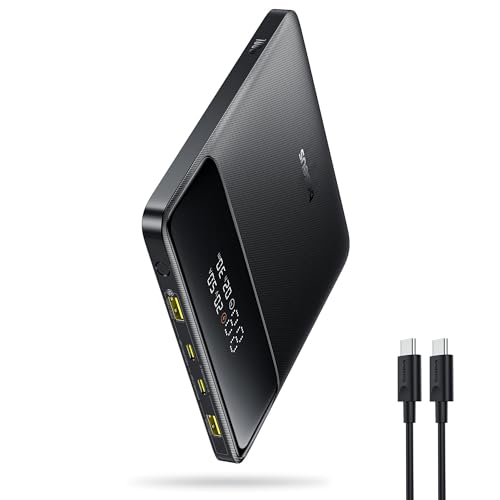
Brick-shaped banks waste space in a packed carry-on. The Baseus Blade family solves that with a flat, notebook-like silhouette that slides beside a laptop in a sleeve. This 20,000mAh / 100W version keeps laptop-capable PD with its printed Wh rating to be checked against airline rules.
Two USB-C and two USB-A ports cover mixed cable bags: useful if one traveler still carries USB-A earbuds or a camera battery charger. Digital status on the faceplate beats LED bars when you are deciding whether to burn the last 20% on a flight movie or save it for maps after landing.
The Baseus’s 100W single-port claim is in the same laptop-output category as UGREEN’s primary port. Comparing 100W with UGREEN’s 130W combined output would be misleading. The exact linked Blade Travel listing must be checked separately from Blade, Blade HD and Blade H1 revisions; do not assume their input or sharing diagrams are interchangeable.
Why it stands out: Flat pack geometry for carry-on bag and laptop-sleeve travel, 100W PD, 20K capacity, and four ports for mixed cable kits.
Anker model numbers and recall checks
The Anker A1383 and A1647 are different models despite similar capacity and built-in-cable descriptions. The Zolo A1689 is included in the US recall. Check the model printed on your unit and use Anker’s recall checker for its serial number. Stop using affected units and follow the return or disposal instructions in the CPSC recall notice.
5. Anker Nano Power Bank 10,000mAh 45W: compact charging
| Price & Details | |
|---|---|
| Price | $59.99 |
| Brand | Anker |
| Check availability on Amazon |
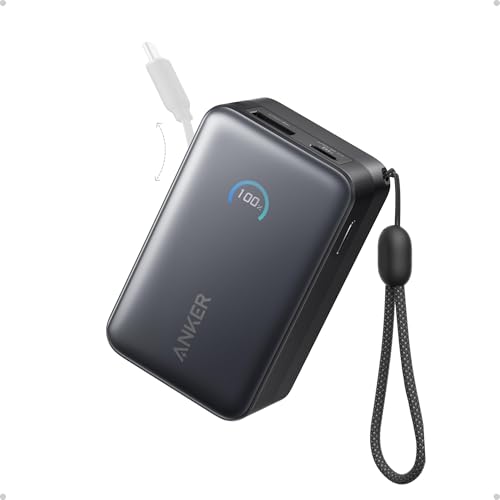
Pocketable does not have to mean weak. Anker’s Nano 10,000mAh with 45W output and a retractable cable is the jacket-pocket charger for travelers who already carry a bigger brick in the bag but want something always on their person.
45W meaningfully beats older 18-20W minis on modern phones and can sip-charge some lightweight laptops in a pinch. Retractable cable length matters in cramped airplane seats where your only outlet is under the seat in front of you.
At about 37 Wh, this is a smaller-capacity option for phone use. Check its label and your operating airline’s rules before packing it in your carry-on bag.
Why it stands out: True pocket size, 45W PD, retractable USB-C cable, and enough 10K capacity for a full day without a backpack brick.
6. INIU 10,000mAh 22.5W Mini Power Bank: compact phone backup

| Price & Details | |
|---|---|
| Price | $23.99 |
| Brand | INIU |
| Check availability on Amazon |
Sometimes you need a low-cost insurance policy, not a soda-can power station. INIU’s tiny 10,000mAh / 22.5W bank is one of the highest-volume budget minis on Amazon for a reason: it is small, and it still does USB-C in/out plus a USB-A port.
22.5W will not thrill anyone coming from a 45-100W pack, but it is enough to reverse a dead phone before a rideshare or boarding call. Check the model’s safety notices and physical condition before packing it; customer-review counts do not establish battery safety.
Treat it as a secondary: primary bank in the bag, INIU in the passport pouch. If you only buy one charger and travel with a laptop, skip to UGREEN or Anker above. For connectivity when hotel Wi-Fi dies, a dedicated mobile hotspot still beats phone tethering on long trips.
Why it stands out: A compact option for phone charging when you do not need laptop-class output.
How to Choose a Travel Power Bank in 2026
Use the printed Wh rating. Watt-hours equal nominal battery voltage multiplied by amp-hours. Do not assume every bank uses the same voltage, or infer flight approval from a capacity advertised in mAh.
Match wattage to devices. Read the single-port rating and protocol your laptop requires, then check the allocation with all intended devices connected. A 250W combined bank is not a 250W laptop output. Choose a compatible cable, and check input separately when selecting a wall charger to recharge the bank.
Built-in cables vs bare ports. Built-in USB-C reduces forgotten cords; bare ports stay smaller and let you use the cable you already trust. Many travelers carry one of each: a 10K pocket bank with a cable, plus a 20K+ brick in the bag.
Final Thoughts
Choose the Prime when its 140W single-port capability suits your laptop, or the UGREEN when 100W on the primary port is enough. The A1695 adds integrated cables, while the smaller Nano prioritizes phone use. Check the table’s sharing limits before connecting several devices. For the Baseus and INIU listings, check the shared output limits in the product manual before buying for a specific power requirement.





Share Your Thoughts