

Microsoft hides the “This PC” icon from the desktop by default on both Windows 10 and Windows 11. It’s been that way since Windows 8, and they’ve never changed the default. The icon gives you one-click access to all your drives, connected devices, and system properties, and most people want it on their desktop.
There are several ways to get it back, ranging from a 15-second settings change to registry edits and PowerShell commands. This guide covers all of them for both Windows 11 and Windows 10, plus troubleshooting for when the icon disappears on its own.
Method 1: Desktop Icon Settings (Fastest Way)
This is the official method that works on every edition of Windows 10 and Windows 11, including Home. It takes about 15 seconds.
On Windows 11
Step 1: Right-click anywhere on your desktop and select Personalize.

Step 2: Click Themes in the left sidebar (Windows 10) or scroll down to find Themes (Windows 11).

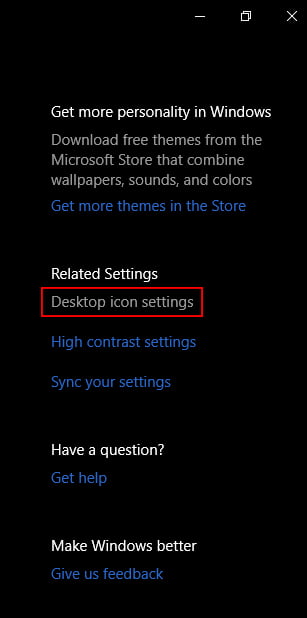
Step 3: Under “Related Settings” (Windows 11) or at the top of the Themes page (Windows 10), click Desktop icon settings.
Step 4: In the Desktop Icon Settings dialog, check the box next to Computer (this is the “This PC” icon). Click Apply, then OK.
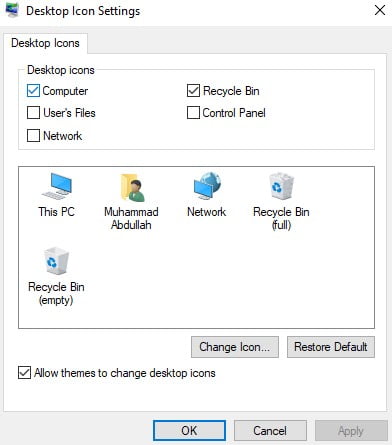
The “This PC” icon appears on your desktop immediately. From this same dialog, you can also enable Recycle Bin, User’s Files, Network, and Control Panel icons.
On Windows 10
The process is identical: right-click desktop > Personalize > Themes > Desktop icon settings > check “Computer” > Apply > OK. The only visual difference is the Settings app layout, but the steps are the same.
Method 2: Use the Run Command (One Step)
If you want to skip navigating through Settings entirely, you can open the Desktop Icon Settings dialog directly with a keyboard shortcut.
Step 1: Press Win + R to open the Run dialog.
Step 2: Type the following command and press Enter:
desk.cpl ,5This opens the Desktop Icon Settings dialog directly. Check “Computer,” click Apply, and you’re done. The alternative command rundll32 shell32.dll,Control_RunDLL desk.cpl,,0 does the same thing and works on all Windows versions.
Here’s a quick reference for all the useful desktop icon shortcut commands:
| Command | What It Opens |
|---|---|
desk.cpl ,5 | Desktop Icon Settings dialog |
ms-settings:themes | Windows Settings > Themes |
ms-settings:personalization | Windows Settings > Personalization |
rundll32 shell32.dll,Control_RunDLL desk.cpl,,0 | Desktop Icon Settings (alternative) |
Method 3: Drag and Drop from File Explorer
This is the simplest method conceptually, though it creates a shortcut rather than the actual system icon (more on that distinction below).
Step 1: Press Win + E to open File Explorer.
Step 2: In the left sidebar, find This PC.
Step 3: Click and drag “This PC” from the sidebar onto your desktop.
Windows creates a shortcut on your desktop labeled “This PC – Shortcut.” You can right-click it and rename it to “This PC” to remove the “- Shortcut” suffix. This method works on both Windows 10 and 11 without any settings changes.
Method 4: Create a Desktop Shortcut Manually
If “This PC” doesn’t appear in your File Explorer sidebar, you can create a shortcut from scratch.
Step 1: Right-click an empty area on your desktop and select New > Shortcut.
Step 2: In the location field, type:
%windir%\explorer.exe shell:MyComputerFolderStep 3: Click Next, name it “This PC,” and click Finish.
The shortcut opens the exact same “This PC” view as the system icon. To give it the proper icon instead of the generic folder icon, right-click the shortcut > Properties > Change Icon > browse to %SystemRoot%\System32\imageres.dll and select the computer icon from the list.
Method 5: Registry Editor
The registry controls which system icons appear on the desktop. This method is useful for automation, scripting, or situations where the Desktop Icon Settings dialog isn’t accessible.
Step 1: Press Win + R, type regedit, and press Enter. Approve the UAC prompt.
Step 2: Navigate to:
HKEY_CURRENT_USER\SOFTWARE\Microsoft\Windows\CurrentVersion\Explorer\HideDesktopIcons\NewStartPanelStep 3: Find the value named {20D04FE0-3AEA-1069-A2D8-08002B30309D}. If it exists, double-click it and change the value data to 0. If it doesn’t exist, right-click in the right pane > New > DWORD (32-bit) Value, name it {20D04FE0-3AEA-1069-A2D8-08002B30309D}, and set its value to 0.
Step 4: Press F5 on your desktop or restart Windows Explorer (Ctrl+Shift+Esc > find Windows Explorer > Restart) to see the icon.
Each system desktop icon has its own CLSID (Class Identifier) in the same registry location. Here’s the complete reference:
| Desktop Icon | Registry Value Name (CLSID) |
|---|---|
| This PC (Computer) | {20D04FE0-3AEA-1069-A2D8-08002B30309D} |
| Recycle Bin | {645FF040-5081-101B-9F08-00AA002F954E} |
| User’s Files | {59031a47-3f72-44a7-89c5-5595fe6b30ee} |
| Network | {F02C1A0D-BE21-4350-88B0-7367FC96EF3C} |
| Control Panel | {5399E694-6CE5-4D6C-8FCE-1D8870FDCBA0} |
Method 6: PowerShell Command
For IT administrators deploying settings across multiple machines, or anyone comfortable with the terminal, PowerShell can set the registry value in one command.
Open PowerShell as Administrator and run:
$path = "HKCU:\SOFTWARE\Microsoft\Windows\CurrentVersion\Explorer\HideDesktopIcons\NewStartPanel"
$name = "{20D04FE0-3AEA-1069-A2D8-08002B30309D}"
New-ItemProperty -Path $path -Name $name -Value 0 -PropertyType DWORD -Force
Stop-Process -Name explorer -Force
The last line restarts Windows Explorer so the icon appears immediately. You can wrap this in a deployment script to push the change across all machines in a domain.
Method 7: Group Policy Editor (Pro, Enterprise, and Education Only)
Group Policy doesn’t have a specific toggle for the “This PC” icon, but it controls whether desktop icons are visible at all. If your organization’s Group Policy is hiding all desktop icons, this is where to fix it.
Step 1: Press Win + R, type gpedit.msc, and press Enter.
Step 2: Navigate to User Configuration > Administrative Templates > Desktop.
Step 3: Find “Hide and disable all items on the desktop.” Double-click it and set it to Not Configured or Disabled.
Step 4: Run gpupdate /force in Command Prompt or restart the computer.
Windows 10/11 Home edition does not include the Group Policy Editor. If you’re on Home edition, use the Registry or PowerShell methods instead.
System Icon vs. Desktop Shortcut: What’s the Difference?
Methods 1, 2, 5, 6, and 7 add the actual system icon, which is managed by Windows and has special properties. Right-clicking the system icon shows options like “Properties” (which opens System Information), “Manage” (Computer Management), and “Map network drive.” The icon doesn’t have a small arrow overlay in the corner.
Methods 3 and 4 create a shortcut to “This PC.” It opens the same File Explorer view, but right-clicking it shows shortcut properties instead of system properties. It also displays the small arrow overlay that Windows adds to all shortcuts. For most people this distinction doesn’t matter, but if you want the full system icon experience, use Method 1 or 2.
Other Desktop Icons You Can Enable
The Desktop Icon Settings dialog (Method 1) lets you enable five system icons at once. Here’s what each one gives you:
- Computer (This PC): Opens File Explorer showing all drives, connected devices, and quick access to System Properties.
- Recycle Bin: Shows deleted files waiting to be permanently removed or restored. This is the only system icon enabled by default.
- User’s Files: Opens your personal folder (C:\Users\YourName) with Documents, Downloads, Pictures, Music, and other user directories.
- Network: Shows other computers, printers, and devices on your local network.
- Control Panel: Opens the classic Control Panel, which still provides access to many settings not available in the modern Settings app.
How to Customize Your Desktop Icons
Once you’ve added “This PC” to your desktop, you might want to adjust how it looks alongside your other icons.
Change icon size: Right-click the desktop > View > choose Large, Medium, or Small icons. For more granular control, hold Ctrl and scroll your mouse wheel up or down. This adjusts icon size smoothly between the preset sizes.
Arrange icons: Right-click the desktop > View > “Auto arrange icons” snaps icons to a grid automatically. “Align icons to grid” keeps them snapped when you drag them but doesn’t rearrange them for you.
Change the icon image: In Desktop Icon Settings, select “Computer” from the list, then click Change Icon. Browse Windows’ built-in icon library or point to a custom .ico file.
Prevent themes from changing icons: Uncheck “Allow themes to change desktop icons” at the bottom of the Desktop Icon Settings dialog. This stops your custom icon choices from being overridden when you switch Windows themes.
Troubleshooting: Desktop Icons Missing or Disappearing
If your “This PC” icon (or other desktop icons) keep vanishing, one of these fixes will solve it.
“Show desktop icons” is turned off. Right-click the desktop > View > make sure “Show desktop icons” is checked. This is the single most common cause and the easiest to miss because nothing in the View menu visually indicates whether it’s on or off until you click it.
Tablet mode is hiding icons. On Windows 10, go to Settings > System > Tablet and set “When I sign in” to “Never use tablet mode.” Windows 11 removed the dedicated tablet mode setting, but on 2-in-1 devices, detaching the keyboard can still trigger a simplified desktop that hides icons.
Icon cache is corrupted. Open Command Prompt as Administrator and run:
DEL /A /Q "%userprofile%\AppData\Local\IconCache.db"
DEL /A /F /Q "%userprofile%\AppData\Local\Microsoft\Windows\Explorer\iconcache*"
Then restart your computer. Windows rebuilds the icon cache on the next boot.
Windows Explorer crashed. Press Ctrl + Shift + Esc to open Task Manager. Find Windows Explorer in the list, right-click it, and select Restart. Your desktop icons should reappear within a few seconds.
A Windows Update reset your settings. Major feature updates (like going from 23H2 to 24H2) occasionally reset desktop icon preferences. Go back to Desktop Icon Settings (Method 1 or 2) and re-enable the icons you want.
Group Policy is blocking desktop icons. If you’re on a work computer, your IT department may have pushed a Group Policy that hides all desktop items. Check with your admin, or see Method 7 above if you have local admin access.
Themes changed your icons. If you recently applied a new Windows theme, it may have overridden your desktop icon settings. Open Desktop Icon Settings and uncheck “Allow themes to change desktop icons” to prevent this in the future.
“This PC” vs “My Computer”: The Naming History
If you’ve been using Windows for a long time, you might remember this icon by a different name. Microsoft has renamed it twice over the years:
| Windows Version | Icon Name | Years |
|---|---|---|
| Windows 95, 98, ME, 2000, XP | My Computer | 1995-2006 |
| Windows Vista, 7, 8 | Computer | 2007-2013 |
| Windows 8.1, 10, 11 | This PC | 2013-present |
The rename to “This PC” happened in Windows 8.1 when Microsoft merged Libraries and user folders into a unified view. The function is identical across all names. In the Desktop Icon Settings dialog, it’s still labeled “Computer” regardless of Windows version, which confuses people who are looking for a checkbox labeled “This PC.”
If you prefer the old name, you can rename it: right-click the “This PC” icon on your desktop, select Rename, and type “My Computer” or whatever you prefer. This doesn’t affect any system functionality.
Frequently Asked Questions
What is the difference between a This PC shortcut and the system icon?
The system icon (added through Desktop Icon Settings) gives you additional right-click options like System Properties, Computer Management, and Map Network Drive. It also doesn’t show the small shortcut arrow in the corner. A shortcut created by dragging from File Explorer opens the same view but only has shortcut properties when right-clicked. For most daily use, both work identically.
Does adding This PC to the desktop slow down my computer?
No. Desktop icons use a negligible amount of system resources. Adding This PC, Recycle Bin, or any other system icon to your desktop has zero measurable impact on performance, startup time, or memory usage.
How do I remove the This PC icon from my desktop?
Go to Desktop Icon Settings (right-click desktop > Personalize > Themes > Desktop icon settings) and uncheck the Computer checkbox. Click Apply, then OK. The icon disappears immediately. If you added it as a shortcut instead, just right-click it and select Delete.
Does this work on Windows 11 Home and Windows 10 Home?
Yes. All methods work on Home editions except Method 7 (Group Policy Editor), which is only available on Pro, Enterprise, and Education editions. The most common methods (Desktop Icon Settings and Run command) work on every Windows edition.
Why does my This PC icon keep disappearing?
The most common causes are: the Show Desktop Icons toggle got turned off (right-click desktop > View > Show desktop icons), a Windows Update reset your desktop icon settings, a new theme overrode your choices, or tablet mode is active. Check each of these in order. If the problem persists after fixing all of them, rebuild your icon cache using the command in the troubleshooting section above.
Can I rename This PC back to My Computer?
Yes. Right-click the This PC icon on your desktop and select Rename. Type My Computer or any other name you prefer. This changes only the display label and doesn’t affect any system functionality. The change applies everywhere the icon appears, including File Explorer’s sidebar.




?
Thanks
Desktop Icon Settings
Thank you!…. it worked
Wow, awesome blog layout! How long have you been blogging for?
you made blogging look easy. The overall look of your site
is wonderful, as well as the content!