

The average home in 2026 has somewhere between 20 and 30 connected devices: phones, laptops, smart TVs, gaming consoles, security cameras, smart speakers, thermostats, and everything else competing for the same internet connection. When things slow down, most people blame their ISP and consider upgrading their plan. But in roughly 80% of cases, the problem is somewhere between the router and the device, not the connection coming into your house.
Before spending money on a faster plan, work through this guide in order. The first few fixes take less than five minutes. The later sections cover deeper optimizations that can genuinely transform a sluggish connection. I’ve organized everything from quickest to most involved so you can stop as soon as your speeds are where you want them.
Start with a Proper Speed Test

You can’t fix what you haven’t measured. Before changing anything, run a speed test to establish your baseline. But most people test wrong, and bad data leads to bad decisions.
How to test properly: Close all other apps and pause any downloads or streaming. If possible, connect your computer directly to the router with an Ethernet cable (this removes Wi-Fi variables and tests your ISP speed directly). Run tests on at least two different platforms: Speedtest.net and Fast.com. If Speedtest shows significantly higher numbers than Fast.com, your ISP may be prioritizing Ookla traffic (which some do) or throttling streaming traffic.
Run tests at different times of day. Speeds during the afternoon and late at night are often faster than during peak hours (7-11 PM) when everyone in your neighborhood is streaming simultaneously. Three to five tests averaged together give you a reliable number.
What your results mean: If your Ethernet speed test shows 80-100% of your plan’s advertised speed, your ISP connection is fine and the problem is your Wi-Fi setup, your router, or your devices. If the Ethernet test is significantly below your plan speed, call your ISP. The problem is on their end.
Quick Fixes That Take Five Minutes or Less
Start here. These solve the problem more often than you’d expect.
Restart your modem and router. Unplug both devices, wait 30 seconds, plug the modem in first, wait for it to fully boot (all lights stable), then plug in the router. This clears memory leaks, resets stale connections, and forces the router to renegotiate its connection with your ISP. It’s not a placebo. Consumer routers accumulate state over time that genuinely degrades performance.
Switch from 2.4GHz to 5GHz or 6GHz. If your router broadcasts multiple bands, make sure your device is connected to the 5GHz or 6GHz network (often labeled with “5G” or “6G” in the network name). The 2.4GHz band is slower, more congested, and shared with Bluetooth devices, baby monitors, and microwaves. The 5GHz band is faster but has shorter range. The 6GHz band (available on Wi-Fi 6E and Wi-Fi 7 routers) is the fastest and least congested but requires newer devices.
Disconnect unused devices. Every connected device takes a slice of bandwidth and router processing power. Smart home devices you rarely use, old phones still connected to Wi-Fi, tablets the kids haven’t touched in months: disconnect them or set them to connect only when needed.
Close bandwidth-hogging apps. Cloud backup services (iCloud, Google Drive, OneDrive), system updates downloading in the background, streaming music, and video calls all consume bandwidth. On Windows, open Task Manager (Ctrl+Shift+Esc) and click the “Network” column to see which apps are using the most bandwidth. On Mac, open Activity Monitor and check the Network tab.
Optimize Your Router Placement
Router placement is the single most underrated factor in Wi-Fi speed. Moving your router can double your effective speed without changing any settings or buying any hardware.
Place it centrally and elevated. The router should be as close to the center of your home as possible, on a shelf or mounted on a wall at roughly head height. Wi-Fi signals radiate outward and downward from the router’s antennas. A router in the corner of the house wastes half its signal broadcasting outside. A router on the floor loses signal strength pushing through furniture before it reaches your devices.
Keep it away from interference sources. Microwaves, baby monitors, cordless phones, and Bluetooth speakers all operate on the 2.4GHz band and interfere with Wi-Fi. Metal objects, mirrors, and large bodies of water (including fish tanks) absorb or reflect Wi-Fi signals. Concrete and brick walls reduce signal strength far more than drywall.
Angle the antennas correctly. If your router has external antennas, point one vertically and one horizontally. Devices receive the strongest signal when their internal antenna orientation matches the router’s antenna. Since phones and laptops are used in different orientations, a mixed antenna setup covers both.
Use Ethernet for Devices That Stay in One Place
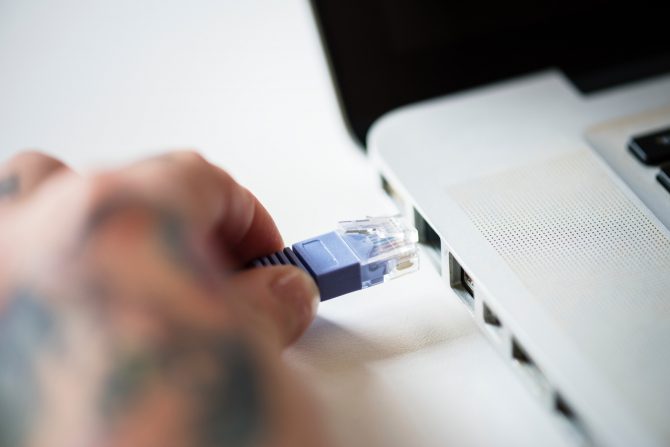
Desktop computers, gaming consoles, smart TVs, and streaming devices all sit in the same spot permanently. There’s no reason for them to use Wi-Fi. An Ethernet cable delivers a faster, more stable connection with lower latency, zero interference, and no signal degradation.
The cable category matters, but only if you have a fast plan. Cat5e handles speeds up to 1 Gbps and is perfectly fine for most households. Cat6 supports up to 10 Gbps at shorter distances and has better shielding against interference. Cat6a supports 10 Gbps at full 100-meter cable runs, which makes it the future-proof choice if you’re wiring walls. Cat7 and Cat8 are overkill for home use.
If running Ethernet cable isn’t practical, consider MoCA adapters (which use your existing coaxial cable to create an Ethernet-like connection at up to 2.5 Gbps) or powerline adapters (which use electrical wiring, though speeds depend heavily on your home’s wiring age and quality).
Switch to a Faster DNS Server
DNS (Domain Name System) translates website names into IP addresses. Every time you visit a website, your device asks a DNS server “what’s the IP address for this domain?” before it can connect. Your ISP’s default DNS server is often slow and sometimes unreliable. Switching to a faster DNS won’t increase your raw download speed, but it reduces the time between typing a URL and the page starting to load, which makes browsing feel noticeably snappier.
| DNS Provider | Primary | Secondary | Best For |
|---|---|---|---|
| Cloudflare | 1.1.1.1 | 1.0.0.1 | Speed (fastest globally) |
| 8.8.8.8 | 8.8.4.4 | Reliability | |
| Quad9 | 9.9.9.9 | 149.112.112.112 | Security (blocks malware domains) |
How to change DNS on your router (affects all devices at once): Log into your router admin panel (usually 192.168.1.1 or 192.168.0.1), find the DNS settings under WAN or Internet settings, and replace the ISP’s DNS with your preferred servers. Save and restart the router.
How to change DNS on individual devices: Windows: Settings > Network & Internet > your connection > DNS server assignment > Manual > enter the addresses. Mac: System Settings > Network > your connection > Details > DNS > add the addresses. iPhone/Android: Wi-Fi settings > your network > Configure DNS > Manual.
Optimize Your Wi-Fi Channel
If you live in an apartment building or a densely packed neighborhood, your router is probably competing with dozens of other routers on the same Wi-Fi channel. This congestion slows everyone down, especially on the 2.4GHz band where only three non-overlapping channels exist (1, 6, and 11).
Download a free Wi-Fi analyzer app (NetSpot on Mac/Windows, WiFi Analyzer on Android) to see which channels are most crowded in your location. Then log into your router’s admin panel and manually set the channel to the least congested option. On 5GHz, you have more channels available, and enabling DFS channels (if your router supports them) opens up additional frequencies that most consumer routers avoid.
The 6GHz band available on Wi-Fi 6E and Wi-Fi 7 routers has so much spectrum that channel congestion essentially doesn’t exist in residential areas yet. If you have a 6GHz-capable router and devices, use the 6GHz band for your most bandwidth-hungry activities.
Update Router Firmware and Settings

Router manufacturers regularly release firmware updates that fix bugs, patch security vulnerabilities, and sometimes improve performance. Most routers don’t update automatically. Log into your router’s admin panel and check for available updates. If your router is from your ISP, they may push updates automatically, but it’s worth checking.
While you’re in the admin panel, adjust these settings:
- Enable QoS (Quality of Service): This lets you prioritize traffic types. Set video calls and gaming to high priority, and downloads to low priority, so a large file download doesn’t kill your Zoom call.
- Switch to WPA3 security: If your router and devices support it, WPA3 is more secure and slightly more efficient than WPA2. At minimum, make sure you’re not still using WPA or WEP (both are insecure and can degrade performance).
- Disable legacy Wi-Fi protocols: If every device in your household supports Wi-Fi 5 (ac) or newer, disable 802.11b and 802.11g in your router settings. Legacy protocol support forces the router to slow down for backward compatibility, even when no devices need it.
- Enable band steering: This feature automatically pushes devices to the less congested 5GHz or 6GHz band instead of letting them default to 2.4GHz.
Upgrade to Wi-Fi 6E or Wi-Fi 7
If your router is more than four years old, it’s likely running Wi-Fi 5 (802.11ac) or older. Upgrading to a modern Wi-Fi 6E or Wi-Fi 7 router can dramatically improve speeds, especially in homes with many connected devices.
Wi-Fi 6E adds the 6GHz band with 1,200 MHz of clean spectrum. Real-world speeds hit 1-2 Gbps with compatible devices, and there’s virtually no interference from legacy devices since only Wi-Fi 6E and newer hardware can access the band.
Wi-Fi 7 is the current cutting edge. The headline feature is Multi-Link Operation (MLO), which lets devices connect across the 2.4GHz, 5GHz, and 6GHz bands simultaneously. Instead of picking one band, your device uses all three at once, dramatically increasing throughput and reducing latency. Wi-Fi 7 also supports 320MHz channel widths (double Wi-Fi 6E) and 4096-QAM modulation for higher data density.
The practical reality: Wi-Fi 7 routers start around $150 in 2026, and most flagship phones (iPhone 16+, Galaxy S25+), recent laptops, and gaming consoles (PS5 Pro) already support it. If you’re buying a new router anyway, there’s no reason to buy anything older than Wi-Fi 7. But remember, you only get the Wi-Fi 7 benefits when both the router and the device support it. Older devices connecting to a Wi-Fi 7 router will still use their maximum supported standard.
Consider a Mesh Network for Large Homes
A single router, no matter how powerful, struggles to cover homes larger than about 1,500 square feet or multi-story buildings. Dead zones appear in far rooms, and speeds drop as you move away from the router. There are two common solutions, and one of them is a mistake.
Range extenders (also called Wi-Fi repeaters) are cheap ($20-50) but they rebroadcast the signal on the same channel, cutting your bandwidth in half. They create separate network names, cause dropped connections when you move between zones, and generally make the experience worse. Avoid them.
Mesh systems are the proper solution. Multiple nodes placed throughout your home create a single seamless network with automatic handoff as you move between rooms. Good mesh systems use a dedicated wireless backhaul channel (so they don’t sacrifice bandwidth) and support Ethernet backhaul between nodes if you can run cable. Systems from TP-Link (Deco BE series), Eero (Max 7), Netgear (Orbi 970), and Asus (ZenWiFi) all perform well in 2026.
One important note: in a small apartment (under 1,000 sq ft), a single good router almost always outperforms a mesh system. Mesh adds overhead from inter-node communication. Only invest in mesh if your space actually needs it.
Detect and Fix ISP Throttling
ISP throttling is when your internet provider intentionally slows down specific types of traffic, usually video streaming, torrenting, or gaming. It’s legal in many regions and more common than most people realize.
How to detect throttling: Run a speed test on Speedtest.net, then run the same test while connected to a reputable VPN. If your speeds are significantly faster through the VPN, your ISP is likely throttling. The VPN encrypts your traffic so the ISP can’t identify what type of content you’re accessing and therefore can’t selectively slow it down.
You can also compare results from Speedtest.net (which some ISPs optimize for) versus Fast.com (which tests Netflix throughput specifically). A large gap between the two suggests selective throttling of streaming traffic.
Solutions: A VPN is the most practical fix for throttling. It encrypts all traffic so the ISP can’t discriminate. The trade-off is a small amount of added latency (typically 5-15ms with a good VPN provider). Other options: file a complaint with the FCC (US), switch to a different ISP if available in your area, or upgrade to a higher-tier plan that may not be subject to deprioritization.
Secure Your Network from Freeloaders and Malware

If someone is using your Wi-Fi without permission, they’re consuming bandwidth you’re paying for. Log into your router’s admin panel and check the list of connected devices. If you see devices you don’t recognize, change your Wi-Fi password immediately. Use a strong password with at least 12 characters mixing letters, numbers, and symbols.
Malware is another hidden bandwidth drain. Botnets, cryptominers, and adware all use your internet connection in the background. A device infected with botnet malware might be sending spam or participating in DDoS attacks without showing any obvious symptoms on screen. Run a full malware scan on all devices connected to your network. On Windows, Windows Defender is sufficient for most threats. On Mac, consider Malwarebytes for a secondary scan.
Don’t forget about IoT devices. Smart cameras, smart plugs, and cheap smart home gadgets are frequent targets for malware because they often run outdated firmware with known vulnerabilities. Update them regularly, and if a device no longer receives security updates from the manufacturer, consider replacing it.
Device-Level Optimizations
Sometimes the internet is fine but the device accessing it is the bottleneck. A few quick checks can reveal whether the problem is device-specific rather than network-wide.
Update network drivers. On Windows, open Device Manager > Network adapters > right-click your Wi-Fi adapter > Update driver. Outdated drivers can cause slower speeds, dropped connections, and failure to connect to newer Wi-Fi standards even when your hardware supports them.
Flush your DNS cache. Stale DNS entries can cause connection delays. On Windows, open Command Prompt and type ipconfig /flushdns. On Mac, open Terminal and type sudo dscacheutil -flushcache; sudo killall -HUP mDNSResponder.
Use an ad blocker. This is less about internet “speed” and more about page load speed. Modern web pages load 30-50% faster with an ad blocker like uBlock Origin because you’re not downloading dozens of ad scripts, tracking pixels, and video ads with every page. The data savings add up significantly on metered or slower connections.
Limit open browser tabs. Each tab maintains active connections and can consume background bandwidth for auto-refreshing content, push notifications, and streaming. If you regularly have 30+ tabs open, try closing the ones you’re not actively using.
When to Upgrade Your Internet Plan
If you’ve worked through everything above and your Ethernet speed test consistently hits your plan’s advertised speed but it still isn’t enough, it’s genuinely time to upgrade. Here’s a rough guide for how much speed different households need in 2026:
| Household | Typical Use | Recommended Speed |
|---|---|---|
| 1-2 people | Browsing, email, social media, HD streaming | 100-200 Mbps |
| 3-4 people | Multiple 4K streams, gaming, video calls | 300-500 Mbps |
| 5+ people | Heavy streaming, gaming, working from home, smart home | 500 Mbps – 1 Gbps |
| Power users | Content creation, large file uploads, home servers | 1-2 Gbps |
One thing many people overlook: upload speed. Most cable internet plans are heavily asymmetric (500 Mbps download but only 20 Mbps upload). If you work from home on video calls, stream on Twitch, or upload large files regularly, look at fiber plans which typically offer symmetric speeds (same upload as download). The upload difference is often more impactful than the download difference.
Internet Speed Myths That Waste Your Time
A few persistent myths lead people to “fix” things that aren’t broken while ignoring the actual problem:
- “More signal bars means faster internet.” Signal strength affects reliability and connection stability, not speed directly. You can have full bars on a congested channel and still get slow speeds.
- “5GHz is always better than 2.4GHz.” 5GHz is faster at close range, but 2.4GHz penetrates walls better and has longer range. If you’re two rooms away from the router, 2.4GHz might actually deliver better throughput than a weak 5GHz signal.
- “Expensive Ethernet cables are faster.” A $5 Cat5e cable handles gigabit speeds perfectly fine. Cat8 cables in a home network are wasted money unless you’re running 25/40 Gbps enterprise equipment.
- “A VPN always slows your connection.” Modern VPN servers add 5-15ms of latency, which is barely noticeable. And if your ISP is throttling your traffic, a VPN can actually make your connection faster by preventing that throttling.
- “You need your ISP’s router.” You can almost always buy your own router and modem (check your ISP’s compatible device list). Your own equipment is usually faster, more configurable, and cheaper long-term than renting from the ISP at $10-15/month.
- “Restarting the router is a placebo.” It genuinely clears memory leaks, releases stuck connections, and can force the router to pick a less congested channel. It’s the most effective single troubleshooting step for intermittent slowdowns.
Frequently Asked Questions
Why is my internet slower at night?
Peak usage hours (roughly 7 PM to 11 PM) create congestion at two levels: your ISP’s network and your local Wi-Fi. More people in your neighborhood are streaming, gaming, and downloading simultaneously, which can saturate the ISP’s local infrastructure. At home, more family members are online at the same time, splitting your router’s available bandwidth. If speeds are consistently bad during peak hours but fine during the day, your ISP’s network may be oversold in your area.
Is upgrading to a Wi-Fi 6E or Wi-Fi 7 router worth it?
If your current router is more than four years old and you have 10+ connected devices, yes. Wi-Fi 6E and Wi-Fi 7 handle multiple simultaneous connections far better than older standards. The 6GHz band alone eliminates congestion issues for compatible devices. However, if you only have a few devices and a small home with a working Wi-Fi 5 router, the upgrade may not produce a noticeable difference for your use case.
Does changing DNS really make the internet faster?
Changing DNS doesn’t increase your download or upload speed. What it does is reduce the lookup time when your browser resolves a domain name to an IP address, which makes pages start loading faster. The difference is typically 10-50 milliseconds per lookup, which adds up across dozens of requests per page. Cloudflare’s 1.1.1.1 is consistently the fastest public DNS in independent benchmarks.
How many devices is too many for one router?
Most consumer routers handle 20-30 active devices without issues. The problem isn’t usually the device count but the number of devices actively transferring data simultaneously. A router with 25 connected devices where most are idle performs fine. The same router with 10 devices all streaming video at once will struggle. Wi-Fi 6 and newer routers handle high device counts significantly better than older models thanks to technologies like OFDMA and MU-MIMO.
How do I know if my ISP is throttling my internet?
Run a speed test on Speedtest.net without a VPN, then run the same test while connected to a VPN. If your speeds are noticeably faster through the VPN, your ISP is likely throttling certain types of traffic. You can also compare results from Speedtest.net and Fast.com. A large gap between the two (especially with Fast.com being slower) suggests your ISP is throttling streaming traffic specifically.
Why is my speed test lower than what I pay for?
ISPs advertise ‘up to’ speeds, not guaranteed speeds. On a wired Ethernet connection, you should see 80-100% of your advertised speed. On Wi-Fi, expect 50-75% depending on distance from the router, interference, and how many devices are connected. If your wired speed is significantly below your plan, contact your ISP. If only Wi-Fi is slow, the issue is your router setup, not your ISP connection.



Share Your Thoughts