

If you work past dark, your monitor is the brightest blue-white object in the room. Windows has a built-in fix for that, and it costs nothing: Night light shifts your display towards warmer, more amber tones so the screen stops fighting the rest of the room. It is not a gimmick and it is not a third-party download — it has shipped with Windows since 2017, and it is still there in Windows 11.
This guide covers how to enable Night light on both Windows 11 and Windows 10, how to tune its strength, how to schedule it to follow sunset, and — the part most guides skip — what to do when the toggle is greyed out or does nothing at all.
One note before we start. Windows 10 reached end of support on 14 October 2025. Consumer PCs enrolled in the Extended Security Updates programme keep receiving critical security patches on version 22H2 through 13 October 2026, but there are no new features coming. The Windows 10 steps below still work exactly as written — just be aware you are on a clock, and plan the move to Windows 11 or an ESU enrolment accordingly.
What Night light actually does
Night light changes the colour temperature of everything your display outputs, pulling it away from cool blue-white towards warm amber. Software-side, it is a colour profile adjustment, not a filter you can see through and not a brightness control — the backlight stays exactly as bright as you set it.
Be clear about what it is not, because the marketing around “blue light” has got well ahead of the evidence:
- It is not dark mode. Dark mode changes what colours apps draw; Night light changes how the whole panel renders colour. They stack, and many people run both.
- It is not a brightness reducer. If your screen is searing at night, lower the brightness as well — warm colours at full brightness are still bright.
- It is not a cure for eye strain. Research on screen use links long uninterrupted sessions to eyestrain and disrupted sleep patterns, but the specific benefit of blue-light filtering is far less settled than the accessory industry suggests. Distance, blink rate and taking breaks matter more.
What it reliably does deliver is comfort. A warm screen in a dim room is less jarring, and that alone makes late-night work easier on the eyes.
How to enable Night light in Windows 11
There are two routes — the fast one and the one with the settings.
The fast way: Quick Settings
- Press Windows + A to open Quick Settings (or click the battery / network / volume cluster in the taskbar).
- Click the Night light tile. The screen warms immediately.
- Click it again to turn it off.
If there is no Night light tile in the panel, click the pencil Edit icon, choose Add, pick Night light from the list, and click Done. It will stay pinned.
The full way: Settings
- Press Windows + I to open Settings.
- Go to System > Display.
- Under Brightness & color, switch Night light on.
- Click the words Night light (not the toggle) to open the strength and schedule options.
How to enable Night light in Windows 10
The feature is identical; only the shell around it differs.
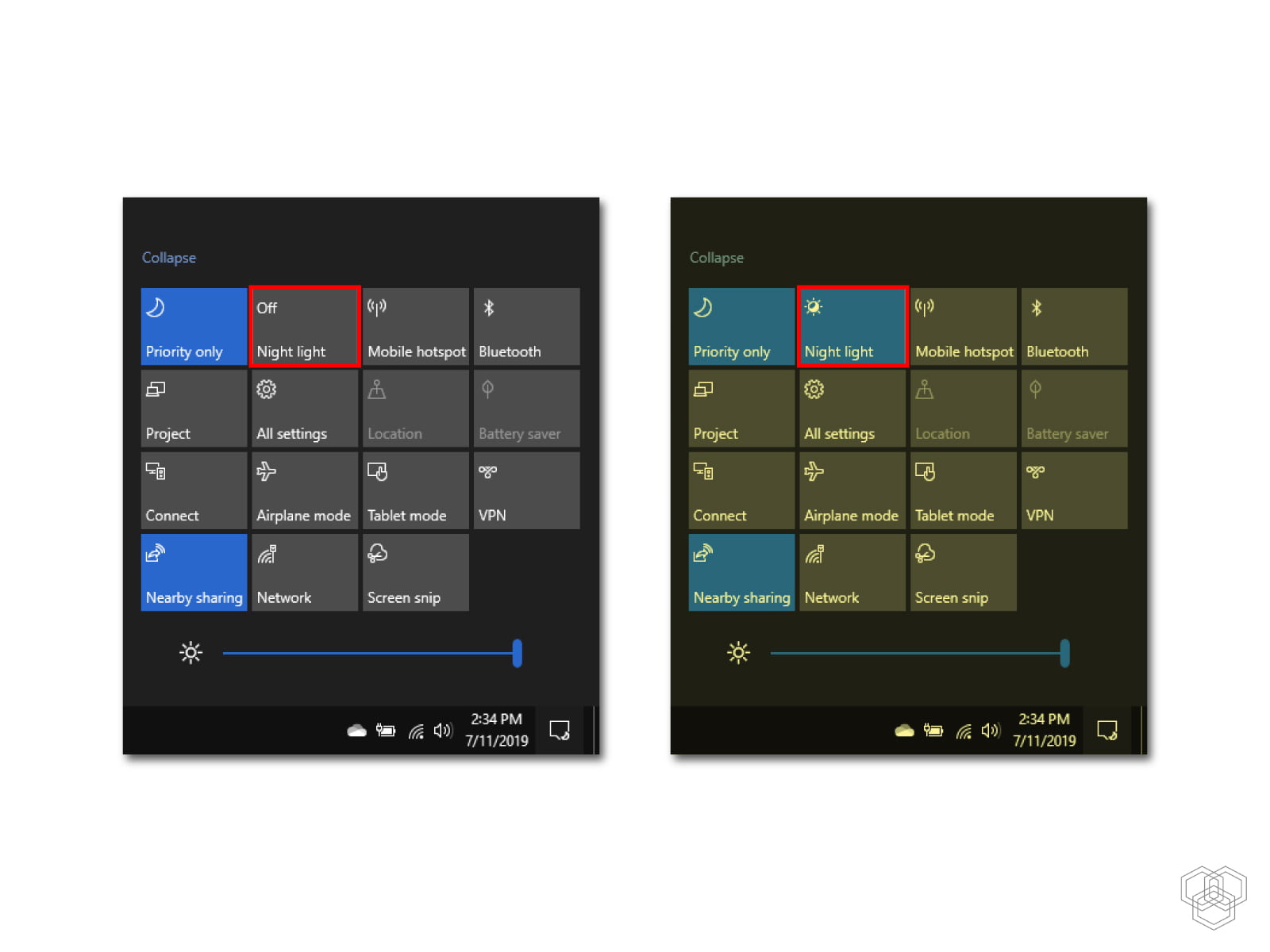
- Press Windows + A to open the Action Center.
- If you only see a few tiles, click Expand.
- Click the Night light tile. The screen turns warm straight away.
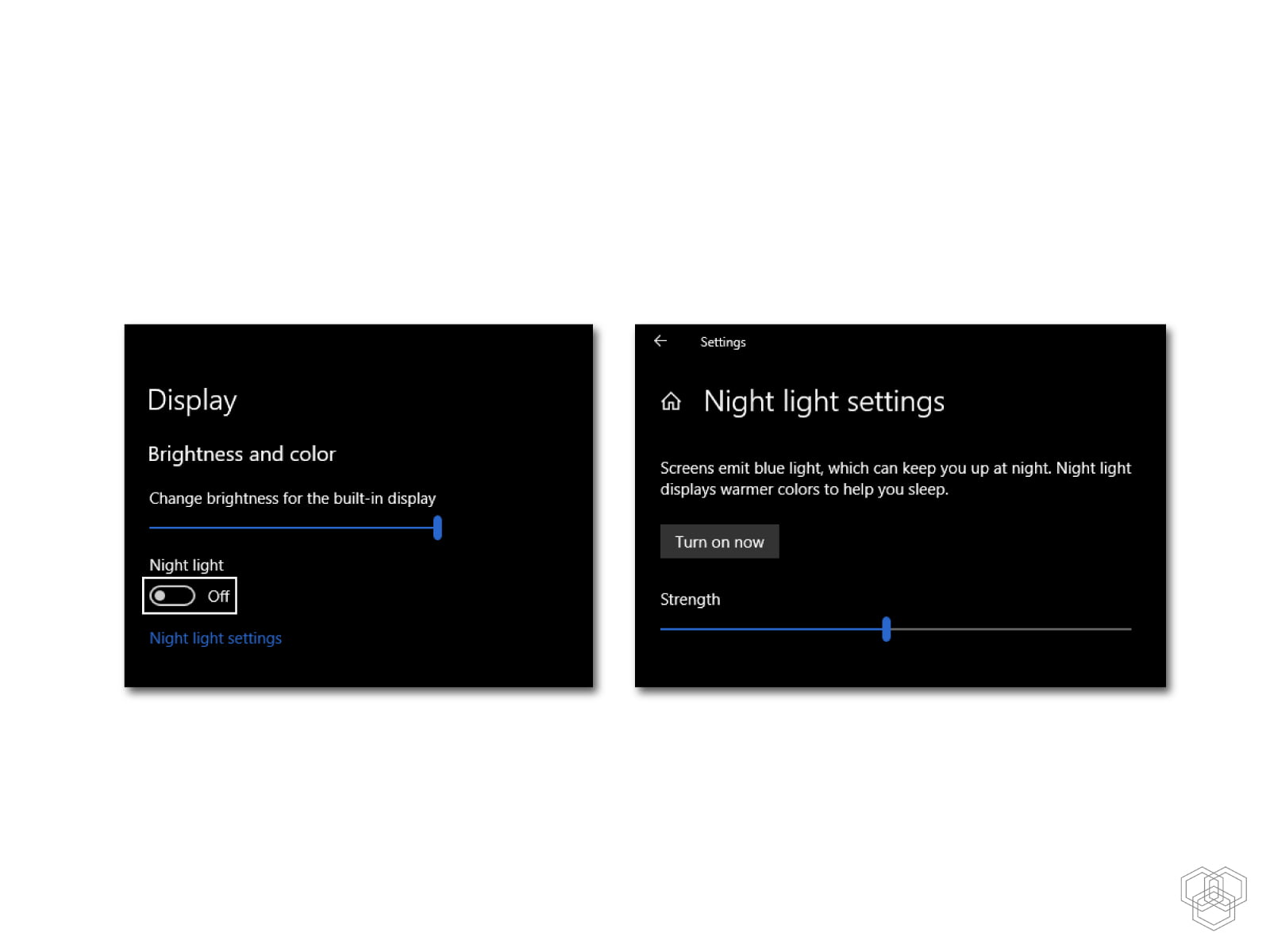
For the settings, go to Settings > System > Display > Night light settings.
Set the strength (how warm is too warm)
Open the Night light settings page and drag the Strength slider. The change previews live, so you can judge it against the room you are actually sitting in rather than a spec sheet.
- Low (left third) — a gentle warmth. Barely noticeable after a minute, and safe if you do any colour-sensitive work.
- Middle — the sweet spot for most people at night. Clearly amber, still perfectly readable.
- High (right third) — deep orange. Comfortable in a fully dark room, but whites go noticeably muddy.
Important for creatives: turn Night light off entirely before editing photos, grading video, or picking brand colours. Everything on screen is being shifted, so your colour judgement will be wrong. This is the single most common way people ruin an evening’s editing work.
Schedule Night light so you never think about it again
Manual toggling gets old fast. Set it once and let Windows handle it:
- Go to Settings > System > Display > Night light.
- Turn on Schedule night light.
- Choose Sunset to sunrise to follow your local daylight automatically, or Set hours to enter your own on and off times.
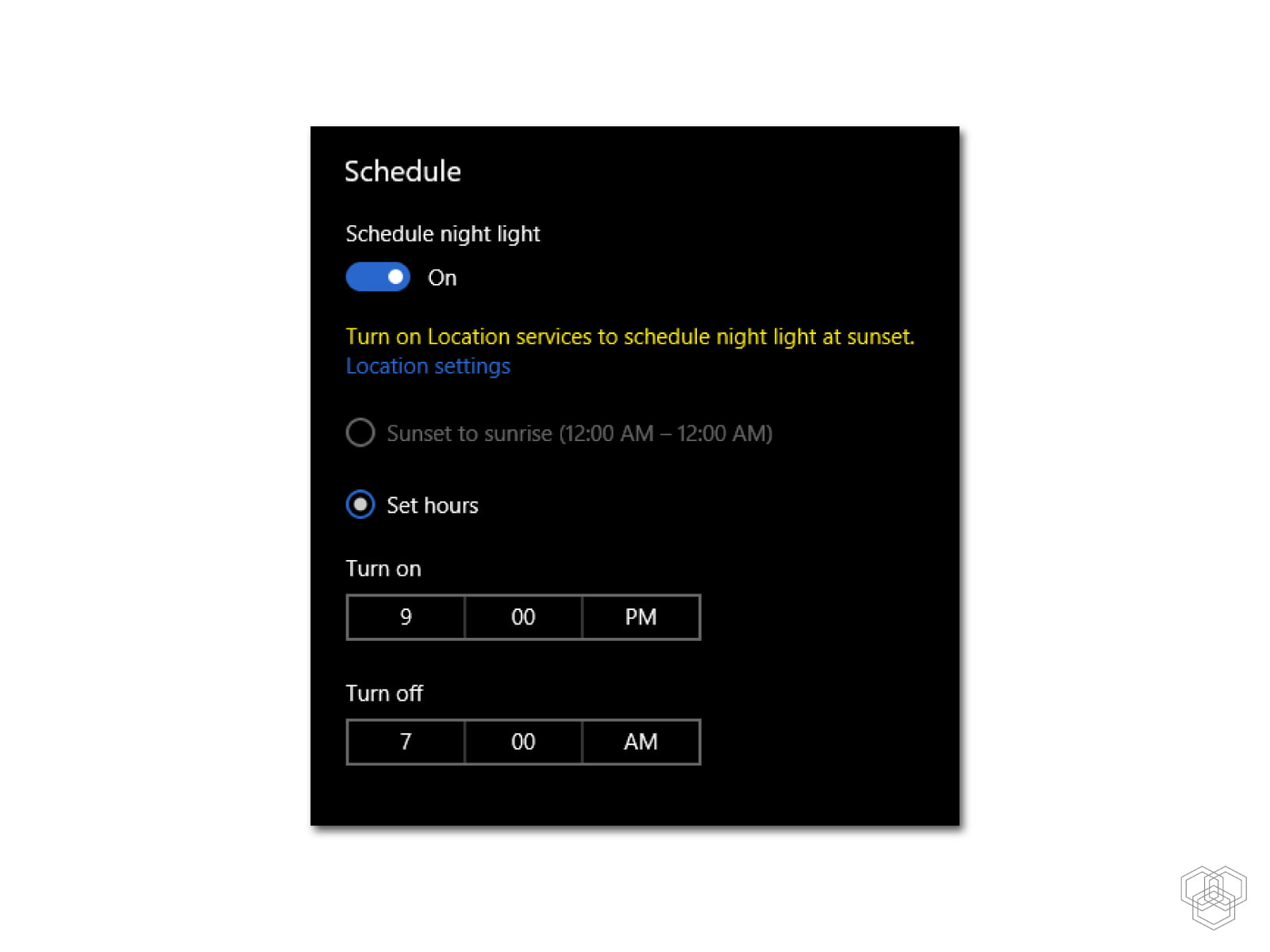
Sunset to sunrise is greyed out? That option needs to know where you are, so it requires Location services to be enabled. Go to Settings > Privacy & security > Location (Windows 11) or Settings > Privacy > Location (Windows 10) and switch location on. If you would rather not share location at all, use Set hours instead — on most schedules, something like 19:00 to 07:00 is close enough all year.
Also check that your system clock and time zone are correct. A wrong time zone means Windows calculates sunset for the wrong place and Night light fires at odd hours.
Night light greyed out or not working: the fixes
This is the most-reported problem with the feature, and it almost always comes down to one of four things. Work down the list:
1. HDR is switched on
This is the number one cause. On most configurations, enabling HDR disables Night light — the two colour pipelines conflict. Go to Settings > System > Display > HDR and turn Use HDR off, then check whether Night light comes back. Toggling HDR off and on again also clears the state on machines where Night light has simply got stuck.
2. Your graphics driver
Night light is implemented through the display driver, so a broken, outdated or half-installed GPU driver takes it out. Download the current driver directly from Intel, NVIDIA or AMD rather than relying on Windows Update, and do a clean install if the option is offered. A well-known symptom that points squarely at the driver: Night light works when Windows falls back to the Microsoft Basic Display Adapter, then breaks again the moment the real driver loads.
3. Location, date and time
If only the schedule misbehaves — Night light works manually but never turns itself on — the problem is location services or a wrong clock, as covered above. Fix those two and the schedule starts behaving.
4. A stuck shell
Sometimes the toggle is simply wedged. In order of effort: restart Windows Explorer from Task Manager; sign out and back in; reboot; then run sfc /scannow from an elevated Command Prompt to repair system files. Installing pending Windows updates is worth doing before any of that — a fair number of Night light regressions have been fixed in cumulative updates.
One more thing worth checking on laptops: some manufacturer display utilities (colour-management or “eye care” apps bundled by the OEM, plus GPU control panels with their own colour settings) take over the colour pipeline and quietly override Night light. If you have one installed, disable its colour feature and try again.
Night light vs the alternatives
- Night light — free, built in, zero configuration, works on all connected displays driven by the GPU. Weakness: no per-app control, and it fights HDR.
- f.lux and similar third-party apps — more granular control over transition curves and colour temperature values, plus presets. Worth it only if you genuinely want that level of control.
- Your monitor’s own low-blue-light mode — done in the panel’s hardware, so it survives OS quirks entirely and works even in HDR. Usually buried in the OSD menu under “Eye Saver,” “Low Blue Light” or “Reader.” This is the best option if Night light refuses to work on your machine.
- Dark mode — different tool, same goal. Run it alongside Night light: see our guide to turning on dark mode in Windows and to enabling dark mode in Chrome.
FAQs
Is there a keyboard shortcut for Night light?
There is no dedicated single-key shortcut. The quickest built-in route is Windows + A to open Quick Settings (Windows 11) or the Action Center (Windows 10), then click the tile. Some laptops map a function key to a manufacturer’s own eye-care mode, which is a different feature.
Does Night light work on a second monitor?
Yes — it applies to displays driven by the graphics adapter, so external monitors are normally covered. Multi-GPU laptops and some docking or adapter chains are the common exceptions; if one screen stays cold while the other warms, that is a driver-path issue rather than a settings one.
Does Night light save battery?
Not meaningfully. It changes colour temperature, not backlight output, so the panel draws roughly the same power. Lowering brightness saves battery; on OLED screens, dark mode saves battery. Night light does neither.
Will Night light actually help me sleep?
Possibly, but do not count on it doing the heavy lifting. The stronger evidence points at total screen time and the hour you stop, not the colour temperature. Night light makes the screen more comfortable; putting the laptop down an hour before bed does more.
Can I use Night light and HDR together?
On most systems, no — turning HDR on disables Night light. If you need both, use your monitor’s hardware low-blue-light mode, which sits outside the Windows colour pipeline.
Is Night light still available now that Windows 10 is out of support?
Yes. End of support means no new features and, without ESU, no security updates — it does not remove anything already in the OS. Night light works on Windows 10 exactly as it always did.
The bottom line
Night light takes about thirty seconds to set up and then looks after itself. Turn it on from Quick Settings or the Action Center, set the strength somewhere in the middle, switch on the sunset-to-sunrise schedule, and forget it exists — until the evening you notice the screen no longer feels like a torch. If the toggle refuses to work, check HDR first and your graphics driver second; between them they account for the overwhelming majority of cases.
What’s the first setting you change on a fresh Windows install? Let us know in the comments.




In Windows 10 new update, you will get a new option for the night light and it will help you to work on the computer in dark. It is a really very effective feature for those who use the computer till late at night.
Yes, the new update comes with night light feature. The guide is about the same feature.