


In March 2022, the Oculus Quest 2 was the dominant standalone VR headset and Meta had recently rebranded the product line away from the Oculus name. Four years on, the headset has been renamed (it’s the Meta Quest 2 now), succeeded by the Meta Quest 3 and Meta Quest 3S, and joined in the high end by Apple’s Vision Pro.
Contents
What the Meta Quest 2 is
The Meta Quest 2 (originally the Oculus Quest 2) is a standalone VR headset launched on October 13, 2020. Standalone means it does everything onboard — Snapdragon XR2 chipset, integrated displays, six degrees of freedom tracking, hand controllers — with no PC tether required. The headset runs an Android-derived operating system and pulls apps from the Meta Quest Store.
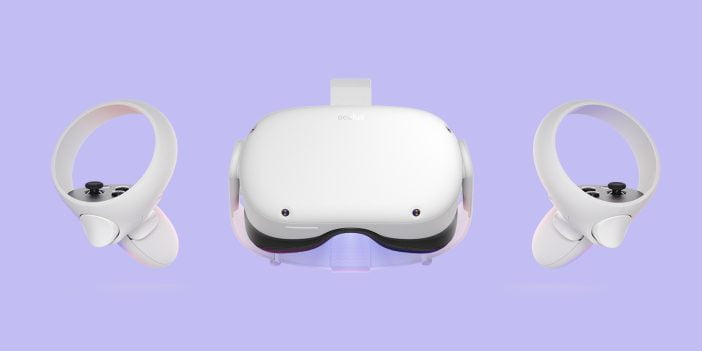
It is also the headset that pushed VR into mass-market price territory. Quest 2 launched at $299 for the 64 GB model and $399 for 256 GB; Meta has lowered and raised pricing several times since. As of 2026, new Quest 2s are no longer sold by Meta directly — the Quest 3S replaced it as the entry tier in October 2024 — but the Quest 2 still receives Horizon OS software updates and remains supported.
The five features below were buried in the menu structure at launch. All of them still work on Quest 2 in 2026.
1. Voice commands
The headset has a built-in voice assistant. Open the Quick Settings panel, press the Voice Command button, double-tap the Meta button, or say the wake phrase to trigger it.
One thing changed in 2024: the wake phrase moved from “Hey Facebook” to “Hey Meta”, in line with the broader Oculus-to-Meta rebrand. To enable it, open Settings > Voice Commands and toggle the Wake Word option on. Voice can launch apps, take screenshots, start recording, change the volume, and (since 2024) trigger Meta AI for general-knowledge questions.
2. Track phone settings from VR
One of the longstanding worries about VR is that putting on the headset cuts you off from text messages, calls, and notifications. Quest 2 has a pairing feature that surfaces phone notifications inside VR so you can decide whether to break the immersion.
Setup: install the Meta Horizon app (renamed from the Oculus app in 2022) on iOS or Android. Open the app, tap Menu, then Devices, then your Quest 2. Inside Headset Settings, toggle Phone Notifications on. Notifications appear as overlay panels you can dismiss or open inside the VR UI. For shared headsets in a household, set up separate Meta accounts so each user sees only their own notifications.
3. Fitness tracking with Move
VR fitness was one of the unexpectedly large categories on Quest, helped by lockdown-era home workouts and by titles like Supernatural and FitXR.
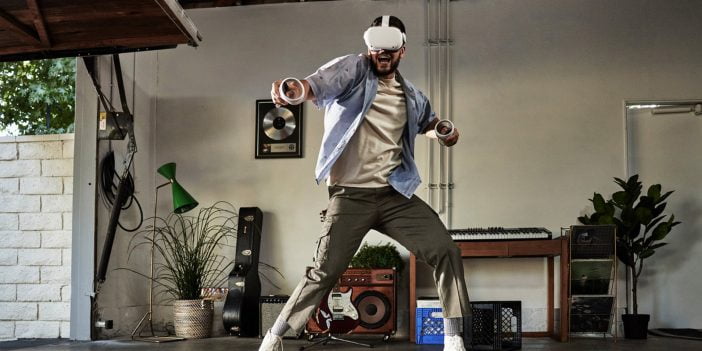
Meta Move (still called Oculus Move in older firmware) is the built-in activity tracker. Turn it on under Settings > Move, and the headset starts logging calories burned, minutes active, and total play time across compatible apps. Move is best understood as a casual indicator — it does not replace a dedicated heart-rate monitor or fitness ring for serious training. For light cardio context, it’s perfectly adequate.
4. 120 Hz gaming mode
The Quest 2’s displays support up to 120 Hz refresh rate, although the default is 72 or 90 Hz. The 120 Hz mode is hidden under Experimental Features — toggle 120 Hz on, and any compatible app will render at the higher rate.
Two caveats matter: not every Quest title supports 120 Hz (the developer has to opt in), and running at 120 Hz drains the battery noticeably faster. For rhythm games like Beat Saber, the smoother frame rate is worth the trade. For longer story-driven titles, 90 Hz is usually a better balance.
5. Casting to phone or TV
When one person is in VR and everyone else in the room is staring at a black headset, the experience does not translate. Casting fixes that — Quest 2 can stream its first-person view to a Chromecast, a Meta-compatible Smart TV (Samsung, LG, and Vizio added support across 2022–2024), or directly to a phone running the Meta Horizon app.
To start a cast: open the Meta Horizon app on your phone, tap the cast icon at the top right, pick the destination device (your TV, your phone, or a connected Chromecast). On the headset side, the cast indicator shows that mirroring is active. Quest 2 supports casting at up to 720p at 30 fps, which is enough for the bystander view to be readable.
Where the Quest 2 fits in 2026
The Quest 2 has been superseded twice since March 2022:
- Meta Quest Pro (October 2022) — high-end headset with face tracking and eye tracking. Discontinued in 2024 after slow sales.
- Meta Quest 3 (October 2023) — Snapdragon XR2 Gen 2, full-colour mixed-reality passthrough, slimmer form factor. The current flagship.
- Meta Quest 3S (October 2024) — replaced Quest 2 as the entry tier. Quest 3 internals with the older Quest 2 lenses, starting at $299.
- Apple Vision Pro (February 2024) — Apple’s high-end mixed-reality headset, starting at $3,499. Different market, different audience, but the first mainstream alternative to Meta’s headsets at the premium tier.
Quest 2 owners in 2026 are still well-served: Meta continues to ship Horizon OS updates to the device, the major VR titles still launch with Quest 2 support, and the resale market is healthy. The strongest reason to upgrade is the colour passthrough on Quest 3 / 3S, which enables mixed-reality apps that the Quest 2’s black-and-white passthrough cannot run.
For broader context on Meta’s VR strategy, see Meta’s dissolved AR/VR OS teams and our piece on how the metaverse aims to create a new VR world.
FAQ
Is the Meta Quest 2 still supported in 2026?
Yes. Meta has continued to ship Horizon OS updates to the Quest 2 through 2025 and into 2026. The headset is no longer sold new by Meta directly (the Quest 3S took the entry-tier slot in October 2024), but software support and major game releases still cover Quest 2. The clearest functional gap is colour passthrough — Quest 2 can only see the room in greyscale.
Should I upgrade from Quest 2 to Quest 3 or 3S?
If you mainly play VR-only games (Beat Saber, Half-Life Alyx via Air Link), the Quest 2 is still adequate. If you want to use mixed-reality apps that put virtual objects in your real room — fitness apps with the room in colour behind you, productivity apps with virtual monitors, AR-style experiences — the colour passthrough on Quest 3 / 3S is the main reason to upgrade.
Does “Hey Facebook” still work as the voice wake phrase?
No. The wake phrase was changed to “Hey Meta” in 2024 as part of the Oculus-to-Meta rebrand. Older headsets running outdated firmware may still respond to the old phrase, but the current Horizon OS only listens for “Hey Meta.”
Quest 2 vs Apple Vision Pro — what’s the comparison?
They are different products at different price points. Quest 2 was $299 at launch and focused on VR gaming. Vision Pro is $3,499 and focused on spatial computing — productivity, video, immersive media. They share the headset form factor but have minimal overlap in target use or library. Vision Pro is not in direct competition with Quest 2; it competes more directly with the Quest Pro / Quest 3 tier.
Can the Quest 2 cast to an iPhone?
Yes. The Meta Horizon iOS app supports cast-to-phone — open the app, tap the cast icon, and the headset’s view streams to the phone screen. The same flow works on Android via the Horizon Android app. Casting to TVs requires either a Chromecast or a Quest-compatible Smart TV (Samsung, LG, Vizio models from 2022 onward).


Share Your Thoughts