• Skip to primary navigation
  • Skip to main content
  • Skip to primary sidebar
  • Skip to footer
TechEngage

TechEngage®

Technology Reviews, Guides & Analysis

  • News
  • AI
  • Mobile
  • Apps
  • Security
  • Reviews
  • More
    • Internet & Social
    • Computing
    • Gadgets
    • Gaming
    • Car Tech
    • Business
    • Science & Health
TechEngage » Science & Health Tech

Voyager 2 enters Interstellar Space to accompany its twin, Voyager 1

Avatar for Noor Imtiaz Noor Imtiaz Updated: January 17, 2020

voyager 2 enters interstellar space
NASA
FacebookTweetPinLinkedInPrint
The interstellar medium is what astrologists call the matter and radiation present between the star systems in a galaxy. Voyager 2 became the second man-made object to have entered interstellar space ever. Although its twin the Voyager 1 is already in the interstellar space, this probe will bring data in higher resolution. NASA made the announcement on Monday when the spacecraft finally stopped registering solar wind. As this happened, NASA scientists knew that it was completely out of the Sun’s influence and effectively, in interstellar space. NASA has previously planned to go to the moon and beyond. Nicola Fox is the director of the Heliophysics Division at NASA. She sums up the excitement surrounding the Voyager 2 officially entering interstellar space.
“To have the Voyagers sending back information about the edge of the Sun’s influence gives us an unprecedented glimpse of truly uncharted territory.”

Historical Context

NASA launched Voyager 2 in 1977 to study outer planets. As the astrological term ‘outer planets’ refers to planets after the asteroid belt, Voyager 2 began its mission with Jupiter. Voyager 2 has a twin spacecraft, Voyager 1. Although NASA launched Voyager 1, 16 days after Voyager 2 in 1977, Voyager 1 made it to Jupiter first. Voyager 1 was able to do so because it had been set on a faster trajectory. Consequentially, the scientists put the Voyager 2 to a different mission towards Uranus and Neptune after both the twins visited Saturn and Jupiter.
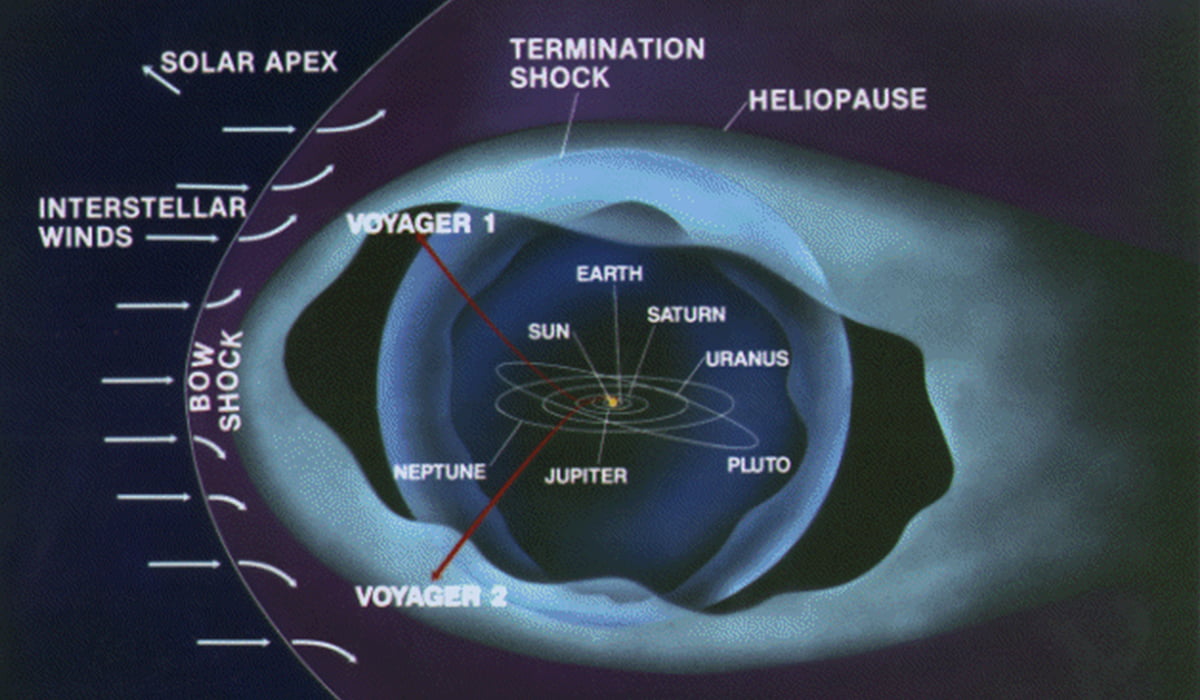
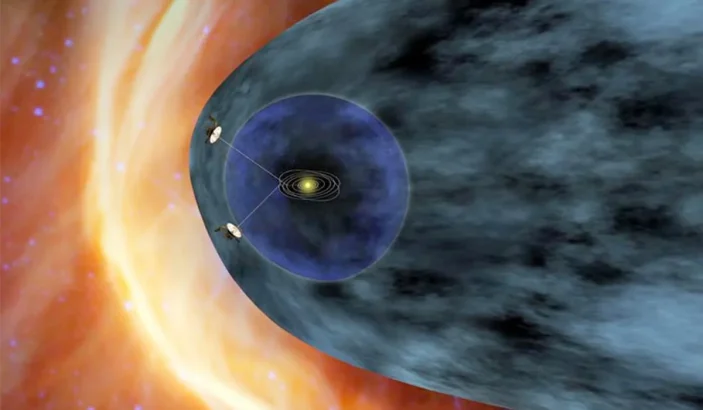
Diagram Showing Voyager 1 In Interstellar Space
NASA
The primary mission of Voyager 2 ended when it successfully visited Jupiter, Saturn, and Uranus in 1979, 1981 and 1986. It has therefore been operational for 41 years. Now, the Voyager 2 is in its extended mission of interstellar space. Throughout, the spacecraft has been in link with the scientists through the NASA Deep Space Network. In astrological terms, a heliosphere is a cavity that the sun forms in an otherwise interstellar space. Voyager 2 has been foraging out of heliosphere in the second part of its space mission. After the spacecraft completed its early mission in 1986, the scientists working on it soon announced that it would now begin its interstellar mission. Scientists wanted to explore the solar system beyond the heliosphere. The data they receive from the Voyager 1 in interstellar space is crucial. Still, the data that Voyager 2 has the capacity to transmit is still impeccable.

The Breakthrough

NASA made the official announcement on Monday when the Voyager 2 crossed the heliosphere boundary. It is now officially traveling at a distance of 11 billion miles from earth. The reason why the world is hailing this as a massive scientific breakthrough is the data we are expecting to receive from the spacecraft. Voyager 1 was the first spacecraft that crossed the heliosphere boundary into interstellar space in 2012. However, by the time it did so, its Plasma Science Experiment (PLS) instrument had already broken off. With the Voyager 2, it will finally be possible to receive real-time data from humanity’s most distant emissaries. John Richardson is the principal investigator for the PLS instrument. He said in a press release:
“Working on Voyager makes me feel like an explorer, because everything we’re seeing is new. Even though Voyager 1 crossed the heliopause in 2012, it did so at a different place and a different time, and without the PLS data. So we’re seeing things that no one has seen before.”
With Voyager 1, the transition brought a rise in cosmic rays, but it could not detect a decrease in solar wind. Therefore, we saw a change in the charged particles but none in the magnetic field. However, with Voyager 2 on Monday, we finally saw the spacecraft detecting a drop in the solar wind until it vanished altogether.
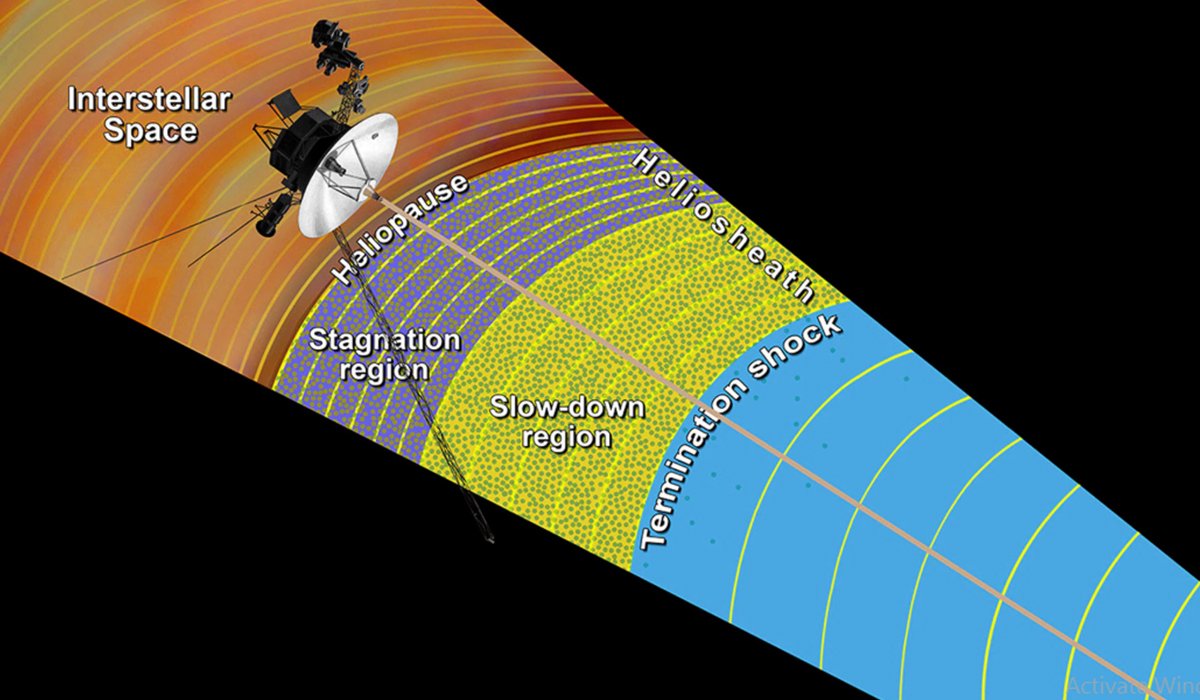
Diagram Of Interstellar Space And Voyager 2
NASA
Studying the solar wind transition has obviously been a trip for the scientists involved. However, we are still looking forward to the magnetic field transition.

Looking On

Other than the Plasma Science Experiment instrument, scientists are using a variety of instruments to have a better understanding of what the Voyager 2 is traveling through. The magnetometer, the low energy charged particle instrument, as well as the cosmic ray subsystem, are all vital. All three of these instruments are on board the Voyager 2. These can measure speed, temperature, pressure, and density. However, the two spacecraft are relying on the radioactively decaying element. The scientists have shut down several of their instruments to stay within the power budget drop of 4 watts a year. Eventually, it will run out, and the spacecraft will lose connection with Earth. Their power is likely to run out by. The scientists and researchers at NASA have announced that they are hopefully launching a new mission. They will build this space mission around the observations they have received via the two Voyager spacecraft. They have already talked about how companies are now ready to enter space. The future can look like finally figuring out a way to break out of the solar system. Although the Voyager twins have left the heliosphere, they are still bound by the Oort Cloud. Oort Cloud acts as the arbitrary boundary to the solar system and has small objects influenced by the sun’s gravity. Scientists fear that it can take up to 30,000 years to fly out of the solar system. Source: Fox News Network

Related reading

  • Is the James Webb Space Telescope a New Era of Space Exploration or a Quest for a Habitable Planet?
  • Blue Origin sues NASA over the decision to award SpaceX lunar lander contract

Filed Under: Science & Health Tech Tagged With: InterstellarSpace, NASA, Space, Voyager1, Voyager2

Related Stories

  • Drones Are Changing The World In 9 Ways

    Drones are Changing the World in 9 Ways

  • We’ll Have Bots And Drones For The Delivery Of Our Pizzas Soon!

    We’ll have bots and drones for the delivery of our pizzas soon!

  • When Ai Meets Healthcare; Robots For Autism

    When AI meets healthcare; Robots for Autism

FacebookTweetPinLinkedInPrint
Avatar for Noor Imtiaz

Noor Imtiaz

Science & Culture Correspondent

Noor Imtiaz is a Science and Culture Correspondent at TechEngage, covering social media trends, cybersecurity, scientific breakthroughs, AI developments, and IoT across nearly 100 articles. Currently pursuing a Master of Science in Healthcare Biotech at NUST, Noor bridges the gap between laboratory research and technology journalism, bringing a scientific lens to every story.

Joined November 2018

Reader Interactions

Share Your Thoughts Cancel reply

Please read our comment policy before submitting your comment. Your email address will not be used or published anywhere. You will only receive comment notifications if you opt to subscribe below.

Primary Sidebar

TechEngage on Google News

Recent Stories

  • Letter Boxed Hints Today: Clues and Answer for July 14, 2026
  • Spelling Bee Hints Today: Clues and Answer for July 14, 2026
  • Octordle Hints Today: Clues and Answer for July 14, 2026
  • Contexto Hints Today: Clues and Answer for July 14, 2026
  • Waffle Hints Today: Clues and Answer for July 14, 2026

Footer

Discover

  • About TechEngage
  • Newsroom
  • Our Team
  • Advertise
  • Send us a tip
  • Startup Submission Questionnaire
  • Brand Kit
  • Contact us

Legal pages

  • Reviews Guarantee & Methodology
  • Community Guidelines
  • Corrections Policy and Practice
  • Cookies Policy
  • Our Ethics
  • Disclaimer
  • GDPR Compliance
  • Privacy Policy
  • Terms and Conditions

Must reads

  • Best AirPods alternatives on Amazon
  • Best PC monitors for gaming on Amazon
  • Best family board games
  • Best video doorbells without subscription
  • Best handheld video game consoles
  • Best all-season tires for snow
  • Best mobile Wi-Fi hotspots
  • Best treadmills on Amazon

Download our apps

TechEngage app coming soon on App Store

© 2026 TechEngage®. All Rights Reserved. TechEngage® is a project of TechAbout LLC.

TechEngage® is a registered trademark in the United States under Trademark Number 6823709 and in the United Kingdom under Trademark Number UK00003417167. It is also ISSN protected under ISSN 2690-3776 and has OCLC Number 1139335774.