

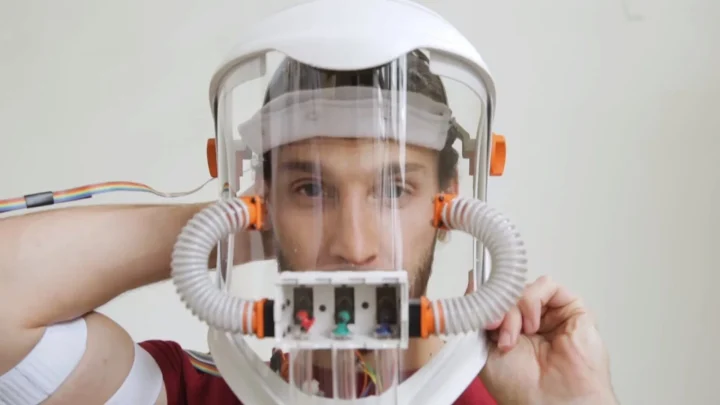
The Synesthesia Mask does not give anyone synesthesia. It does something more mechanical: a color sensor on your fingertip reads the red, green and blue values of whatever you touch, and three servos meter matching amounts of essential oil scent into a face mask. Touch a blue surface and you smell the “blue” oil. Touch purple and you get a blend of the red and blue ones.
Aerospace engineer Zachary Howard published the build as an 18-step Synesthesia Mask guide on Instructables on November 3, 2015, and it has since passed 66,000 views. More than a decade later, the idea still works, but the board it was built around is long discontinued, and the science of real synesthesia has moved well past what was known when the mask first went viral.
How the synesthesia mask turns color into smell
Howard describes the device as a “smell pixel.” A screen pixel mixes red, green and blue light in different strengths to make any color, so the mask mixes a “red,” a “green” and a “blue” scent in proportion to the color under your finger.
The plumbing is simple. A small fan at one end of a boxy scent manifold blows air across three test tubes of essential oil. Each tube has a 3D-printed cover attached to a mini servo, and the wider the servo tilts that cover open, the more air picks up that tube’s scent. A second fan at the other end pushes the mixed air through tubing into a full face mask. An Intel Edison board strapped to the upper arm reads the sensor in a continuous loop and resets the three servo angles, so the smell shifts as you move your hand across different surfaces.
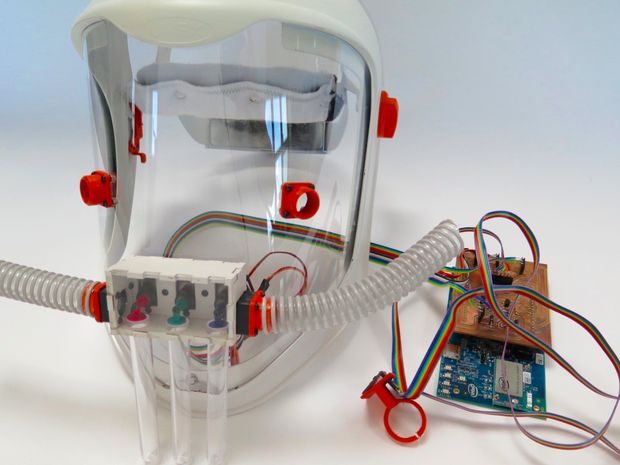
Howard’s own mapping used grapefruit for red, pine for green and lavender for blue, according to Discover Magazine’s report on the project. Nothing in the design fixes those choices. Any three oils work, and the choice matters more than it sounds: neutral colors such as white and gray contain similar amounts of red, green and blue, so they open all three tubes at once and produce the muddiest smell the mask can make.
Parts list from the original build guide
- Controller: Intel Edison with the Edison Arduino breakout board, housed in an armband
- Sensor: an RGB color sensor that talks over I2C, mounted on a 3D-printed finger clip (Howard suggests hot-gluing it to an old ring instead)
- Scent delivery: three mini servos, two 100mA fans, three test tubes of essential oil, 2 feet of 3/4-inch tubing and a full face mask
- Manifold: laser-cut 1/8-inch plywood and clear acrylic, though balsa wood cut with a craft knife is the suggested no-laser alternative
- Power and protection: a 10,000mAh external battery, two 2N2222 transistors so the fans do not draw current straight from the board, and two 1N4001 flyback diodes
- Optional: a custom single-sided circuit board milled on an Othermill in place of a breadboard or perfboard
Can you still build the synesthesia mask in 2026?
Yes, with one substitution. Intel issued end-of-life notices for its Edison, Galileo and Joule maker boards in June 2017, with a last order date of September 16, 2017 and final shipments on December 16, 2017, as CNX Software reported from Intel’s notices. Hunting down a board that has been out of production for nearly nine years makes little sense for a new build.
The good news is that the mask asks very little of its brain. The code reads three raw color values from the sensor and maps each one to a servo angle, then switches two fans on. Any current microcontroller board with an I2C bus and three PWM outputs can do that job, so the realistic work is rewiring the pinout and rewriting a short sketch, not redesigning the mask. If you have never taken a hardware idea from sketch to working object, this guide to turning an idea into a functional prototype covers the planning side.
Two cautions from the build itself. Howard’s guide admits the circuit is complicated: it involves soldering, transistor switching and a wiring harness that runs from finger to forearm to mask, so it suits someone who has already finished a few electronics projects, such as a DIY MakerPhone kit. He also tells builders to water down the oils, because undiluted scents were overpowering inside a closed face mask. If strong fragrances give you headaches or make breathing uncomfortable, treat this as a short demo, not something to wear for an afternoon.
What synesthesia is, and why about 4% of people have it
Synesthesia is a condition in which stimulating one sense automatically triggers a second perception, such as hearing a note and seeing a color. It was long treated as extremely rare. The first prevalence study that did not rely on people volunteering themselves, published by Julia Simner and colleagues in the journal Perception in 2006, found synesthesia 88 times more common than the old estimate of 0.05% of births, which works out to roughly 4% of people.
The same study overturned two popular beliefs repeated in early coverage of the mask, including the first version of this article. Seeing letters and numbers in color was not the most common form; it showed up in about 1% of people. The most common variant was colored days of the week. And there was no strong skew toward women.
This is where the mask and the condition part ways. A synesthete does not choose that Tuesday is yellow, and the pairing holds steady enough that researchers use objective consistency tests to confirm genuine cases. The mask’s color-to-smell rule is whatever three oils the builder happened to pour into the test tubes, and it changes the moment someone swaps a tube. It simulates the experience of a blended sense, not the brain wiring behind it.
What causes synesthesia: 6 genes flagged in a 2018 family study
When the mask was new, the leading explanation was that brain regions handling different senses are more connected in synesthetes than in other people. Genetics now gives that idea some support. In a 2018 PNAS study, researchers sequenced the exomes of three families with sound-color synesthesia spanning three or more generations. They found rare variants that tracked with synesthesia in each family, 37 genes of interest in total, and six of them (COL4A1, ITGA2, MYO10, ROBO3, SLC9A6 and SLIT2) are involved in axonogenesis, the growth of the nerve fibers that connect brain regions, and are active in early childhood.
The more telling result is what the families did not share: no single variant appeared in all three. Synesthesia is not one gene with one switch. Different genetic routes seem to arrive at the same outcome, a brain wired with extra cross-talk between senses, which is exactly the part a wearable cannot copy.
Can adults learn synesthesia? A 14-person training study
The closest anyone has come to giving non-synesthetes the real thing used flashcards and e-books, not hardware. In a 2014 University of Sussex study published in Scientific Reports, 14 adults trained for nine weeks on 13 letter-color pairings through daily memory and reading tasks. Afterward, 9 of the 14 said they experienced colors when looking at black letters, some of them outside the lab, which is normally considered a hallmark of genuine synesthesia.
It did not last. When the researchers retested participants three months later, much of that experience had faded, and the authors were explicit that they had not turned anyone into a true synesthete. For the mask, that suggests a reasonable guess but not a finding: wearing it for weeks might build learned color-smell associations, and they would probably fade once you stopped. No one has published a study testing the mask itself.
Smell technology since the synesthesia mask
Howard’s mask is limited by chemistry. Three oils can only produce blends of three smells, no matter how precisely the servos move. Research since then has tried to get past fixed cartridges. In 2018, a team at Malaysia’s Imagineering Institute worked on sending virtual smells over the internet by electrically stimulating the inside of the nose instead of releasing any scent at all.
The larger commercial effort is Osmo, which spun out of Google Brain in 2022 to build AI models that predict how a molecule smells from its structure. In 2024 the company said it had digitized the scent of a real plum and recreated it as a matching fragrance. That is a fragrance-design tool, not a wearable, but it points at the missing piece in Howard’s design: a way to describe smells as data rather than as three bottles on a rack.
Multisensory hardware for the other senses has moved in parallel, from Microsoft’s PIVOT haptic controller that simulates touch in VR to Alibaba’s Smart Touch for visually impaired users. Smell remains the hardest of the three to reproduce on demand.
Who the synesthesia mask is for
The mask makes most sense as a teaching and exhibition piece. It turns an abstract idea, that a perception can be built from three channels, into something a museum visitor or a classroom can literally sniff, and it shows RGB color mixing in a way a screen never will. Makers who want an intermediate project with sensors, servos and fabrication in one build will get a lot out of it.
It is the wrong project if you want to know what synesthesia actually feels like, or if you are looking for an accessibility aid. A synesthete’s pairings arrive without a sensor, a fan or a choice of oils, and the research above shows that even weeks of deliberate training produce only a temporary version of the real experience.
Synesthesia mask FAQs
What is the synesthesia mask?
The Synesthesia Mask is a DIY wearable that aerospace engineer Zachary Howard published as an 18-step Instructables guide on November 3, 2015. A color sensor on the finger reads red, green and blue values, and three servos release matching amounts of three essential oil scents into a face mask.
Can the synesthesia mask give you real synesthesia?
No. Real synesthesia is an automatic, consistent perception that a 2006 Perception study found in roughly 4 percent of people. The mask applies a color-to-smell rule chosen by the builder, so it simulates the experience of blended senses without changing how the brain processes them.
How does the synesthesia mask turn colors into smells?
An RGB color sensor sends three color values to an Intel Edison board, which sets three mini servos. Each servo tilts a cover over a test tube of essential oil, and two fans push the scented air through tubing into the mask. Howard used grapefruit for red, pine for green and lavender for blue.
Can you still buy an Intel Edison to build the mask?
Not new. Intel set a last order date of September 16, 2017 and a last shipment date of December 16, 2017 for the Edison. A current microcontroller board with an I2C bus and three PWM outputs can run the same logic after rewiring and a short code rewrite.
How common is synesthesia?
A 2006 study by Julia Simner and colleagues found synesthesia 88 times more common than the old 0.05 percent estimate, or roughly 4 percent of people. The most common form was colored days of the week, while letter and number color synesthesia affected about 1 percent.
Can you learn synesthesia?
Only temporarily, based on current evidence. In a 2014 University of Sussex study, 9 of 14 adults reported seeing colors for black letters after nine weeks of training, but much of that experience had faded when they were retested three months later.





Share Your Thoughts