

Most laptop battery problems come down to a handful of settings that ship with terrible defaults. Fix these and the difference is immediate.
Laptop manufacturers quote battery life under conditions nobody actually uses — screen at 50%, Wi-Fi on but idle, no apps running. Real-world usage with a browser, Slack, Spotify, and a few tabs open burns through a charge far faster. The gap between advertised and actual battery life is where these adjustments make the biggest difference.
Table of Contents
Lower the Screen Brightness (and Use Auto-Brightness)
The display is the single biggest battery drain on any laptop. Dropping brightness from 100% to 60% can add 30 to 60 minutes of runtime depending on screen size and panel type. On a 15-inch display, the difference is dramatic.
Both Windows 11 and macOS offer adaptive brightness that adjusts based on ambient light. On Windows, search “Change brightness automatically” in Settings. On Mac, System Settings > Displays > Automatically adjust brightness. Let the sensor handle it instead of manually maxing it out every morning. Most people run screens far brighter than their environment requires.
Switch to the Right Power Mode
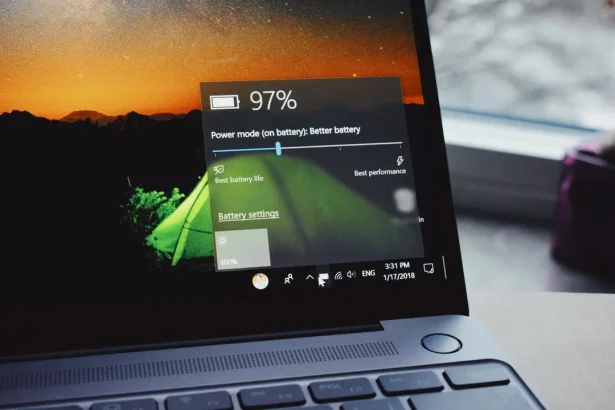
Windows 11 offers three power modes accessible from Settings > System > Power & battery: Best power efficiency, Balanced, and Best performance. The default is Balanced, which is fine for plugged-in use but wasteful on battery. Switching to Best power efficiency throttles the CPU slightly and limits background activity. For email, documents, and browsing, the performance difference is barely noticeable. The battery difference is substantial.
On macOS, Low Power Mode lives under System Settings > Battery. It reduces screen brightness slightly and slows system animations. Apple Silicon Macs already manage power aggressively, but enabling Low Power Mode still squeezes out an extra hour on most MacBook models.
Windows also has a Battery Saver mode that kicks in at 20% by default. Change the threshold to 30% or even 40% under Settings > System > Power & battery. By the time the laptop hits 20%, battery saving is a rescue operation. Starting earlier makes it a prevention strategy.
Kill Background Apps That Drain Silently
The biggest battery thieves are not the apps being actively used. They are the ones running in the background, checking for updates, syncing files, and indexing content that nobody asked for.
On Windows 11, go to Settings > Apps > Installed apps, click the three dots next to any app, choose Advanced options, and set “Let this app run in background” to Never. Start with apps like OneDrive, Teams, Skype, and any antivirus that runs constant scans. On macOS, check Activity Monitor sorted by Energy Impact to find what is silently draining power. Spotlight indexing after a major update can eat battery for hours.
Pick the Right Browser
Chrome is a notorious battery hog. Multiple tabs running JavaScript-heavy sites will drain a laptop faster than almost anything else. Safari on macOS and Edge on Windows are optimized for their respective operating systems and consistently outperform Chrome in battery benchmarks. The difference is not small. Tests routinely show 60 to 90 minutes of extra runtime when switching from Chrome to the native browser.
Regardless of browser, close tabs that are not actively needed. A browser with 40 open tabs is doing background work on every single one of them. Extensions compound the problem. Ad blockers actually help battery life by preventing resource-heavy ads from loading, but most other extensions add overhead.
Turn Off Wi-Fi and Bluetooth When Not Needed
Wi-Fi and Bluetooth radios draw power even when idle. They scan for networks and devices periodically, and each scan wakes components that would otherwise sleep. If working offline on a document or presentation, switching to airplane mode eliminates this drain entirely. On most laptops, airplane mode adds 15 to 20 minutes per hour of use.
Bluetooth is the smaller offender of the two, but if no wireless mouse, headphones, or keyboard is connected, there is no reason to leave it on. Both can be toggled from the quick settings panel on Windows (Win + A) or the Control Center on macOS.
Related: How to save your Android’s battery.
Unplug USB Devices
Every USB device draws power from the laptop, whether it is being used or not. External mice, USB hubs, webcams, and thumb drives all pull current through the port. An external hard drive spins up every time the system checks for it. Unplug anything that is not essential when running on battery.
Use Dark Mode on OLED Screens
This tip only applies to laptops with OLED displays, which are increasingly common in premium and mid-range models. OLED screens light each pixel individually, so displaying black means those pixels are completely off and drawing zero power. Switching to dark mode across the OS and apps can reduce display power consumption by 30% or more depending on how much of the screen shows dark content.
On IPS or LCD screens, dark mode makes no measurable difference to battery life because the backlight stays on regardless of what colors are displayed. It might be easier on the eyes, but it will not save any power on those panels.
Charge Smarter, Not Longer
Lithium-ion batteries degrade fastest when held at 100% for extended periods or drained to 0% repeatedly. The ideal range for battery longevity is between 20% and 80%. Charging to 100% before a trip is fine, but leaving a laptop plugged in at full charge on a desk for weeks at a time ages the battery faster than normal use would.
Modern laptops handle this better than older ones. Many now include smart charging features that stop at 80% when the laptop detects it is being used as a desktop replacement. But the underlying chemistry has not changed. Keeping a lithium-ion cell at high voltage shortens its total lifespan.
Keep the Laptop Cool
Heat accelerates battery degradation permanently. A laptop running at 35°C internally will retain battery capacity significantly longer than one consistently running at 45°C. Using a laptop on a bed, couch cushion, or lap blocks the ventilation ports and traps heat against the chassis.
A hard, flat surface is all most laptops need for adequate cooling. A $20 laptop stand with open airflow underneath does more for battery longevity than any software tweak. The vents on the bottom of the chassis need space to exhale. Blocking them with soft surfaces is the single most common cause of premature battery wear.
Also read: How to limit your screen time.
Use Battery Health Features Built into Your OS
Windows 11 shows battery usage per app under Settings > System > Power & battery > Battery usage. This screen reveals exactly which apps consumed the most power over the last 24 hours or 7 days. Check it once a week to catch any app that is draining battery in the background without providing any visible benefit.
macOS shows similar data under System Settings > Battery. The usage history graph highlights when the Mac was on battery versus plugged in, and Activity Monitor’s Energy tab ranks running processes by power impact. Apple Silicon Macs also report battery health percentage and whether capacity is still “Normal” under System Settings > Battery > Battery Health.
On Windows, running powercfg /batteryreport from Command Prompt generates a detailed HTML report showing original battery capacity versus current capacity, charge cycles, and usage history. This is the fastest way to check whether a battery is degrading faster than expected.
Frequently Asked Questions
Does closing the laptop lid save battery?
It depends on the power setting. Most laptops enter sleep mode when the lid closes, which reduces power draw to a trickle but does not eliminate it entirely. Sleep still uses a small amount of battery to keep RAM active. Shutting down completely or using hibernate (which saves the session to disk) uses zero battery. For short breaks of an hour or two, sleep is fine. For overnight or longer, hibernate or shutdown is better.
Should a laptop stay plugged in all the time?
Not ideal for battery longevity. Lithium-ion batteries degrade faster when held at 100% charge continuously. Many modern laptops from Apple, Lenovo, ASUS, and Dell include smart charging that caps the charge at 80% when the laptop detects constant AC power. If the laptop offers this feature, enable it. If not, unplugging occasionally and letting the battery cycle between 20% and 80% helps extend its useful life.
How many charge cycles does a laptop battery last?
Most lithium-ion laptop batteries are rated for 300 to 1000 full charge cycles before capacity drops to 80% of the original. A full cycle means draining from 100% to 0%. Using the laptop from 80% to 40% and recharging counts as roughly half a cycle. Apple rates its MacBook batteries at 1000 cycles, and most Windows laptop manufacturers aim for 300 to 500 cycles depending on the model and price point.
Why does my laptop battery drain fast even when idle?
Background processes are usually the culprit. Windows Search indexing, cloud sync services like OneDrive or Dropbox, software update checks, and antivirus scans all run without any visible window open. On Windows, check Settings > System > Power & battery > Battery usage to identify what consumed power. On Mac, open Activity Monitor and sort by Energy Impact. A freshly updated OS often runs indexing tasks for the first few hours after an update, which temporarily increases battery drain.
Does dark mode actually save laptop battery?
Only on OLED screens. OLED displays turn off individual pixels to show black, so dark mode means large portions of the screen draw no power. On traditional LCD or IPS displays, the backlight stays on at the same brightness regardless of the content shown, so dark mode has no effect on battery consumption. Check the laptop’s specs to see whether the display is OLED before relying on dark mode as a battery-saving strategy.





Share Your Thoughts