

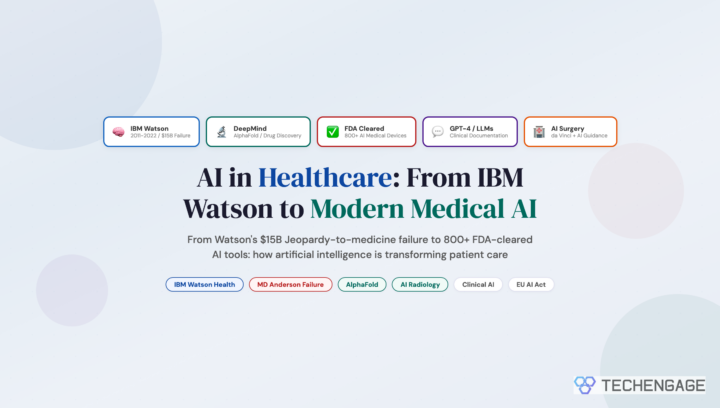
AI in healthcare covers several different jobs: identifying patterns in medical images, drafting clinical notes, supporting research and helping clinicians interpret information. A tool that performs one of those jobs well is not automatically qualified to diagnose a patient or choose treatment.
The useful questions are specific: what is the system intended to do, which patients was it evaluated on, and who checks its output? IBM Watson Health, AlphaFold and medical chatbots illustrate why those distinctions matter.
What happened to IBM Watson Health?
Watson Health is often described as one failed diagnostic computer. That shorthand hides a business containing different datasets, software products and clinical projects. Evaluating the entire portfolio as a single system gives a misleading account of both its capabilities and its sale.
On January 21, 2022, IBM announced an agreement to sell healthcare data and analytics assets that were part of Watson Health to Francisco Partners. The named assets included MarketScan, Micromedex and imaging software. IBM did not disclose the financial terms and said it remained committed to its broader Watson business.
A clinical product needs evidence for its particular task. A demonstration, a company acquisition or a successful research benchmark cannot establish that every system carrying the same brand improves patient outcomes.
Watson answering a game-show question in an earlier clip. Quiz performance is not clinical validation.
AlphaFold predicts structures, rather than proving treatments
AlphaFold is a research example with a more defined output: a predicted molecular structure. EMBL-EBI explains that AlphaFold models are assessed using predicted accuracy and confidence scores, rather than direct fit to experimental scattering or resonance measurements. Confidence can differ between regions of the same model.
A useful structural prediction can help a scientist decide what to investigate. It is not, by itself, experimental confirmation of a drug target, evidence that a medicine is safe, or proof that a treatment works in people. Those are separate questions requiring separate evidence.
What FDA authorization tells you
The FDA’s AI-enabled medical-device list identifies devices authorized for marketing in the United States. The agency describes review in relation to a device’s intended use and technological characteristics. Its list is not comprehensive, so a changing total should not be treated as a count of every medical AI product.
“Approved,” “cleared” and other authorization terms refer to different regulatory routes. A device’s database entry and supporting documentation are more informative than a headline saying “FDA-approved AI.” Look for the exact product, task and intended users. Authorization for one function does not extend to an unrelated chatbot or to every future use of the software.
Imaging assistance and surgical systems have different roles
Image-analysis tools and surgical systems should not be grouped together as if they perform the same job. For an imaging claim, ask what was measured: cancers detected during screening, missed cancers diagnosed later, false alarms and reader workload are different outcomes. An improvement in one measure does not establish an improvement in all of them.
The FDA’s explanation of computer-assisted surgery describes systems for planning, navigation and assistance with procedures. It says the robotically assisted surgical devices it describes require direct human control. A surgeon moving instruments through a console is not evidence of autonomous AI surgery. Discuss the particular procedure, alternatives and the clinician’s training when considering such a system.
Language models can produce plausible medical errors
Generating a consultation summary is a different task from making a diagnosis. The World Health Organization’s guidance on large multimodal models discusses documentation, patient queries, education and research, while warning that outputs can be false, incomplete or biased. Fluency can make an error harder to notice, especially when users defer to an automated answer.
For patients, the practical distinction is between a clinician using an appropriate tool within a care process and a general-purpose service responding without access to a complete medical assessment. A convincing answer or a score on an exam-style benchmark does not establish safe performance in an individual consultation.
Check whether a mental-health app is still available
Woebot Health says its app retired on June 30, 2025. New accounts cannot be created and previous users cannot access it. It should not be presented as an available mental-health support option.
A conversational interface also does not establish that a service can handle an emergency, deliver a particular therapy or arrange human care. Check the provider’s stated purpose and access arrangements before relying on it. This overview explains technology and evidence; it does not provide a diagnosis or treatment recommendation.
Questions to ask when AI is involved in care
The FDA’s transparency principles recommend explaining a device’s medical purpose, intended users, target population, evidence and limitations. These questions can help you discuss a particular tool with the care team.
- What task does this tool perform, and who makes the final decision?
- Was it evaluated for this condition and for people with characteristics like mine?
- What information is sent to the provider, who can access it, and how long is it retained?
- Can I review an AI-generated note and have an error corrected?
- What happens if the system is unavailable or its output conflicts with a clinician’s assessment?
Frequently asked questions
Did IBM sell all of Watson in 2022?
No. Its announcement concerned specified healthcare data and analytics assets within Watson Health. IBM said it remained committed to the broader Watson business.
Does an FDA listing authorize every use of an AI tool?
No. Read the particular device’s authorization and intended use. A listing is not a general endorsement of every use of AI in healthcare.
Does detecting more cancers mean fewer false negatives?
Those results need their own definitions and study evidence. Screening detection, interval cancers and false-positive recalls should be assessed separately.
Does a medical benchmark score establish clinical competence?
No. Answering exam-style questions does not establish that a system can assess a patient safely, manage treatment or practice medicine.
Does robotic surgery mean autonomous surgery?
No. The robotically assisted surgical devices described by the FDA require direct human control.
What should patients ask about healthcare AI?
Ask about its task, supporting evidence, clinician oversight, data handling and the process for correcting errors.
Correction, November 5, 2026: IBM did not disclose financial terms in its 2022 sale announcement, and Woebot retired in June 2025. An earlier version misstated those facts. Its claims of a 20% reduction in mammography false negatives and 15 to 20% shorter operations were not supported by the cited sources and have been withdrawn.




that actually looks like a lot of fun dude. Wow.
anonymize.it.tc
that actually looks like a lot of fun dude. Wow.
anonymize.it.tc
excellent article! thanks for point this out… watson is one smart pc
excellent article! thanks for point this out… watson is one smart pc
Hope it really makes no mistake.
Hope it really makes no mistake.