
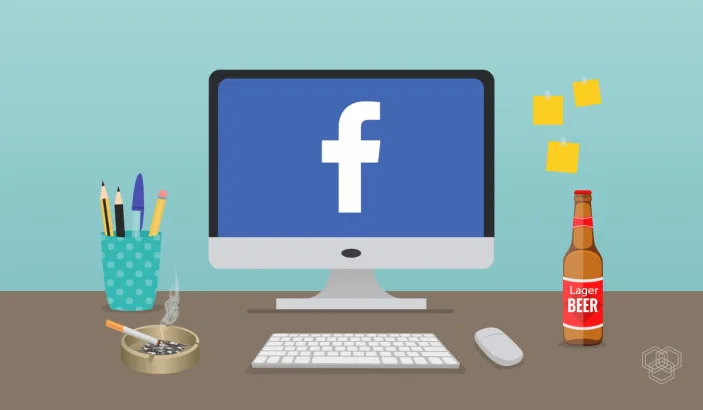
Everyone has spoken these words, “Hey man, I think you might actually be addicted to Facebook,” at least once in their life to someone close to them. Turns out there might be more to this than just playful teasing. Researchers from Michigan State University have found a strong correlation between social media use and addictive behavior.
Their paper, titled “Excessive social media users demonstrate impaired decision making in the Iowa Gambling Task,” published in the Journal of Behavioral Addictions demonstrated how excessive Facebook use is linked to bad decision making and impulsive behavior, which are also characteristics of people with drug addictions.
The researchers asked 71 participants to measure their Facebook usage using the Bergen Facebook Addiction Scale. Participants were asked questions about the amount of time they spent on the social media network, their feelings when unable to surf Facebook, attempts to quit the social network platform, and the impact Facebook had on their jobs or lives.
Researchers then compared the Facebook usage with the Iowa Gambling Task (IGT), a popular measure tool that calculates impaired decision making.
The Iowa Gambling Task evaluates decision making capability by presenting test subjects with four virtual card decks. Participants are then asked to choose cards from the decks in a manner that will get them the maximum winnings possible.
Researchers had told the participants in advance that some decks were good while others were bad, so they should avoid the bad decks and choose cards from the decks that were better, even if it meant not being rewarded as quickly. Subjects who considered themselves as excessive Facebook users performed poorly on the IGT compared to other participants. They constantly chose the bad decks that offered quick rewards but ultimately resulted in an overall loss.
The results were significantly different for users who were able to control their social media usage; they were able to assess the decks more carefully. These participants were more likely to appreciate the risks associated with the bad decks.
IGT has previously been used to measure addiction levels in heroin users and evaluate the mental capabilities of people with frontal lobe impairments. Using IGT to assess social media addiction is a groundbreaking concept.
The researchers extrapolated on the concept of addiction for their study and applied this existing addiction testing framework to analyze social media addiction, an addiction that is often overlooked.
The study suggested that social media addicts make bad, irrational, and impulsive decisions, similar to those of gambling or drug addicts.
The study poses the questions as to why social media addiction isn’t being treated as an illness similar to other addictions. Implementing stricter rules and banning social media sites altogether is not the solution, as addicts always find a way to continue their addiction. Getting likes and new followers give users a dopamine rush, which is part of what makes social media so addictive.
Psychologists and lawmakers (and, of course, users and parents) need to look at the root causes of social media addiction, especially social factors like social isolation, a lack of close friends, poor relationships, and feelings of loneliness. Recognizing these factors and alerting people to them will be an integral part of any public health campaign aimed at combatting social media addiction.
We need to figure out what is making users turn away from the real world and flee their responsibilities in a way that negatively affects their lives. In the meantime, we still need more data on the harmful effects of social media. Maybe then social media addiction will be considered an actual mental illness.
One solution for those headed towards addition may be new apps that help limit onscreen times. At first, it might seem counterintuitive to use technology to fight social media addiction, but it could be a small, positive step towards correcting one’s behavior.




Share Your Thoughts