

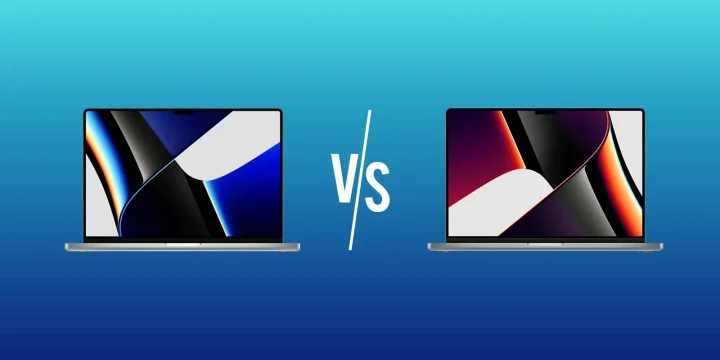
When Apple launched the M1 Pro and M1 Max chips inside the redesigned 14-inch and 16-inch MacBook Pro in late 2021, they redrew the map for what a laptop could do. Years later, those machines are no longer Apple’s newest — the line has since moved through M2, M3, and the current M4 Pro and M4 Max — but the M1 Pro and M1 Max remain fast, capable, and, crucially, excellent value on the used and refurbished market. If you’re deciding between the two today, the same questions apply now as then: where’s the real difference, and do you actually need the pricier Max?
Here’s a clear, no-hype breakdown of how the M1 Pro and M1 Max compare, and how to choose the right one in 2026.
M1 Pro vs. M1 Max: specs at a glance
| Specification | Apple M1 Pro | Apple M1 Max |
|---|---|---|
| CPU cores | Up to 10 (8 performance + 2 efficiency) | 10 (8 performance + 2 efficiency) |
| GPU cores | 14 or 16 | 24 or 32 |
| Max unified memory | 32GB | 64GB |
| Memory bandwidth | 200GB/s | 400GB/s |
| Transistors | 33.7 billion | 57 billion |
| ProRes media engines | 1 | 2 |
| Available in | 14″ and 16″ MacBook Pro | 14″ and 16″ MacBook Pro |
CPU: nearly identical
This is the part that surprises people: for raw processor work, the M1 Pro and M1 Max are essentially the same chip. In their full configuration both use a 10-core CPU — eight high-performance cores plus two efficiency cores — and those cores are identical between the two. That means compiling code, running spreadsheets, browsing, and everyday multitasking feel the same on either chip.
The practical takeaway: if your workload is CPU-bound rather than graphics-bound, paying extra for the Max buys you almost nothing in processor speed. The differences live entirely in the graphics and memory subsystems.
GPU: this is the real difference
Graphics is where the Max earns its name. The M1 Pro tops out at a 16-core GPU, while the M1 Max doubles that to a 32-core GPU (both also come in cut-down 14-core and 24-core versions respectively). On paper and in practice, the M1 Max delivers roughly twice the graphics horsepower of the M1 Pro.
For most people, that gap simply doesn’t matter — web work, writing, photo editing, and light video all run beautifully on the M1 Pro. It starts to matter when you push heavy, sustained GPU loads: 3D rendering, high-resolution video timelines, complex effects, and machine-learning work. If your day involves those, the Max’s extra GPU cores translate into meaningfully faster exports and smoother playback.
Memory and bandwidth
Both chips use Apple’s unified memory, where the CPU and GPU share one fast pool. The ceilings differ: the M1 Pro supports up to 32GB of unified memory, while the M1 Max goes up to 64GB. Just as important, the M1 Max has 400GB/s of memory bandwidth — double the M1 Pro’s 200GB/s.
That bandwidth is what lets the Max feed its larger GPU without starving it, and the higher memory ceiling matters if you juggle enormous files — think multi-layer 8K video projects or large 3D scenes. If you routinely open everything at once and see memory pressure, the Max’s headroom is the single best reason to choose it.
Media engine: ProRes acceleration
Both chips include Apple’s dedicated media engine for hardware-accelerated video encoding and decoding, but the M1 Max has two ProRes accelerators to the M1 Pro’s one. For video editors working in ProRes, that means the Max can handle more simultaneous high-resolution streams and faster ProRes exports. For anyone not living in a professional video pipeline, it’s a non-factor.
14-inch vs. 16-inch: it’s about the chassis, not the chip
Both chips are offered in the 14-inch and 16-inch MacBook Pro, so your choice of screen size is separate from your choice of chip. The differences come down to the body: the 16-inch has a larger display, a bigger battery for longer runtime, and a more generous thermal system that can sustain peak performance a little longer under heavy load. The 14-inch is far more portable and still remarkably powerful. Pick the size that fits your desk and your bag; then pick the chip that fits your workload.
What the difference looks like in real work
Specs only mean so much, so here’s how the gap shows up in practice. Open a browser with 30 tabs, run a code editor, and export a batch of RAW photos, and you’d struggle to tell the two chips apart — both feel instant, because that’s CPU and light-GPU work. Now switch to scrubbing a multi-layer 4K video timeline with effects, or rendering a 3D scene: the M1 Max pulls ahead, finishing exports faster and keeping playback smoother because its extra GPU cores and doubled bandwidth are finally being used. In short, the harder and more graphics-heavy the task, the wider the Max’s lead — and the lighter the task, the more the M1 Pro looks like the smarter spend.
Which should you buy in 2026?
Because these are now previous-generation machines, they’re a smart value buy rather than a new-flagship purchase. Here’s how to decide:
- Choose the M1 Pro if you do coding, writing, office work, photo editing, web development, or light-to-moderate video. It handles the vast majority of professional workloads without breaking a sweat, and it’s the better value.
- Choose the M1 Max if you do sustained heavy graphics work — 4K/8K video editing, 3D rendering, motion graphics, or ML — and you’ll benefit from the doubled GPU, 64GB memory ceiling, and dual ProRes engines.
- Buying used or refurbished? Prioritize memory and storage over the chip tier. A 32GB M1 Pro will outlast an 8GB-equivalent bargain, and storage can’t be upgraded later on Apple Silicon.
How do they hold up against Apple’s latest chips?
Apple has since released the M2 Pro/Max, M3 Pro/Max, and the current M4 Pro and M4 Max, each adding CPU and GPU performance, better efficiency, and newer features. If you need the absolute fastest machine or the longest software-support runway, a current M4 model is the buy. But the M1 Pro and M1 Max were built on the same modern Apple Silicon architecture and still comfortably handle demanding 2026 workloads — which is exactly why they hold their value and remain a sensible choice for anyone shopping smart rather than shopping new.
FAQs
Is the M1 Max worth it over the M1 Pro?
Only if you do heavy graphics or video work. The Max’s advantages are all in the GPU, memory ceiling, and ProRes engines. For CPU-focused tasks the two perform the same, so most users are better served by the M1 Pro.
What is the actual difference between M1 Pro and M1 Max?
The CPU is essentially identical. The Max doubles the GPU cores (up to 32 vs. 16), doubles memory bandwidth (400GB/s vs. 200GB/s), raises the memory ceiling to 64GB, and adds a second ProRes media engine.
Are M1 Pro and M1 Max MacBooks still good in 2026?
Yes. They remain fast and capable for coding, content creation, and most professional work. They’re no longer Apple’s newest chips, but they hold their value and are strong buys on the used and refurbished market.
How much memory should I get?
For general professional use, 16GB is a comfortable minimum and 32GB is ideal. Only heavy video and 3D workflows genuinely need the M1 Max’s 64GB. Since memory is soldered on Apple Silicon, buy more than you think you need up front.
The bottom line
The M1 Pro and M1 Max share the same CPU and the same design — the Max simply adds graphics muscle, memory headroom, and video-encoding power for professionals who need it. Most people will be happier and better off with the M1 Pro, saving money for more memory or storage. Choose the Max only if sustained GPU or high-end video work is genuinely part of your day. Either way, in 2026 both remain some of the best-value professional laptops you can buy.




Share Your Thoughts