

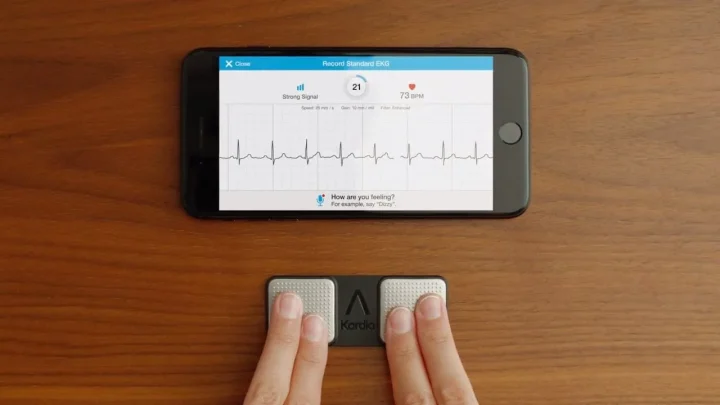
AliveCor’s six-lead personal ECG was a development story in 2018, not an already established replacement for a clinical ECG. The device was later marketed as KardiaMobile 6L, with FDA clearance announced in May 2019. Its additional electrical views do not establish that it diagnoses every heart condition or is universally more accurate than Apple Watch.
Correction, November 5, 2026: The earlier article confused ECG leads with physical electrodes, overstated comparative accuracy and diagnostic capabilities, and treated a breakthrough-device designation as market approval. The timeline and limitations below have been corrected.
The 2018 context and subsequent clearance
Apple’s 2018 FDA De Novo record for the ECG app describes a single-channel recording similar to Lead I. Its intended role was to help distinguish atrial fibrillation from sinus rhythm on a classifiable recording, with important limitations. That regulatory record does not support calling the app a universal cardiac diagnostic tool.
AliveCor announced KardiaMobile 6L clearance on May 13, 2019 and said availability would follow in June. Its FDA record under the Triangle System name describes recording Lead I and Lead II and deriving the other limb leads. This later milestone should be distinguished from the company’s plans at the time of the original September 2018 story.
Six leads do not mean six attached stickers
A lead is an electrical view of the heart; an electrode is a physical contact used to collect the signal. AliveCor’s announcement describes two contacts on top of KardiaMobile 6L and another underneath, allowing six limb-lead views. The number of views should not be confused with the number of contacts.
More views can provide additional information, but usefulness depends on the condition, recording quality, software and clinical interpretation. A lead count by itself is not a comparative-accuracy study. Check each diagnostic claim against the model’s permitted uses and supporting evidence.
The hyperkalemia project was a separate claim
In September 2018, AliveCor reported a Breakthrough Device designation for KardiaK, a software project intended to screen for elevated blood potassium using ECG data. This was a separate development program, rather than proof that every KardiaMobile recording could measure potassium or diagnose hyperkalemia.
The FDA explains that its Breakthrough Devices Program expedites development, assessment and review. A designation is different from marketing authorization, and a device must still meet the relevant safety and effectiveness standards. Do not read a development designation as approval for every proposed use.
What the ECG result does not settle
Apple’s current ECG guidance says its app cannot detect a heart attack, blood clot or stroke. A sinus-rhythm result applies to that recording and is not a general certificate of good health. App availability, intended age and supported hardware also matter.
A personal recording may give a clinician useful information, but it should not be treated as a complete diagnosis or a reason to change medication without advice. If you have chest pain, pressure, tightness or symptoms that may be a heart attack, seek emergency help rather than waiting for a reassuring wearable result.
For another example of the distinction between proposed capabilities and established medical uses, see AI in healthcare. Our autism-robotics research explanation discusses study limits, and Science & Health Tech carries related reporting.





Share Your Thoughts