

A generation ago, knowing how to type was considered a bonus skill. Today, typing is assumed. Coding is following the same trajectory. Children who learn programming fundamentals early don’t just gain a technical skill; they develop a structured approach to thinking that transfers to every academic subject and, eventually, every profession. The question isn’t really whether kids should learn to code. It’s why we waited this long to make it a priority.
This isn’t about turning every child into a software engineer. It’s about giving them fluency in the language that drives the modern world. From the apps on their phones to the algorithms that decide what they see online, code shapes daily life in ways most adults barely understand. Kids who grasp these fundamentals will be better equipped to navigate, question, and ultimately build the technology around them.
Coding Teaches Problem-Solving, Not Just Programming
When a child writes a program, they’re doing something that looks deceptively simple: breaking a big problem into smaller pieces, testing each piece, and assembling a working solution. Computer scientists call this computational thinking, and it shows up in fields far removed from technology. A doctor diagnosing symptoms, a lawyer constructing an argument, an architect planning a building, they’re all using the same logical decomposition that coding teaches naturally.
Research from Code.org and studies funded by Google and Gallup consistently show that students who learn coding score higher in math and reading comprehension. The connection makes sense: programming requires precise logical thinking, attention to sequence, and the ability to debug errors systematically. These are the same cognitive muscles that standardized tests measure.
What makes coding unique as a teaching tool is the instant feedback loop. Write code, run it, see what happens. If it breaks, the error message tells you roughly where to look. Kids learn to treat failure as data rather than defeat. That mindset shift alone is worth the effort.
It’s as Natural as Learning a New Language
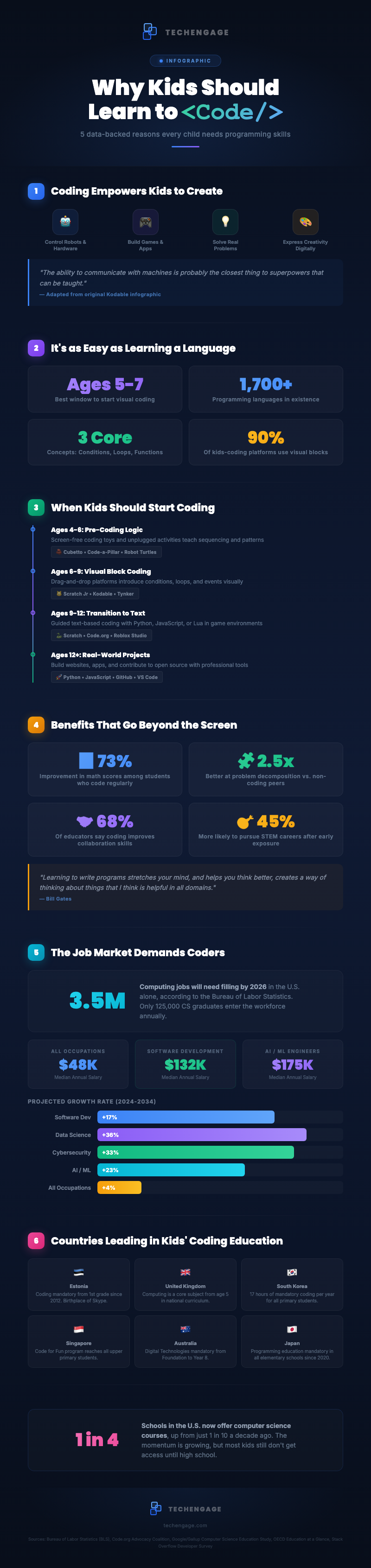
Young brains are wired for pattern recognition and language acquisition. Programming languages, despite the intimidating syntax, are ultimately just structured sets of rules, exactly like spoken languages. The best time to start is between ages 5 and 7, when children are already in their prime language-learning window. Visual coding platforms like Scratch (developed at MIT) and Kodable take advantage of this by letting kids snap together colorful blocks instead of typing syntax.
Three foundational concepts underpin virtually every programming language ever created: conditions (if this happens, do that), loops (repeat this action), and functions (save a set of steps to reuse later). Kids pick these up intuitively through game-based platforms because the concepts map directly to how they already think. “If the path is blocked, turn right” is a condition. “Keep walking until you reach the end” is a loop. A child who understands these patterns at age seven will find Python or JavaScript far less intimidating at age twelve.
Estonia recognized this early. The small Baltic nation, birthplace of Skype, made coding mandatory for first graders back in 2012. The United Kingdom followed by embedding computing as a core subject from age five. South Korea, Japan, Singapore, and Australia have all integrated coding into their national curricula. The U.S. is catching up, but unevenly: only about 1 in 4 schools currently offer computer science courses.
The Right Age and the Right Tools
One of the most common mistakes parents make is thinking coding means staring at a screen full of text. For younger kids, the best entry point is actually screen-free. Toys like Cubetto (a wooden robot that follows physical coding blocks) and ThinkFun’s Robot Turtles board game teach sequencing and logic without any screen time at all. These unplugged activities are ideal for ages four through six.
Between ages six and nine, visual block-based platforms hit the sweet spot. ScratchJr is designed specifically for this age group, with simplified drag-and-drop blocks and character animation. Kodable gamifies the experience with puzzle-like levels that introduce conditions and loops. Tynker bridges block coding with more complex projects, including Minecraft modding, which is a powerful motivator for kids already invested in that world.
By age nine or ten, many kids are ready to transition toward text-based coding. Codecademy and Khan Academy’s computing courses offer structured pathways. Python is the most popular starting language for this age group because its syntax reads almost like English. Roblox Studio, which uses Lua scripting, is another compelling option because kids can build games their friends actually play.
Teenagers ready for real-world projects can dive into JavaScript for web development, Python for data science and automation, or Swift for iOS app development. GitHub, VS Code, and collaborative coding platforms give them access to the same tools professionals use.
Benefits That Extend Far Beyond the Computer
The case for teaching kids to code doesn’t rest on career prospects alone. Multiple studies point to broader cognitive and social benefits that persist regardless of whether a child ever writes code professionally.
Math performance improves measurably. A study published in the Journal of Educational Psychology found that students who participated in coding programs showed significantly higher scores on standardized math assessments compared to control groups. The improvement was most pronounced in areas involving pattern recognition, logical reasoning, and spatial thinking.
Collaboration skills develop naturally. Coding projects, especially in classroom settings, involve pair programming, code reviews, and team-based problem solving. Kids learn to articulate their thinking clearly, give and receive constructive feedback, and divide complex tasks among team members. These are the same collaboration skills that employers consistently rank among the most desired traits in job candidates.
Resilience and persistence strengthen. Every program has bugs. Every bug requires systematic investigation. Kids who code learn that the path from “it doesn’t work” to “it works perfectly” is paved with incremental fixes and creative workarounds. Bill Gates put it well: coding “stretches your mind, and helps you think better, creates a way of thinking about things that I think is helpful in all domains.”
Creative expression finds new outlets. Coding isn’t just logic; it’s a creative medium. Kids build interactive stories, compose algorithmic music, design animations, and create digital art. For children who struggle with traditional artistic mediums, programming offers an alternative creative channel that rewards both imagination and precision.
The Job Market Reality
Even if coding’s educational benefits were modest, the economic argument would be overwhelming. The Bureau of Labor Statistics projects that computing occupations will grow significantly faster than the national average through 2034. Software development alone is expected to grow 17%, data science roles by 36%, and cybersecurity positions by 33%. The average growth rate across all occupations sits at just 4%.
The salary differential is equally stark. The median annual wage for all occupations in the U.S. is approximately $48,000. For software developers, it’s $132,000. AI and machine learning engineers command median salaries around $175,000. These aren’t niche roles anymore; they represent some of the largest and fastest-growing job categories in the economy.
The supply side tells an even more urgent story. The U.S. produces roughly 125,000 computer science graduates annually, but the economy needs to fill an estimated 3.5 million computing-related positions by 2026. That gap won’t close by itself. Children who start learning programming concepts today will enter a job market that is practically desperate for their skills.
And this isn’t limited to traditional tech companies. Healthcare, agriculture, manufacturing, finance, entertainment, virtually every industry now depends on software. A child who learns to code has options in nearly any field they’re passionate about. Combine coding with an interest in biology and you get bioinformatics. Pair it with music and you get audio engineering. Mix it with journalism and you get data-driven reporting.
Countries That Are Getting It Right
Several nations have moved beyond pilot programs and made coding a core part of childhood education. Their experiences offer both inspiration and practical lessons.
Estonia has been the global pioneer. Since 2012, every first grader in the country learns programming fundamentals. The initiative is part of a broader digital society push that also made Estonia the first country to offer e-residency and online voting. The results speak for themselves: Estonia consistently ranks among the top performers in PISA assessments for math and science.
The United Kingdom overhauled its entire ICT curriculum in 2014, replacing passive computer literacy lessons with active computing education. Children as young as five learn about algorithms and simple programs. By age 11, students are expected to use at least two programming languages. The change was controversial at the time but is now widely regarded as successful.
Singapore’s Code for Fun program reaches all upper primary students through a partnership between the Infocomm Media Development Authority and the Ministry of Education. The program emphasizes computational thinking through robotics and block-based coding, with a clear pathway into more advanced secondary school computing courses.
Japan made programming education mandatory in all elementary schools starting in 2020. Rather than teaching a specific language, the Japanese approach integrates computational thinking across existing subjects, using coding to explore math concepts, simulate science experiments, and create interactive social studies projects.
How to Get Your Child Started
The practical path depends on your child’s age, interests, and how much screen time you’re comfortable with. Here’s a realistic starting framework.
For kids under six, keep it physical. Board games like Robot Turtles, LEGO coding kits, and the Cubetto robot teach sequencing and conditional logic through tactile play. No screen required, no prior knowledge needed from parents.
For ages six through nine, introduce visual coding through Scratch, ScratchJr, or Kodable. Set aside 20 to 30 minutes, two or three times per week. Don’t push marathon sessions; short, consistent practice builds comfort and confidence. If your child is into gaming, Tynker’s Minecraft integration or Code.org’s Minecraft-themed hour of code are excellent hooks.
For ages nine through twelve, explore Python through guided platforms. Codecademy, Khan Academy, and Replit all offer free or affordable courses designed for beginners. If your child gravitates toward game design, Roblox Studio provides an engaging environment for learning Lua scripting while building something they actually care about.
For teenagers, the options expand dramatically. Free resources like freeCodeCamp, The Odin Project, and MIT’s OpenCourseWare provide university-level instruction at zero cost. Local coding bootcamps, hackathons, and competitive programming contests add social motivation and real-world experience. Check if your child’s favorite devices offer developer modes or APIs they can experiment with.
What Parents Should Know
You don’t need to know how to code to support your child’s learning. Most platforms are designed for independent use, with built-in tutorials and progressive difficulty curves. Your role is encouragement and consistency, not instruction.
Screen time concerns are valid but manageable. Coding is active screen time, not passive consumption. A child building a Scratch project is exercising creativity, logic, and problem-solving in ways that watching YouTube videos simply doesn’t. That said, balance still matters. Mix coding sessions with physical activity, reading, and unstructured play.
Cost shouldn’t be a barrier. Scratch is completely free. Code.org is free. Khan Academy is free. Python is free. Many libraries and community centers offer free coding clubs. The paid platforms (Tynker, Kodable, Codecademy Pro) offer polished experiences but aren’t strictly necessary. A basic laptop with a web browser is genuinely all the hardware required to start.
Perhaps most importantly: follow your child’s interests. If they love art, point them toward creative coding with p5.js or Processing. If they’re obsessed with Minecraft, show them how to build mods. If they’re into science, introduce them to data collection and visualization. The best coding education doesn’t feel like education at all. It feels like play with a purpose.
Frequently Asked Questions
What is the best age for kids to start learning to code?
Most experts recommend starting with pre-coding logic activities (unplugged games, coding toys) around age 4-5, then transitioning to visual block-based platforms like ScratchJr or Kodable between ages 5-7. This aligns with the natural language-learning window when children absorb pattern-based systems most effectively.
Do kids need a computer to learn coding?
Not initially. Several screen-free coding toys and board games teach programming logic through physical play. Cubetto, Robot Turtles, and LEGO coding kits are popular options for young children. Once kids are ready for digital platforms (typically around age 6), a basic laptop or tablet with a web browser is sufficient.
Which programming language should kids learn first?
For children under 9, visual block-based languages like Scratch are ideal because they eliminate syntax errors and focus on logic. For ages 9-12, Python is the most recommended first text-based language due to its readable syntax and versatility. JavaScript is another strong option, especially for kids interested in web development or interactive projects.
Will coding still be relevant with AI writing code?
AI tools like code assistants are changing how software is built, but they haven’t eliminated the need for human programmers. Understanding coding logic is becoming more important, not less, because someone needs to direct AI tools, verify their output, and solve problems that AI can’t handle independently. Computational thinking skills remain valuable regardless of how much code AI generates.
How much does it cost to teach kids to code?
It can cost nothing. Scratch, Code.org, Khan Academy, Python, and freeCodeCamp are all completely free. Paid platforms like Tynker and Kodable offer premium features for $5-$10 per month but are optional. The only hardware requirement is a basic computer with internet access.
Is coding only useful for kids who want to become programmers?
No. Coding teaches transferable skills like logical thinking, problem decomposition, debugging, and systematic reasoning that benefit students in any field. Students who code perform better in math, science, and reading comprehension. Many professions outside of tech, from medicine to journalism to agriculture, increasingly rely on data analysis and automation skills that coding provides.




Share Your Thoughts