

You are halfway through a film on your laptop and you want it on the big screen instead. The file is sitting on your hard drive, not on a streaming service, so there is no “cast” button to press in a browser tab. This is exactly the job VLC’s built-in Chromecast support was made for — and it has been part of VLC since version 3.0, so you almost certainly already have it.
Below is how to cast from VLC on Windows, macOS, Android and iPhone, plus the certificate prompt that trips up most first-timers and the reasons casting sometimes stutters when the file itself plays perfectly.
What you need
- A Google Cast target on your TV. An old Chromecast, a Chromecast with Google TV, the newer Google TV Streamer that replaced the Chromecast line in 2024, a TV with Chromecast built in, or an Android TV / Google TV set. Cast speakers work too, for audio.
- VLC media player 3.0 or newer. Earlier builds do not expose the Renderer entry at all. The current stable desktop release is 3.0.23 (January 2026) and the Android app is on the 3.6.x line; VLC 4.0, with a rebuilt interface and media library, is still in nightly development, so 3.0.x is what most people are running.
- Both devices on the same Wi-Fi network. This is the most common failure point — see the troubleshooting section on guest networks and band separation.
How to cast from VLC on Windows or macOS
The desktop route uses the Renderer menu. You can select the renderer before or during playback:
- Open your video in VLC as normal.
- Go to the Playback menu in the menu bar.
- Select Renderer. VLC scans the network and lists the Cast devices it finds — give it a few seconds on first use.
- Choose your device from the list. If nothing appears yet, select Scan or reopen the menu after a moment.
- Approve the certificate prompt. VLC will usually warn you about an insecure site or an untrusted certificate the first time you cast to a device. Choose View certificate and then Accept permanently so you are not asked again for that device.
- Playback moves to the TV. Your laptop becomes the remote — play, pause, seek and volume are all still controlled from VLC.
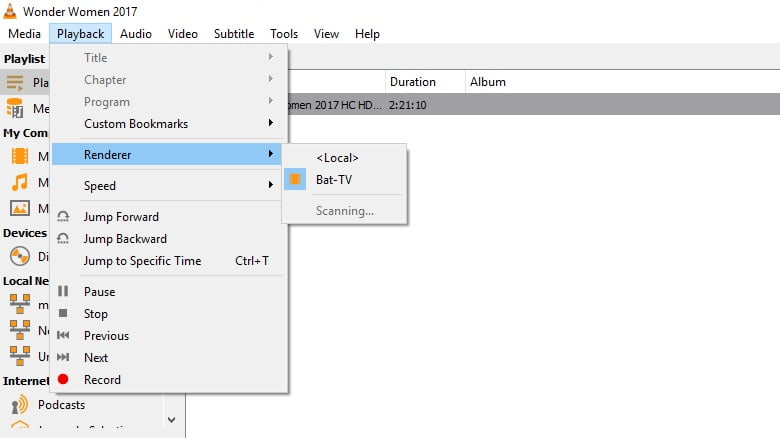
To stop casting, go back to Playback → Renderer and pick Local. Playback returns to your computer. Note that the renderer choice is sticky — if VLC seems to be “playing” with no picture on your screen later, check whether it is still pointed at the TV.
How to cast from VLC on Android
The Android app puts casting front and centre rather than burying it in a menu:
- Open VLC for Android and start the video or track you want.
- Tap the Google Cast icon in the top-right corner of the screen.
- Pick your device from the list that appears.
- Accept the certificate prompt if you are shown one, and playback moves to the TV with your phone acting as the remote.
You can also set this up before playing anything: tap the Cast icon from the library screen, choose your device, and everything you open afterwards goes straight to the TV until you disconnect.
How to cast from VLC on iPhone or iPad
VLC for iOS gained Chromecast support in version 3.1 and it works much like the Android app — which makes it one of the few straightforward ways to get a local video file from an iPhone onto a Chromecast without converting it first.
- Open VLC for iOS and play your file.
- Tap the Cast icon in the player controls.
- Select your Chromecast or Google TV device and confirm any certificate warning.
One iOS-specific note: VLC needs local network permission to discover Cast devices. If the device list is empty, check Settings → VLC → Local Network on your iPhone and make sure it is allowed.
Casting is not screen mirroring — and that is a good thing
It is worth understanding what is actually happening, because it explains most of the problems people hit.
When you mirror a screen, your laptop captures its display and sends a live video feed of it. Everything on the screen goes to the TV, quality suffers, and closing the lid ends the show. When you cast from VLC, VLC hands the media stream itself to the Chromecast and steps back into a remote-control role. The picture is sharper, you can carry on using your computer for other things without it appearing on the TV, and playback is more stable.
The catch is that your computer is still serving the file, so it needs to stay awake and on the network. If you want to mirror an Android device on your TV instead — for apps, photos or anything that is not a media file — that is a different feature entirely.
Which files cast smoothly, and which make your fans spin
A Chromecast can only decode certain codecs. When your file is in a format the device supports, VLC passes the stream straight through and your computer barely notices. When it is not, VLC transcodes the video on the fly — re-encoding it in real time on your CPU as it plays.
That is why the same file can play flawlessly in a VLC window and then stutter the moment you cast it. Signs you are transcoding: the fans ramp up, the laptop gets hot, playback hitches every few seconds, and seeking becomes slow. What helps:
- Prefer H.264/AAC in an MP4 or MKV container. This is the most widely supported combination and usually plays without re-encoding.
- Expect trouble from exotic formats. Very high-bitrate 4K files, unusual audio tracks and older or niche codecs are the ones most likely to force a transcode.
- Plug in, both ways. A laptop on battery throttles its CPU, which makes transcoding stutter worse. If your Cast device supports Ethernet — the Google TV Streamer does — a wired connection removes Wi-Fi from the equation.
- Close the heavy apps. Transcoding wants the CPU that your browser tabs are currently holding.
- Convert once instead of transcoding every time. If it is a file you will watch repeatedly, converting it to H.264/AAC in advance is less painful than re-encoding it live on every play.
Troubleshooting VLC casting
My Chromecast does not appear in the Renderer list
Almost always a network issue rather than a VLC one. Work through these:
- Confirm both devices are on the same network — not the guest network, and not one on 2.4GHz while the other is on a separate 5GHz SSID.
- Turn off any VPN on your computer. A VPN routes your traffic elsewhere and hides local devices from discovery.
- Check that AP isolation (sometimes called client isolation) is off on your router. It is designed to stop devices seeing each other, which is precisely what breaks Cast discovery.
- Allow VLC through your firewall, and on macOS check the local network permission for VLC in System Settings → Privacy & Security.
- Reopen the Renderer menu — discovery is not instant, and the list populates a few seconds after you open it.
The certificate warning keeps coming back
You accepted it for that session only. Next time, select View certificate and then Accept permanently rather than the temporary option.
Video plays but there is no sound
Usually an audio track the Cast device cannot handle — multi-channel or less common surround formats are the frequent culprits. If the file has more than one audio track, switch to a stereo AAC track under Audio → Audio Track and try again.
Playback stutters or drops out
Either transcoding is overloading your CPU or Wi-Fi cannot keep up. Test with a small, ordinary H.264 MP4 file first: if that casts cleanly, the problem is the original file’s format, not your setup. Otherwise it is the network — move closer to the router, or use Ethernet on the Cast device.
Subtitles are not showing on the TV
Subtitle handling over Cast is one of the rougher edges of this feature and behaviour varies with the file and the device. If an external subtitle file will not appear, the reliable workaround is to mux the subtitles into the video file beforehand, or to play locally and accept the smaller screen for subtitled content.
Casting stops when I close my laptop
Expected. Your computer is the source of the stream, so sleeping it ends playback. Adjust your sleep settings, or copy the file onto a USB drive and plug it into the TV if you want the laptop out of the loop entirely.
FAQs
Does VLC casting work with the Google TV Streamer?
Yes. The Streamer is a Google Cast target like the Chromecasts before it, so it shows up in VLC’s Renderer list the same way. Its Ethernet port is a real advantage for high-bitrate files.
Can I cast to an Apple TV from VLC?
Not through the Renderer menu — that is for Google Cast devices. Apple TV uses AirPlay, so on a Mac or iPhone you would use AirPlay rather than VLC’s casting feature.
Can I cast a DVD, a Blu-ray or a network stream?
Casting is built for media files and streams that VLC can open and re-serve. Disc playback and some protected or unusual sources are unreliable over Cast; local files are what this feature does well.
Do I need VLC 4.0 for better casting?
No. VLC 4.0 is a large rework — new interface, media library, VR and 3D video support, a rebuilt audio pipeline — but it is still in nightly development. The stable 3.0.x line is where Chromecast support lives today, and keeping it up to date is the useful step.
Can I cast audio only, to a speaker?
Yes. Cast-enabled speakers and speaker groups appear in the Renderer list alongside video devices, so VLC can push a music library to them the same way.
The short version
On a computer: Playback → Renderer → your device, accept the certificate permanently, and use VLC as the remote. On a phone: tap the Cast icon in VLC for Android or iOS. If the device will not appear, the problem is nearly always the network — same Wi-Fi, no VPN, no AP isolation. And if a file plays fine locally but stutters on the TV, that is transcoding, not a broken Chromecast: an H.264/AAC MP4 will usually go straight through untouched.
If you have a question about casting from VLC, leave it in the comments below.


Hi, I was wondering if it helps to put the casting device close to the physical location of the chromecast if the file you are casting is stored locally on the casting device.
More details; say I want to cast a 1080p recorded video to the chromecast through vlc via a laptop, the casting isn’t smooth (lagg, probably because upload speed over wifi is slow?)
Since I’m not casting from Netflix/YouTube, but a file stored on the laptop, I imagine that communication is a direct one between the chromecast and the laptop. (and not a more complex communication, between the router & laptop & chromecast)?
Hope to get answers, thx
And what About subtitels? Vlc doesn’t stream subtitels.
Unfortunately, VLC doesn’t support subtitles on Chromecast. Maybe in the future, we never know.
My Playback Renderer is on Local, the Synchronizing is greyed out.
What can I do to make the Vic See My chromecast?