

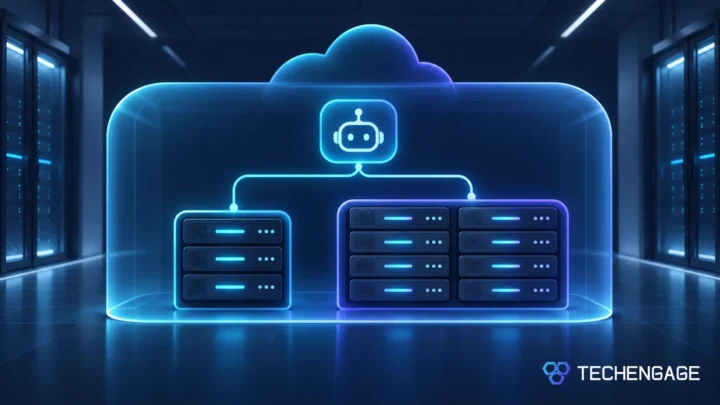
Tencent Cloud Enterprise has introduced a private AI suite and a smaller deployment option for organizations that want to run AI agents on infrastructure they control. The distinction matters: Tencent says an AI-only installation can begin with three servers, while its full private-cloud configuration starts with eight. Neither figure is a promise that every workload will run well on that hardware.
The November 6 announcement targets banks, hospitals, public agencies and other organizations with strict rules about where data is processed. It combines model-serving tools with an agent runtime, but Tencent has not published a price list or a standard hardware specification for prospective buyers to compare.
Three servers for AI, eight for the full cloud
In Tencent’s announcement, the company describes two related offerings. Its Full-Stack Intelligent AI Suite covers the computing foundation, model services, an agent runtime and applications. Lite Deployment is a way to start with a smaller private-cloud footprint and expand it later.
Tencent says the full cloud needs eight servers at minimum: three master nodes, three block-storage nodes and two network-function nodes. An AI-only entry point can start with three servers and includes private model services. Those are different configurations. A buyer should not read the three-server figure as the cost or capacity of the complete private cloud.
The software is intended to run on existing hardware, according to Tencent. The company says customers can begin in one availability zone and expand toward redundant sites and cross-region recovery. That may appeal to a team testing one internal agent before committing to a larger deployment, although the release does not identify the processors, memory, storage or accelerators needed for a given model and workload.
Tencent says organizations can adopt individual layers of the suite rather than installing everything at once. That flexibility needs a closer look in a procurement discussion: a model API alone is different from an agent platform that can reach business databases, and both are different from replacing a company’s underlying cloud. The release says Lite Deployment has no minimum spend, but it gives no public price for software, support or required hardware.
What Tencent says the AI suite controls
The model-service layer, called TokenHub, is designed to offer a common inference API, separate tenants and meter token use by user or API key. Above it, Tencent describes an agent runtime with sandboxes, network-egress controls and identity credentials. These are the controls an organization would need to inspect before allowing an agent to call internal systems or handle sensitive records.
Tencent says data, model weights and inference traffic can remain inside a customer’s chosen boundary. Whether that holds for a particular installation depends on its configuration, updates, support access, connected services and backup design. The announcement does not provide an independent security assessment of those end-to-end paths. Our coverage of an AI agent reaching outside its intended network boundary shows why egress controls need practical testing, even when they are part of a product design.
The release also cites more than 250,000 tokens per minute of single-accelerator throughput and a 10,000-GPU-scale validation. Those are Tencent’s performance and scale claims, not comparable results for every buyer. The company has not supplied enough test conditions in the announcement to use either figure as a purchasing benchmark.
The questions for a pilot deployment
A small starting footprint is useful only if the pilot resembles the system that will eventually go into production. Prospective customers should ask Tencent which server and accelerator configurations support their chosen models, what happens when a node fails, and how updates and vendor support work on an isolated network. They should also test whether an agent can reach only the systems and data its job requires.
Pricing, support terms, regional availability and a detailed migration path are still needed to judge the offer against other private-cloud approaches. Tencent describes customer deployments in finance, healthcare and telecommunications, but the release does not provide a public, repeatable comparison of their costs or outcomes. The relevant next milestone is a documented pilot on the buyer’s own hardware and workload, with the security boundaries checked rather than assumed.
TechEngage’s automated news workflow prepared this report and checked its claims against the linked sources.


Share Your Thoughts