

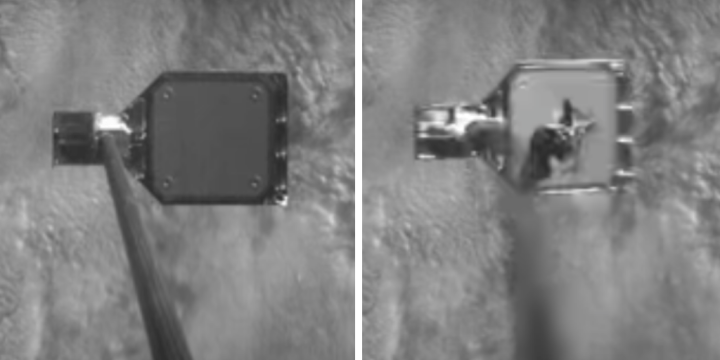
“It’s been a really successful test and gives us really good confidence in the harpoon technology that has been developed.”He also revealed that the spacecraft was programmed to make an autonomous decision about when to execute the launch command:
“The ground-control team had to upload a series of commands for the harpoon and the spacecraft, which the spacecraft then autonomously executed when it was at the right angle to the sun so that we could get a good video of the experiment.”It took the engineers over a week to review the data sent back by the spacecraft, but when they did they confirmed that the harpoon hit its target at a speed of 65 feet per second. While the experiment was successful, it didn’t go off flawlessly. Space.com also reported that the tip of the harpoon penetrated the debris and released its spring-loaded array of barbs to make the capture, but “the carbon-fiber boom the target was attached to didn’t withstand the force of the impact and snapped.” However, the researchers anticipated this possibility and “secured the harpoon with a tether to make sure the experiment didn’t create additional space debris.” Researchers will continue developing the technology, which has received $18.7 million dollars of investment. But in the meantime, one of the most critical space junk-removal missions will be conducted by a different piece of technology. The European Space Agency’s (ESA) e.Deorbit mission, which will launch in the mid-2020s will use a robotic arm to remove one of the largest pieces of debris in Earth’s lower orbit. The item, an observation satellite called Envisat, was launched in 2002 and was the world’s largest civilian Earth observation satellite. When the ESA lost contact with it in 2012, it became one of the most dangerous pieces of space junk because of its size.





Share Your Thoughts