

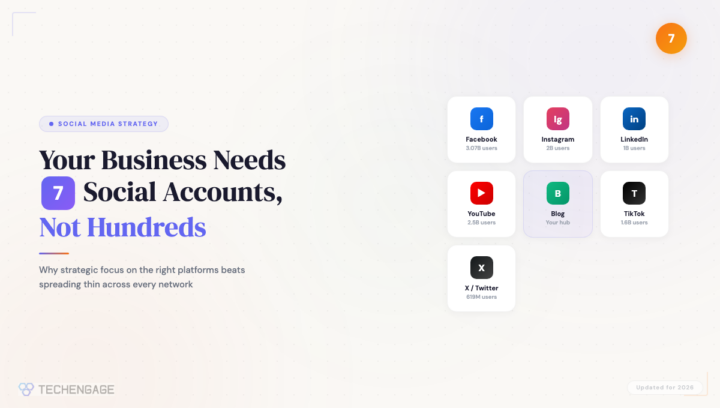
Back in 2013, a common pitch from social media agencies went something like this: “We’ll get your business listed on dozens of social networks.” It sounded impressive, the same way “we’ll submit your site to thousands of search engines” sounded impressive in 2003. Both pitches shared the same fatal flaw. They prioritized quantity over quality, and businesses that bought in ended up with dozens of abandoned profiles collecting dust and security vulnerabilities.
The original argument from that era still holds up, but the landscape has changed dramatically. Google+ is gone. MySpace is a relic. Vine disappeared. Meanwhile, TikTok didn’t exist and Instagram was barely three years old. The core principle, though, remains as relevant as ever: your business needs a focused presence on the platforms that actually matter, not a scattered footprint across every network with a signup page.
Here’s the updated playbook for 2026, along with the data that supports it.
Why Seven Accounts Is the Right Number
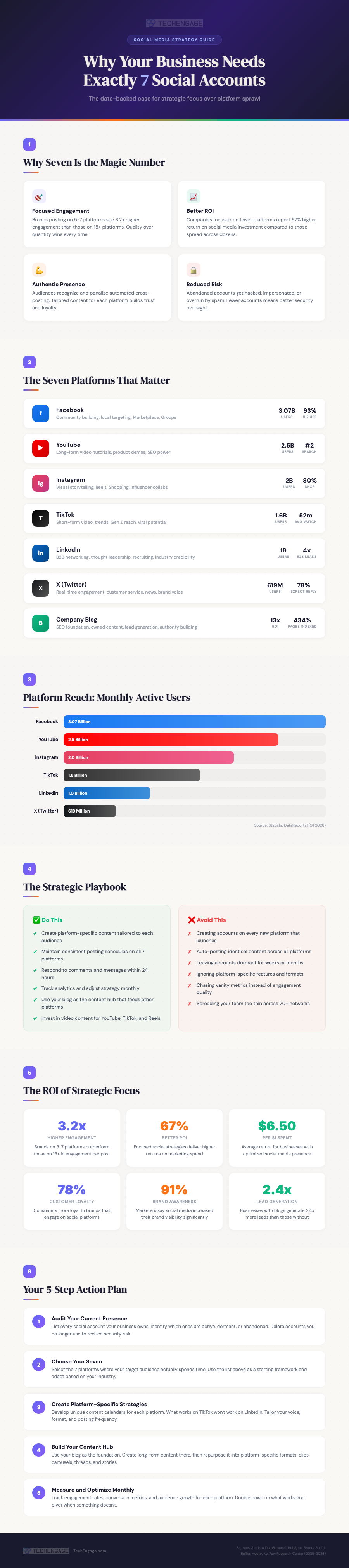
The number seven isn’t arbitrary. It comes from a practical intersection of audience reach, resource allocation, and content quality. Research from HubSpot and Sprout Social consistently shows that businesses maintaining five to seven active social accounts generate significantly higher engagement per post than those spread across fifteen or more platforms.
The math is straightforward. Most businesses have limited social media staff, often just one or two people for small to mid-size companies. Each platform demands its own content format, posting frequency, community management, and analytics review. When you stretch a small team across twenty platforms, you get twenty mediocre presences instead of seven strong ones. And mediocre presences don’t just underperform. They actively hurt your brand by signaling neglect to anyone who stumbles across a stale profile.
There’s also the security angle that the original article flagged back in 2013, and this has only become more critical. Abandoned social media accounts are prime targets for hackers and impersonators. If someone takes over a dormant account with your business name, they can post anything under your brand’s identity before you even notice. Fewer accounts means tighter security oversight and faster response times when something goes wrong.
The Seven Platforms Every Business Should Consider
The specific seven will vary slightly by industry, but for most businesses in 2026, the following platforms form the strongest foundation.
1. Facebook
Facebook remains the largest social network with over 3.07 billion monthly active users, according to Statista. The platform’s advertising infrastructure is unmatched for targeted local and demographic reach. Facebook Groups have become particularly valuable for community building, and Marketplace has evolved into a genuine commerce channel for businesses of all sizes. About 93% of social media marketers use Facebook for business, making it nearly universal.
2. YouTube
YouTube functions as the world’s second-largest search engine behind Google, with 2.5 billion monthly active users. For businesses, it serves as a permanent video library. Product demonstrations, tutorials, customer testimonials, and behind-the-scenes content live on YouTube essentially forever, driving organic traffic for years after publication. Unlike ephemeral social content, a well-optimized YouTube video can generate leads for a decade.
3. Instagram
Instagram has 2 billion monthly active users and remains the dominant platform for visual storytelling. Reels compete directly with TikTok for short-form video attention. Instagram Shopping has matured into a serious commerce feature, with roughly 80% of users saying they’ve discovered new products on the platform. For businesses with any visual component, whether products, services, or brand personality, Instagram is essential.
4. TikTok
TikTok has grown to 1.6 billion monthly active users and offers something no other platform can match: viral reach for accounts of any size. The algorithm surfaces content based on engagement rather than follower count, giving small businesses a genuine shot at massive exposure. TikTok’s influence extends well beyond Gen Z, with the fastest-growing demographic being users over 35. TikTok Shop has also turned the platform into a direct sales channel.
5. LinkedIn
LinkedIn has crossed 1 billion members and is no longer just a job board. It has become the primary platform for B2B marketing, thought leadership, and professional brand building. LinkedIn generates four times more B2B leads than Facebook and Twitter combined, according to Hootsuite data. Even B2C companies benefit from LinkedIn through employer branding and industry credibility.
6. X (Twitter)
Despite its turbulent years, X still has 619 million monthly active users and remains the go-to platform for real-time conversation. Customer service interactions, breaking industry news, and direct engagement with your audience happen faster on X than anywhere else. Research shows 78% of people who contact a brand on X expect a response within an hour, making it critical for reputation management.
7. Your Company Blog
This is the one most businesses underestimate, and it might be the most important of all seven. Your blog is the only platform you fully own and control. Social algorithms change, platforms rise and fall, but your blog content remains yours. Companies that maintain active blogs generate 434% more indexed pages in search engines and produce 2.4 times more leads than companies without blogs. The blog serves as your content hub, feeding material to all six social platforms.
The Problem With Platform Sprawl
The temptation to join every new platform is understandable. When Threads launched, when Bluesky gained momentum, when BeReal had its moment, the fear of missing out drove millions of businesses to create accounts. Most of those accounts are now gathering digital cobwebs.
Platform sprawl creates several concrete problems beyond just wasted time. First, it dilutes your brand voice. When you’re producing content for fifteen different platforms, maintaining a consistent message becomes nearly impossible. Second, it creates security vulnerabilities. Each account is another potential entry point for hackers, another password to manage, another profile to monitor for impersonation.
Third, and this is the point the original 2013 article made with remarkable foresight, small platforms are inherently riskier. They get acquired, shut down, overrun with spam, or simply become irrelevant. Remember when businesses rushed to create Clubhouse rooms? Or when everyone was building Snapchat Discover strategies? The time invested in those platforms is gone, and the content went with it.
The Automation Trap
Some businesses try to solve the platform sprawl problem by automating everything. Post once, blast it to thirty accounts simultaneously. This approach is worse than doing nothing because audiences on each platform can tell when content wasn’t made for them.
A LinkedIn post that reads like a TikTok caption looks out of place. An Instagram caption that’s clearly a repurposed tweet feels lazy. Audiences have developed sharp instincts for authentic versus automated content, and they reward authenticity with engagement while ignoring or unfollowing accounts that feel robotic.
The better approach is creating a content repurposing workflow, not a cross-posting automation. Start with your blog post. Turn key points into a LinkedIn article. Pull a compelling statistic for a Twitter thread. Create a short video version for TikTok and Reels. Design a carousel for Instagram. This way, each platform gets native content derived from the same core idea.
What About Emerging Platforms?
New platforms will keep launching. That’s inevitable. The question isn’t whether you should pay attention to them (you should), but whether you should immediately create a business account on each one (you shouldn’t).
The smart approach is to monitor emerging platforms personally, reserve your brand name if possible, and wait until the platform demonstrates sustained growth and relevance to your target audience before committing resources. Threads from Meta, for example, may eventually warrant replacing X in your seven. When that happens, you swap one out and add the other. You don’t add a eighth and let the others suffer from reduced attention.
Industry-Specific Adjustments
The core seven won’t be identical for every business. A B2B software company might swap TikTok for Reddit, where developer communities thrive. A restaurant might prioritize Yelp or Google Business Profile over LinkedIn. A fashion brand might add Pinterest to their mix while deprioritizing X.
The principle stays the same regardless of substitutions: pick your seven based on where your specific customers actually spend their time, not where the buzz is. Look at your analytics. Check which platforms drive the most referral traffic. Survey your customers directly. The data will tell you which seven deserve your investment.
Making Your Seven Work Harder
Once you’ve committed to your seven platforms, the focus shifts to making each one deliver maximum value. That starts with understanding what each platform does best. Facebook excels at community and local reach. YouTube builds lasting SEO-driven content libraries. Instagram drives product discovery. TikTok delivers viral exposure. LinkedIn establishes professional credibility. X handles real-time engagement. Your blog anchors everything with owned content that compounds over time.
Treat each platform as a distinct channel with its own audience expectations, content formats, and success metrics. The businesses that win on social media in 2026 aren’t the ones with the most accounts. They’re the ones that post the right content, on the right platforms, with genuine engagement behind it.
The advice from 2013 was right. Seven accounts, maintained well, will always outperform a hundred accounts left to rot. The platforms have changed, but the strategy hasn’t.
Frequently Asked Questions
Why should a business limit itself to only 7 social media accounts?
Maintaining seven focused accounts allows your team to create platform-specific content, respond to engagement promptly, and maintain consistent brand quality across each profile. Research shows brands on 5-7 platforms see significantly higher engagement rates than those spread across 15 or more, because quality and consistency matter more than sheer presence.
Which social media platforms are most important for businesses in 2026?
The seven most impactful platforms for most businesses are Facebook (3.07B users), YouTube (2.5B users), Instagram (2B users), TikTok (1.6B users), LinkedIn (1B members), X/Twitter (619M users), and your company blog. The specific mix may vary by industry, but these platforms collectively reach virtually every demographic and business objective.
Should businesses create accounts on every new social media platform?
No. The recommended approach is to monitor new platforms, reserve your brand name to prevent impersonation, and wait until the platform shows sustained growth and relevance to your target audience before committing resources. When a new platform proves its value, swap it in for the weakest performer in your current seven rather than adding an eighth.
Is it okay to auto-post the same content across all social media platforms?
Cross-posting identical content across platforms is generally counterproductive. Each platform has different audience expectations, content formats, and algorithms. A better approach is content repurposing: start with a blog post, then adapt the core message into platform-native formats like LinkedIn articles, TikTok videos, Instagram carousels, and Twitter threads.
What are the risks of having too many social media accounts?
Abandoned or neglected accounts create security vulnerabilities, as hackers frequently target dormant profiles for impersonation. They also damage brand perception when potential customers find stale, outdated content. Additionally, spreading your team across too many platforms reduces content quality everywhere rather than building strong engagement anywhere.
Why is a company blog considered one of the seven essential social accounts?
Your blog is the only platform you fully own and control. Social media algorithms change constantly, but your blog content remains yours forever. Companies with active blogs generate 434% more indexed pages in search engines and produce 2.4 times more leads. The blog also serves as a content hub that feeds material to all other social platforms.




Share Your Thoughts