

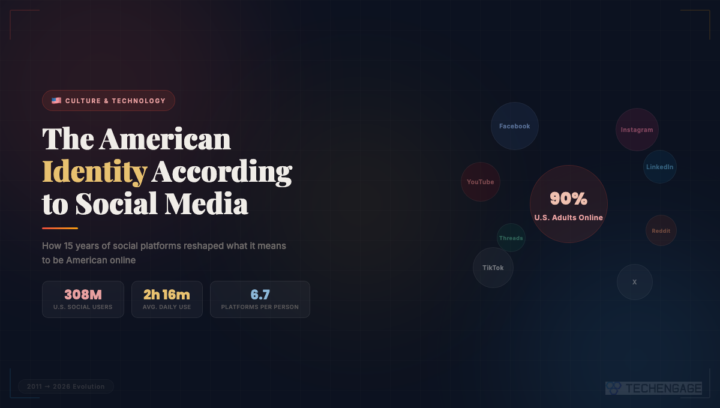
Back in 2011, the question sounded almost philosophical: can a bunch of data about social networking actually help us understand the American people? Fifteen years later, the answer is unambiguous. Social media didn’t just document American identity; it actively reshaped it. The platforms that started as digital town squares became mirrors, megaphones, and marketplaces, reflecting who Americans are while simultaneously changing how they behave, consume, vote, and connect with each other.
What follows is a thorough examination of that transformation. We’ve traced the arc from 2006 (when Facebook first opened to the public) through April 2026, pulling data from Pew Research Center, Statista, DataReportal, and Edison Research to paint a picture of how American online identity evolved, and what it looks like right now.
The Social Media Timeline: From Novelty to Necessity
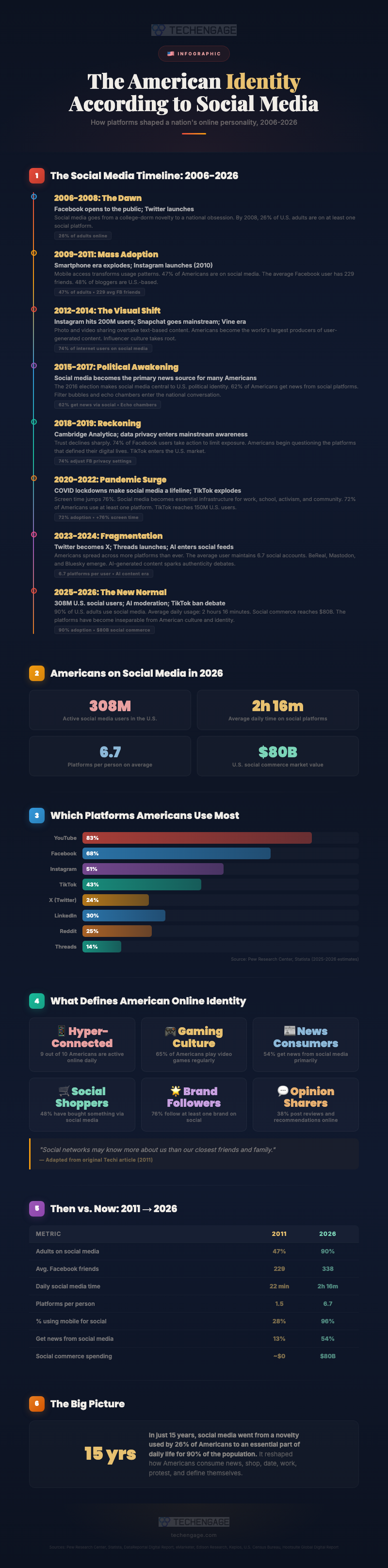
The story starts in 2006-2008, what you might call the dawn era. Facebook dropped its college-only requirement. Twitter launched with its 140-character constraint. MySpace was still relevant. By 2008, roughly 26% of American adults had joined at least one social network, according to Pew Research. Most people treated these platforms like digital scrapbooks, a place to post party photos and reconnect with high school classmates.
The smartphone revolution between 2009 and 2011 changed everything. Instagram launched in 2010 and hit a million users in two months. Suddenly, social media wasn’t something you did at your desk. It was in your pocket, always on, always accessible. By 2011, 47% of American adults were active on social platforms. The average Facebook user had 229 friends. Americans produced 48% of all blog content worldwide. The original Techi infographic captured this exact moment, noting that Americans were “followers,” “hyper-social,” and “obsessed with celebrities.” Those observations were accurate then. They’re even more pronounced now.
The years between 2012 and 2014 brought the visual shift. Instagram surpassed 200 million users. Snapchat went mainstream. Vine’s six-second videos created a new format for comedy and self-expression. Photo and video sharing overtook text-based updates as the dominant form of content. This was the era that gave birth to influencer culture, turning ordinary Americans into micro-celebrities with loyal followings and brand deals.
Then came the political awakening of 2015-2017. Social media’s influence on public discourse became impossible to ignore during the 2016 presidential election. By that point, 62% of Americans reported getting at least some of their news from social platforms. Filter bubbles, echo chambers, and algorithmic amplification entered the national vocabulary. Social media stopped being just a communication tool and became a battleground for American political identity.
The reckoning arrived between 2018 and 2019. The Cambridge Analytica scandal exposed how platform data could be weaponized. Trust eroded sharply: 74% of Facebook users took some action to limit their exposure, whether adjusting privacy settings, deleting the app, or reducing usage. Meanwhile, TikTok quietly entered the American market, planting seeds for the next seismic shift.
COVID-19 transformed social media from a habit into infrastructure during 2020-2022. Lockdowns pushed screen time up by 76%. Platforms became essential for remote work, virtual schooling, political organizing, and maintaining human connection during isolation. TikTok exploded to 150 million U.S. users. Social commerce emerged as a serious retail channel. By 2022, 72% of Americans were active on at least one platform.
The fragmentation era (2023-2024) saw Americans scatter across more platforms than ever. Twitter’s rebrand to X drove millions to alternatives like Threads, Bluesky, and Mastodon. The average American maintained 6.7 social media accounts. AI-generated content flooded feeds, sparking debates about authenticity that continue today.
Which brings us to 2025-2026. An estimated 308 million Americans actively use social media. That’s roughly 90% of the adult population. Average daily usage sits at 2 hours and 16 minutes. Social media usage patterns have become as routine as brushing teeth. The platforms have become inseparable from how Americans define and express themselves.
The Platforms Americans Choose
Platform preferences tell their own story about American identity. YouTube dominates at 83% usage among U.S. adults, reflecting Americans’ insatiable appetite for video content, from tutorials and product reviews to entertainment and news commentary. Facebook remains at 68%, still the largest traditional social network despite years of “Facebook is dead” headlines. Its staying power reveals something about American behavior: once a platform embeds itself in daily routines (Marketplace, Groups, family communication), people don’t leave easily.
Instagram holds at 51%, driven largely by users under 40. TikTok has surged to 43% despite ongoing legislative threats, proof that Americans will adopt whatever platform delivers the most engaging content, regardless of geopolitical controversy. LinkedIn has grown to 30%, reflecting the blurring line between professional and personal identity online. Reddit at 25% has quietly become the platform where Americans go for honest recommendations, niche communities, and unfiltered discussion.
What Social Media Reveals About Americans
Strip away the platform logos and look at the behavioral data, and several distinctly American characteristics emerge.
Americans are hyper-connected. Nine out of ten are online daily. The gap between “online” and “offline” life has essentially disappeared. Americans check their phones an average of 144 times per day, and social media accounts for a significant portion of that activity. This connectivity shapes everything from how Americans shop to how they respond to breaking news.
Americans are digital consumers first. Social commerce has reached $80 billion annually. Nearly half of Americans (48%) have purchased something directly through a social media platform. The line between discovering a product and buying it has collapsed into a single scroll-and-tap motion. Instagram Shopping, TikTok Shop, and Facebook Marketplace have turned social feeds into virtual malls.
Americans are brand-conscious. The original 2011 infographic noted that four out of ten Americans followed products, services, and brands on social media. That number has nearly doubled. Today, 76% follow at least one brand. Americans don’t just buy products; they build relationships with the companies behind them, expecting transparency, responsiveness, and social responsibility.
Americans are opinion sharers. Reviews, recommendations, and hot takes are woven into the American social media experience. Roughly 38% regularly post product reviews or recommendations. This behavior, rooted in what the original infographic called Americans’ tendency to “give advice,” has become a driving force in the creator economy. User-generated content now influences purchasing decisions more than traditional advertising.
Americans are entertainment seekers. The 2011 data showed Americans loved television and video games. That hasn’t changed, but the definition has expanded. Streaming, short-form video, and mobile gaming now account for more entertainment hours than traditional TV. Americans spend more time watching YouTube than any broadcast network. Video games remain a cultural force, with 65% of Americans playing regularly.
Then vs. Now: A 15-Year Transformation
The contrast between 2011 and 2026 is staggering. Social media adoption nearly doubled from 47% to 90%. Daily usage ballooned from roughly 22 minutes to 2 hours and 16 minutes. The average American went from maintaining 1.5 platform accounts to 6.7. Mobile social media usage leaped from 28% to 96%, meaning almost every social media interaction now happens on a phone.
The most telling shift might be in news consumption. In 2011, only 13% of Americans cited social media as a primary news source. By 2026, that figure sits at 54%. This transformation has profound implications for how Americans understand their country, their politics, and each other. The gatekeepers changed, and with them, the stories Americans tell about themselves.
Social commerce didn’t even exist as a category in 2011. Today it’s an $80 billion market. Americans went from using social media to talk about products to buying those products without ever leaving the app. That shift didn’t just change shopping behavior; it changed how Americans relate to brands, entrepreneurship, and economic opportunity.
The Complicated Side
Not every trend line points upward. Mental health concerns have grown alongside usage. The American Psychological Association has documented associations between heavy social media use and increased anxiety, depression, and loneliness, particularly among younger Americans. The paradox of being more connected but feeling more isolated is distinctly American: a country that built the platforms now grappling with their consequences.
Political polarization has deepened. Algorithmic feeds tend to amplify extreme content because it generates engagement. Americans increasingly encounter different realities depending on which platforms they use and which accounts they follow. The shared cultural experiences that once defined American identity (watching the same evening news, discussing the same newspaper headlines) have splintered into millions of personalized feeds.
Privacy remains a persistent tension. Americans express concern about data collection (81% say the risks outweigh the benefits, according to Pew Research) while simultaneously sharing personal information at unprecedented scale. This contradiction is itself an American trait: valuing individual liberty while participating eagerly in systems that surveil individual behavior.
What Comes Next
The American social media landscape in 2026 sits at another inflection point. AI is reshaping content creation and curation. The TikTok ban debate raises questions about digital sovereignty. Decentralized platforms offer alternatives to corporate-controlled spaces. Gen Alpha, the first generation raised entirely within social media’s ecosystem, is beginning to define its own relationship with these tools.
If the past 15 years taught us anything, it’s that Americans don’t just adopt technology; they absorb it into their identity. Social media stopped being something Americans use and became part of what being American means. The platforms will keep changing. The behaviors they’ve shaped are here to stay.
Frequently Asked Questions
What percentage of Americans use social media in 2026?
Approximately 90% of U.S. adults (about 308 million people) actively use at least one social media platform as of early 2026, according to data from Pew Research Center and DataReportal. This represents a massive increase from just 26% in 2008 and 47% in 2011.
Which social media platform is most popular in the United States?
YouTube leads with 83% of U.S. adults using the platform, followed by Facebook at 68%, Instagram at 51%, and TikTok at 43%. The average American maintains accounts on 6.7 different social media platforms simultaneously.
How much time do Americans spend on social media daily?
The average American spends approximately 2 hours and 16 minutes per day on social media platforms. This has increased dramatically from roughly 22 minutes per day in 2011, largely driven by the shift to mobile-first usage and the rise of short-form video content.
How has social media changed American political identity?
Social media has become a primary news source for 54% of Americans (up from 13% in 2011), fundamentally altering how citizens encounter political information. Algorithmic feeds have contributed to political polarization by amplifying engaging content, often favoring extreme perspectives. Social media played a decisive role in elections starting in 2016.
What is the impact of social media on American mental health?
Research from the American Psychological Association has documented associations between heavy social media use and increased anxiety, depression, and loneliness, particularly among younger Americans. However, social media also provides community support, mental health resources, and connection for isolated individuals, making the relationship complex rather than purely negative.
How big is social commerce in the United States?
U.S. social commerce is estimated at $80 billion annually as of 2026. Nearly 48% of Americans have purchased a product directly through a social media platform. Instagram Shopping, TikTok Shop, and Facebook Marketplace are the leading social commerce channels driving this growth.



Share Your Thoughts