


Buying a car is one of those decisions that can feel overwhelming. You walk onto a lot with hundreds of options, and every salesperson has a different pitch. But here’s the thing: certain vehicles have consistently earned the trust of millions of buyers across decades. Their sales numbers tell a story that no marketing campaign can fake.
We looked at cumulative worldwide sales data to identify the 10 best-selling cars of all time. These aren’t just popular models from a single year or region. They represent vehicles that have maintained mass appeal across generations, economic cycles, and shifting consumer preferences. From Japanese fuel sippers to American workhorses, the list reveals a lot about what people actually want when they spend their hard-earned money on a set of wheels.
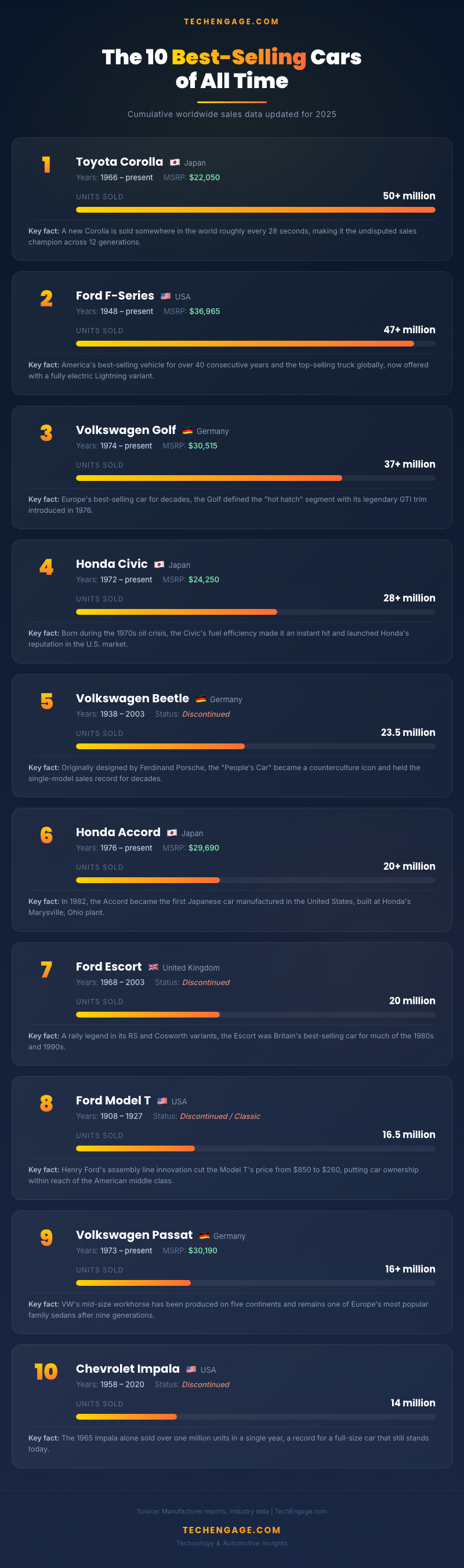
1. Toyota Corolla – 50+ Million Units Sold
The Toyota Corolla sits at the top of this list by a comfortable margin, and it has held that position for over two decades. Since its debut in 1966, the Corolla has moved through 12 generations while sticking to the same formula: reliable transportation at a reasonable price. Toyota manufactures the Corolla across 16 countries, and somewhere in the world, a new one rolls off a dealer lot roughly every 28 seconds.
What makes the Corolla’s dominance remarkable is its consistency. It doesn’t chase trends or try to be exciting. It simply delivers what most car buyers need: solid fuel economy, low maintenance costs, and a resale value that holds up better than most competitors. The current model starts at around $22,050, which positions it as one of the more affordable new sedans on the market.
2. Ford F-Series – 47+ Million Units Sold
The Ford F-Series has been America’s best-selling vehicle (not just truck, but overall vehicle) for more than 40 consecutive years. That kind of streak doesn’t happen by accident. Since 1948, the F-Series lineup has evolved from a basic work truck into a family of vehicles that covers everything from bare-bones fleet trucks to luxury-appointed crew cabs with six-figure price tags.
The F-150, which anchors the lineup, now comes with a fully electric Lightning variant that produces 580 horsepower and can power your house during an outage. Starting MSRP for the 2025 F-150 sits around $36,965, though most buyers opt for higher trims that push well past $50,000. The F-Series moves roughly 800,000 to 900,000 units per year in the US alone, a pace that keeps it closing the gap on the Corolla’s worldwide lead.
3. Volkswagen Golf – 37+ Million Units Sold
The Volkswagen Golf has been Europe’s best-selling car for the better part of four decades. VW launched it in 1974 as the successor to the aging Beetle, and the Golf delivered exactly what the market needed: a practical, front-wheel-drive hatchback with more interior space than its compact dimensions suggested.
The Golf also created an entire vehicle category when VW introduced the GTI trim in 1976. The idea of a small, affordable car with genuine performance capability was novel at the time, and the “hot hatch” segment it spawned remains one of the most enthusiast-friendly corners of the car market. While VW pulled the standard Golf from the US market in 2021 (keeping only the GTI and R variants stateside), it continues to sell strongly in Europe and other global markets. The GTI starts around $32,000 in the US.
4. Honda Civic – 28+ Million Units Sold
Honda released the Civic in 1972, right before the 1973 oil crisis made fuel efficiency the number one priority for car buyers worldwide. The timing was fortunate, but the execution was what turned the Civic into a phenomenon. It was one of the first cars to meet US Clean Air Act standards without needing a catalytic converter, which was a genuine engineering achievement at the time.
Now in its 11th generation, the Civic has grown from a tiny economy car into a well-rounded compact that competes on technology, safety, and driving engagement as much as fuel savings. The current sedan starts at approximately $24,250, and the Type R performance variant has become one of the most sought-after sport compacts on the market. The Civic consistently ranks among the top-selling cars in both the United States and Canada.
5. Volkswagen Beetle (Original) – 23.5 Million Units Sold
The original Volkswagen Beetle holds one of the most complicated origin stories in automotive history. Ferdinand Porsche designed it in the 1930s under a commission from the German government, and early production was funded by the Third Reich. After World War II, the British Army revived the Wolfsburg factory, and the Beetle went on to become a symbol of postwar economic recovery and, eventually, 1960s counterculture.
Production of the original air-cooled Beetle continued until 2003, when the last one rolled off the line in Puebla, Mexico. VW launched modernized versions (the New Beetle and later simply “Beetle”) that traded on nostalgia, but those were fundamentally different cars built on Golf underpinnings. The final modern Beetle left the factory in 2019, closing a chapter that spanned over 80 years. While no longer in production, the original Beetle’s 23.5 million units sold cemented its place as one of the most recognized vehicles ever built.
6. Honda Accord – 20+ Million Units Sold
The Honda Accord has served as the backbone of Honda’s US operation since 1976. It holds a distinction that reshaped the American auto industry: in 1982, it became the first Japanese car manufactured in the United States, rolling off the line at Honda’s Marysville, Ohio plant. That move proved that Japanese automakers could build quality vehicles on American soil, and it forced Detroit to fundamentally rethink its approach to manufacturing.
For 15 consecutive years, the Accord was the top-selling Japanese car in the United States. The current 11th-generation model starts at around $29,690 and is available as a hybrid, which reflects Honda’s broader push toward electrification. The Accord competes in the midsize sedan segment against the Toyota Camry and Hyundai Sonata, and it continues to earn recommendations from virtually every automotive publication.
7. Ford Escort – 20 Million Units Sold
The Ford Escort occupies a unique position on this list. The European and American versions of the Escort were completely different cars that happened to share a name. The European Escort, launched in 1968, was developed by Ford of Britain and became the UK’s best-selling car for much of the 1980s and 1990s. Its RS and Cosworth variants also built a legendary reputation in rally racing.
The American Escort arrived in 1981 as Ford’s answer to the flood of Japanese imports that were eating into domestic market share. It was a practical, no-frills economy car that served its purpose without generating much excitement. Combined global production ended in 2003, though Ford briefly revived the Escort nameplate in China. With 20 million units across all variants, the Escort demonstrated that sometimes being the sensible, affordable choice is enough to generate massive sales volumes.
8. Ford Model T – 16.5 Million Units Sold
The Ford Model T didn’t just sell well. It fundamentally changed civilization. When Henry Ford introduced it in 1908 at a price of $850, automobiles were luxury items that only the wealthy could afford. By 1914, Ford’s moving assembly line had cut the total build time to just 93 minutes per car, and by 1925, the price had dropped to $260. Adjusted for inflation, that’s roughly the price of a modern smartphone.
The Model T put car ownership within reach of the American middle class for the first time. It changed where people lived, how they worked, and how entire cities were designed. Production ran from 1908 to 1927, during which 16.5 million units were built. While you obviously can’t buy a new one today, well-maintained Model Ts regularly sell at collector auctions, and the car remains one of the most influential products in industrial history.
9. Volkswagen Passat – 16+ Million Units Sold
The Volkswagen Passat (named after the German word for “trade wind”) has served as VW’s midsize family car since 1973. Over nine generations, it has gone by several names in different markets, including Dasher, Santana, and Quantum. The Passat shares its platform with the Audi A4, which means buyers get what is essentially a near-premium vehicle at a mainstream price point.
VW discontinued the Passat in the US market after 2022, but the car continues to sell well in Europe, where the latest B9 generation competes against the Skoda Superb and Ford Mondeo. The Passat has been manufactured on five continents and remains one of Europe’s most popular choices for company car fleets and families who need a comfortable, efficient highway cruiser.
10. Chevrolet Impala – 14 Million Units Sold
The Chevrolet Impala was the definitive American full-size car for decades. When it debuted in 1958, it was positioned as the top-of-the-line Chevrolet, recognizable by its distinctive triple taillights. The Impala hit its peak in 1965, when Chevrolet sold over one million units in a single year, a record for any full-size car that still stands.
After a brief hiatus from 1985 to 1994, the Impala returned and continued selling until GM finally discontinued it in 2020. The sedan market had shrunk dramatically as SUVs and crossovers took over, and the Impala’s full-size proportions no longer matched what most buyers were looking for. Still, 14 million cumulative units across six decades is a testament to the car’s enduring appeal as a spacious, comfortable, and affordable American sedan.
What These Numbers Actually Tell Us
Looking at this list as a whole, a few patterns emerge. Japanese automakers dominate the top spots, claiming four of the top six positions with vehicles that prioritize reliability and fuel efficiency. American entries tend to be either trucks (F-Series) or full-size sedans (Impala) that cater to domestic preferences. German entries from Volkswagen occupy three spots, all built on the philosophy of practical, well-engineered vehicles for the masses.
The list also highlights how the automotive landscape is shifting. Four of these ten vehicles have been discontinued, and several others face uncertain futures as the industry moves toward electric powertrains and crossover body styles. The Toyota Corolla and Honda Civic continue to adapt, now offering hybrid variants that keep them relevant. The Ford F-Series has gone a step further with the all-electric Lightning.
Whether you’re in the market for a new car or simply curious about automotive history, these ten vehicles represent the clearest evidence of what actually works in the car business. They weren’t always the flashiest or the most technologically advanced options available. They were the ones that consistently delivered what buyers valued most: dependability, practicality, and a fair price for what you got.
Frequently Asked Questions
What is the best-selling car of all time?
The Toyota Corolla holds the title of best-selling car of all time with over 50 million units sold worldwide since 1966. It has maintained this position since the late 1990s and continues to sell strongly across global markets.
Is the Ford F-150 the best-selling vehicle in America?
Yes, the Ford F-Series (which includes the F-150) has been Americau0027s best-selling vehicle for over 40 consecutive years. It moves between 800,000 and 900,000 units per year in the US alone, outselling every other car, truck, and SUV.
Are any of the best-selling cars of all time still in production?
Six of the ten best-selling cars are still in production: the Toyota Corolla, Ford F-Series, Volkswagen Golf, Honda Civic, Honda Accord, and Volkswagen Passat. The other four (Beetle, Ford Escort, Ford Model T, and Chevrolet Impala) have been discontinued.
Why do Japanese cars dominate the best-selling list?
Japanese automakers like Toyota and Honda built their reputations on reliability, fuel efficiency, and low ownership costs. These qualities generate strong word-of-mouth recommendations and repeat buyers, which compound into massive sales volumes over decades.
What car might join the top 10 best-selling list next?
The Toyota Camry and Toyota RAV4 are the strongest candidates. The Camry has accumulated over 20 million sales globally, and the RAV4 has seen explosive growth in recent years as consumer preferences shift toward crossover SUVs.




Share Your Thoughts