

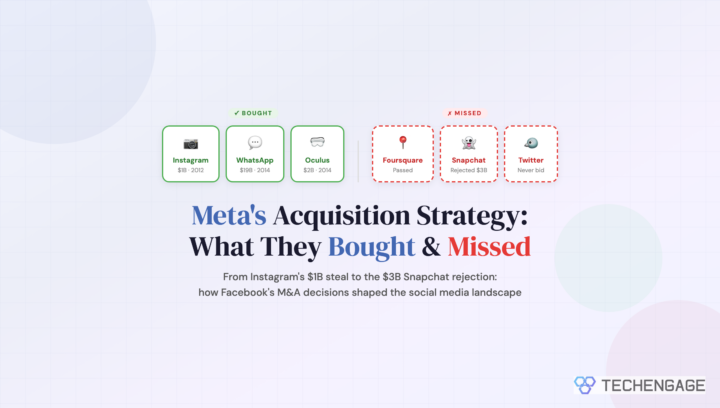
In April 2012, a writer on this very site posed a question that seemed perfectly reasonable at the time: should Facebook buy Foursquare? Facebook had just acquired Instagram for $1 billion, and the argument was simple. If Facebook controlled written content, photos, and location-based check-ins, it would hold the “trifecta” of social media. No competitor could touch it.
Facebook never bought Foursquare. It also failed to buy Snapchat, never seriously pursued Twitter, and passed on dozens of other companies that might have strengthened its grip on social networking. What it did buy (Instagram, WhatsApp, Oculus) reshaped the entire tech industry. What it tried to buy and couldn’t (Snapchat) forced it into years of feature cloning. And what it chose to build internally (location services, a metaverse platform) burned tens of billions of dollars with mixed results at best.
Fourteen years later, we can evaluate each of these decisions with the benefit of hindsight. The scorecard is more complicated than you might expect.
The Acquisitions That Defined Meta
Instagram ($1 Billion, April 2012)
When Facebook announced the Instagram acquisition in April 2012, the reaction was split. A billion dollars for a 13-employee photo-sharing app with zero revenue seemed absurd to many analysts. The company had 30 million users and had existed for barely 18 months.
It turned out to be the best acquisition in social media history, possibly in all of tech. Instagram crossed 2 billion monthly active users by 2023, generates an estimated $50+ billion in annual ad revenue (according to Bloomberg Intelligence estimates), and has become the primary social platform for users under 35 in most Western markets. The $1 billion price tag looks comical in retrospect; Instagram is worth more than many standalone public companies.
The acquisition also prevented a genuine existential threat. Instagram’s growth trajectory in early 2012 showed it was becoming a social network in its own right, not just a photo filter app. Had it remained independent (or been acquired by Google or Twitter, both of which were reportedly interested), it could have siphoned Facebook’s younger user base during the critical mobile transition years.
WhatsApp ($19 Billion, February 2014)
The WhatsApp acquisition remains the largest in Facebook’s history, and the sticker shock was enormous. $19 billion for a messaging app that charged users $1 per year and had no advertising. Even by Silicon Valley standards, the price seemed unhinged.
The strategic logic was defensive. WhatsApp had 450 million users at acquisition and was growing faster than any app in history. In markets across Asia, Latin America, Africa, and Europe, WhatsApp was replacing SMS entirely. If a competitor (Google was again circling) had acquired it, Facebook would have lost its messaging dominance in most of the world outside the United States.
WhatsApp now has over 2.7 billion monthly active users as of 2026, making it the most-used messaging platform on earth. Monetization has been slower than Facebook hoped; WhatsApp Business and payment features generate revenue but nothing close to justifying the acquisition price on a pure financial basis. The real value was strategic: keeping the world’s dominant messaging infrastructure inside Meta’s ecosystem rather than a competitor’s.
Oculus ($2 Billion, March 2014)
Facebook’s acquisition of Oculus VR was a bet on the future of computing. Mark Zuckerberg believed virtual reality would become the next major platform after mobile, and he wanted Meta to own the hardware and software layer the way Apple owns iOS.
The $2 billion purchase price was reasonable. What came after was not. Meta has invested over $50 billion in its Reality Labs division (which houses Oculus, now rebranded to Meta Quest) since the acquisition. Annual losses from Reality Labs have exceeded $13 billion in recent years. The Quest headset line sells well by VR standards (estimated 20+ million Quest 2 units sold), but the metaverse vision that Zuckerberg pitched as the reason for the entire Meta rebrand has not materialized into a mainstream consumer platform.
The Oculus acquisition is harder to grade. The hardware is genuinely good. The Quest 3 and upcoming Quest 4 are the best standalone VR headsets available. But “best VR headset” is still a niche market, and the metaverse social platform (Horizon Worlds) has struggled with low user counts and unflattering press coverage. Whether this bet pays off depends on whether VR/AR actually becomes a mainstream computing platform in the next decade.
The Smaller Deals
Meta has completed over 90 acquisitions since 2005. Most were acqui-hires or technology tuck-ins that never became household names. A few are worth noting:
CTRL-Labs ($500M-$1B, 2019): A neural interface startup developing a wristband that reads electrical signals from the brain to the hand, enabling gesture control without cameras. This technology is central to Meta’s AR glasses ambitions and appeared in demos of the Orion AR prototype in 2024.
Mapillary (2020): A street-level imagery platform, essentially an open-source alternative to Google Street View. Acquired to support AR mapping and location features for future AR glasses and the metaverse.
Giphy ($400M, 2020 / forced divestiture 2023): Acquired to integrate GIF search into Instagram and WhatsApp. The UK’s Competition and Markets Authority (CMA) forced Meta to sell Giphy in 2023, marking the first time a major tech acquisition was unwound by a regulator. Meta sold it to Shutterstock at a significant loss.
The Ones That Got Away
Foursquare: The Road Not Taken
Back to our original question. Foursquare in 2012 was the dominant location-based social platform with roughly 20 million users and a gamified check-in experience that Facebook’s own location features couldn’t match. The argument for acquisition was strong: Facebook’s check-in feature was clunky, slow, and poorly integrated with its mobile app (which was genuinely terrible in 2012).
Facebook chose to build rather than buy. It improved its own check-in tools, launched Facebook Places (which flopped), tried Nearby Friends (also flopped), and eventually integrated location tagging as a passive feature in posts and Stories rather than a standalone product.
Foursquare, meanwhile, pivoted dramatically. The consumer check-in app was split into two products in 2014: Swarm (for check-ins) and Foursquare (for recommendations). When the consumer products stalled, the company reinvented itself as an enterprise location data provider. By 2026, Foursquare’s core business is selling location intelligence to advertisers, hedge funds, and retailers. Its data powers location-based ad targeting for companies including Apple, Uber, and Samsung.
Did Facebook miss out? Probably not. The consumer check-in market that Foursquare pioneered essentially evaporated as location sharing became a feature embedded in every social platform. What Foursquare became (a B2B data company) isn’t aligned with Meta’s consumer-facing business model. This was a case where not acquiring was the right call.
Snapchat: The $3 Billion Rejection
In late 2013, Facebook offered to acquire Snapchat for $3 billion. Evan Spiegel, Snapchat’s 23-year-old CEO, turned it down. It was widely considered one of the most reckless decisions in startup history.
Spiegel was right to refuse. Snapchat went public in 2017 at a $24 billion valuation, and despite intense competition from Instagram Stories (which Facebook launched specifically to counter Snapchat), the platform has maintained roughly 800 million monthly active users as of 2026. Snap’s augmented reality platform, Spectacles hardware, and AI features have kept it differentiated enough to survive the Meta onslaught.
For Meta, failing to acquire Snapchat had real consequences. Instagram Stories, launched in August 2016, was a feature-for-feature clone of Snapchat Stories. It worked commercially (Stories became Instagram’s biggest engagement driver), but the inability to absorb Snapchat meant Meta lost the ephemeral messaging generation. Snapchat remains the primary communication platform for teens in the US, a demographic Facebook has been hemorrhaging for years.
Twitter: The One Nobody Tried
Twitter (now X) was perpetually undervalued during its decade as a public company. Facebook never made a serious bid, despite Twitter’s outsized influence on news, politics, and real-time conversation. The reasons were likely regulatory (antitrust concerns over combining the two largest US social networks) and cultural (Twitter’s open, public-by-default model clashed with Facebook’s private, friends-based architecture).
Elon Musk’s $44 billion acquisition of Twitter in October 2022, and the subsequent chaos of the X rebrand, may have validated Facebook’s decision to stay away. Twitter’s user growth stagnated, advertiser departures accelerated, and the platform’s reputation suffered considerably. Owning Twitter would have been a headache Meta didn’t need.
The FTC Antitrust Case
Meta’s acquisition strategy came under formal regulatory scrutiny when the Federal Trade Commission filed an antitrust lawsuit in December 2020 (refiled in 2021). The FTC’s core argument was that Facebook had pursued an “anticompetitive acquisition strategy” by buying Instagram and WhatsApp specifically to eliminate nascent competitors rather than for legitimate business reasons.
The case survived Meta’s motion to dismiss in 2022, and as of 2026, it remains in litigation. If the FTC prevails, the potential remedy could include forced divestiture of Instagram and WhatsApp, which would be the most significant antitrust action in tech since the AT&T breakup in 1984. Meta argues that both acquisitions were reviewed and approved by the FTC at the time (which is true) and that the platforms have been deeply integrated into Meta’s infrastructure (also true).
Regardless of the outcome, the case has changed how every major tech company approaches acquisitions. The era of casually acquiring potential competitors for billions of dollars is over. Regulatory scrutiny is now intense for any deal involving dominant platforms, as the Giphy forced divestiture demonstrated in the UK.
The Metaverse Gamble
Meta’s biggest “acquisition” wasn’t really an acquisition at all. It was the decision to spend over $100 billion building a metaverse platform internally. The October 2021 rebrand from Facebook to Meta signaled that Zuckerberg was betting the company’s future on virtual and augmented reality, a bet that has tested investor patience like nothing else in the company’s history.
Reality Labs has lost over $55 billion cumulatively since 2020. The Horizon Worlds social VR platform peaked at roughly 200,000 monthly active users in 2022 before declining. Meanwhile, Meta’s core advertising business continued generating enormous profits ($40+ billion annually), essentially subsidizing the metaverse bet from cash flow.
The pivot to AI in 2023-2024 partially replaced the metaverse narrative, with Meta’s LLaMA language models and AI-powered features generating more investor enthusiasm than VR ever did. But Zuckerberg hasn’t abandoned the hardware vision. The Orion AR glasses prototype, demonstrated in September 2024, showed genuinely impressive technology that could represent the long-term payoff of a decade of investment. Whether that payoff materializes remains the biggest open question in Meta’s strategy.
Lessons for Tech M&A Strategy
Meta’s acquisition history offers lessons that apply far beyond social media.
Defensive acquisitions often justify extreme prices. WhatsApp at $19 billion seemed insane. But preventing Google from owning the world’s dominant messaging platform was worth more than $19 billion to Facebook. The strategic value of denial (keeping something away from competitors) often exceeds the standalone financial value of the target.
Build-vs-buy decisions are harder than they look. Facebook’s decision to build location features internally rather than buying Foursquare worked out fine because check-ins as a product category faded. Its decision to build Stories rather than buying Snapchat worked commercially (Instagram Stories is massive) but failed to eliminate the competitor. Build works when the market is shifting away from the target. Buy works when the target owns a durable competitive advantage.
Regulators now have veto power. The Giphy divestiture and ongoing FTC lawsuit mean that any acquisition by a dominant platform will face years of scrutiny and potential unwinding. Companies need to factor regulatory risk into every deal, which makes smaller, earlier-stage acquisitions more attractive than large, visible ones.
Not every missed acquisition is a mistake. Twitter looked tempting. Foursquare seemed logical. In both cases, not buying was probably the right call given how each company’s trajectory played out.
The original 2012 question asked whether Facebook should buy Foursquare to complete its “trifecta.” What actually happened was far more interesting: Facebook bought its way into photos and messaging, clone-copied ephemeral content, built its own location tools, and bet the company’s identity on a VR/AR future that remains unproven. The trifecta never mattered. What mattered was controlling the platforms where people spend their time, by any means available.
Related reading on TechEngage:
- Facebook’s Like Button Bait and Switch: A History of Meta’s Dark Patterns
- How to Protect Your Digital Identity and Social Media Accounts
- Why Your Business Only Needs Seven Social Media Accounts
Frequently Asked Questions
Why did Facebook buy Instagram for $1 billion?
Facebook acquired Instagram in April 2012 to control the fastest-growing photo-sharing platform and prevent it from becoming a competing social network. Instagram had 30 million users and was growing rapidly, particularly among younger demographics that Facebook needed to retain during the mobile transition. The $1 billion price seemed high at the time but proved to be one of the most successful acquisitions in tech history, as Instagram now generates over $50 billion in estimated annual ad revenue.
Why did Snapchat reject Facebook’s $3 billion offer?
Snapchat CEO Evan Spiegel rejected Facebook’s $3 billion acquisition offer in late 2013, believing the company could grow independently to be worth far more. He was correct: Snapchat went public in 2017 at a $24 billion valuation and has maintained approximately 800 million monthly active users as of 2026. While Instagram Stories (a direct clone of Snapchat Stories) hurt Snapchat’s growth, the platform has survived by focusing on augmented reality, AI features, and maintaining dominance among US teens.
What happened to Foursquare after Facebook chose not to buy it?
Foursquare pivoted from a consumer check-in app to an enterprise location data company. In 2014, it split into two apps: Swarm for check-ins and Foursquare for recommendations. When consumer products stalled, the company reinvented itself selling location intelligence to advertisers, hedge funds, and retailers. By 2026, Foursquare’s data powers location-based ad targeting for companies including Apple, Uber, and Samsung. The consumer check-in market that Foursquare pioneered essentially disappeared as location sharing became a built-in feature of every social platform.
What is the FTC antitrust case against Meta about?
The Federal Trade Commission filed an antitrust lawsuit against Meta in December 2020, alleging that Facebook pursued an anticompetitive acquisition strategy by buying Instagram and WhatsApp specifically to eliminate potential competitors. The case survived Meta’s motion to dismiss in 2022 and remains in litigation as of 2026. If the FTC wins, the potential remedy could include forced divestiture of Instagram and WhatsApp, which would be the most significant antitrust breakup in tech since AT&T in 1984.
How much has Meta spent on the metaverse?
Meta has invested over $100 billion in its Reality Labs division since acquiring Oculus in 2014 for $2 billion. Reality Labs, which develops VR headsets (Meta Quest), AR glasses (Orion), and the Horizon Worlds platform, has reported cumulative losses exceeding $55 billion since 2020 alone. Despite this spending, the metaverse has not become a mainstream consumer platform, though Meta’s Quest headsets lead the VR market and the Orion AR glasses prototype has generated interest in the company’s long-term hardware vision.
Why was Meta forced to sell Giphy?
The UK’s Competition and Markets Authority (CMA) ordered Meta to divest Giphy in 2023 after concluding that the acquisition would reduce competition in the display advertising market and give Meta too much control over GIF distribution to rival platforms. Meta had acquired Giphy for approximately $400 million in 2020 to integrate GIF search into Instagram and WhatsApp. The forced sale to Shutterstock marked the first time a completed major tech acquisition was unwound by a regulator, setting a precedent for future antitrust enforcement globally.




Didn’t Facebook already get a location service? I could have sworn they bought Gowalla, at the time the biggest competitor to foursquare.
Amazes me how interactive Social Media is now days. Just imagine in ten more years. Good buy for Facebook.