

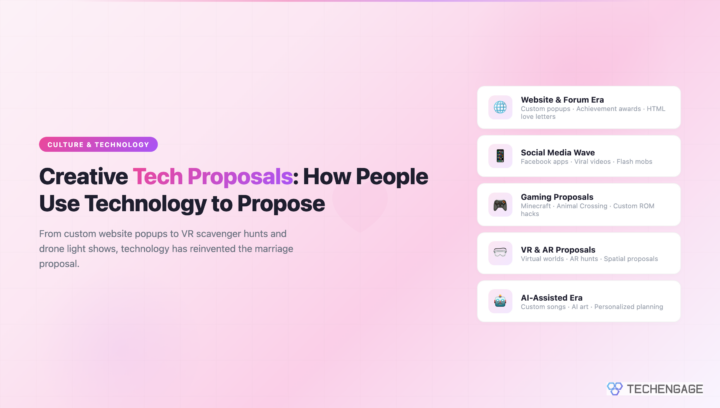
A marriage proposal has always been about timing, surprise, and the right moment. Long before smartphones and social media, people went to extraordinary lengths to make the question feel as big as the answer they hoped for. Technology didn’t invent the art of the memorable proposal. But it handed people a wildly expanded toolkit, and some of them ran with it in ways nobody could have predicted.
From a man quietly emailing a parenting website in 2010 to ask them to hack their achievement system for love, to proposals unfolding inside virtual reality headsets in 2025, the story of tech proposals is really a story about how deeply human creativity finds new expression in every tool we’re handed. These aren’t cold, impersonal gestures. The best ones are some of the most thoughtful proposals ever attempted.
Here’s a tour through the history of people using technology to ask the biggest question of their lives.
When the Internet Became Cupid’s Arrow
The early internet was a scrappy, experimental place. Forums ruled. Personal homepages were a thing. And a certain type of romantically creative person looked at this strange new connected world and thought: what if?
Some of the earliest recorded internet proposals were genuinely simple. A man would build a basic HTML page, put his girlfriend’s name in big letters, embed a photo of a ring, and then find a reason to get her in front of his monitor. The tech was primitive. The emotion was not.
By the mid-2000s, proposals through online forums had become quietly common in niche communities. World of Warcraft players proposed through in-game notes before developers built any formal mechanics for it. Members of tight-knit message boards posted proposals publicly, knowing their partner would log on and see it surrounded by cheers from hundreds of online friends who’d watched the relationship develop over years of posts.
One of the most beautifully executed early web proposals came in 2010, and it used a website called CafeMom. The platform was a social network designed for mothers, built around a sophisticated achievement and badge system that rewarded users for participating in the community. A member named Leslie was a power user, active, engaged, the kind of person who earned achievements regularly.
Her boyfriend Scott had a problem that most proposers dream of: he had a great idea but needed institutional help to pull it off. So he did something unexpectedly bold. He emailed CafeMom’s staff directly, explained the situation, and asked whether they could possibly create a custom achievement for his proposal.
A staff member named Brian Craine took the request seriously. The team engineered a trigger: when Leslie answered a specific question on the site that afternoon, a special achievement popup appeared. The achievement was titled “Will You Marry Me?” and it included a photo of the actual ring Scott had bought.
The proposal worked. The moment was captured on video. Leslie said yes. And the story became a small but genuine piece of internet history, proof that sometimes the most romantic thing you can do is ask a stranger at a website to help you ask the person you love.
What made that proposal remarkable wasn’t the technology. CafeMom’s achievement system wasn’t cutting edge even in 2010. What made it remarkable was the personalization. Scott didn’t just pop the question. He built the proposal around something Leslie genuinely loved, in a space where she felt at home. Every great tech proposal since has followed the same underlying logic.
The Social Media Proposal Era (2010–2015)
When Facebook hit critical mass and everyone suddenly had a public profile tied to their real identity, proposal culture shifted dramatically. The audience for a proposal was no longer just the two people involved. With social media, a proposal could become a shared experience for hundreds or thousands of people simultaneously.
Facebook proposals in the early 2010s ranged from the charmingly low-fi to the surprisingly elaborate. Some proposers simply changed their own status to ask the question and tagged their partner. Others used custom Facebook apps, third-party tools that could generate personalized “proposal pages,” which were shared as links. A few particularly tech-savvy proposers replaced their partner’s timeline cover photo with a proposal message using early admin access tricks that Facebook later locked down.
Twitter proposals developed their own subculture. Because tweets were public and searchable, a well-crafted proposal tweet could attract thousands of retweets within hours, turning a private moment into a viral one. Several Twitter proposals in 2012 and 2013 made national news simply because the community reaction was so enthusiastic. There’s something uniquely 2012 about a man proposing in 140 characters and watching the internet collectively hold its breath for the reply.
YouTube became the most powerful proposal medium of the era. Video proposals uploaded to the platform could accumulate views for years, and the best ones told a complete story. No proposal video from this period came close to matching Isaac Lamb’s February 2012 “Live Lip-Dub Proposal.” With the help of 60 family members and friends, Lamb choreographed an elaborate lip-sync performance while his girlfriend Amy was led through the spectacle blindfolded and then finally brought into the center of it all. The video hit 35 million views. It won awards. It inspired hundreds of imitations.
Flash mobs took a different approach to the audience question. Organized almost entirely through social media group messages, email chains, and early WhatsApp groups, flash mob proposals enlisted strangers and friends alike in creating a synchronized performance in a public space. Shopping malls, train stations, and parks became temporary stages. The proposer could point to dozens of people dancing or singing around them and say, in effect: I recruited all these people to be here for you.
Instagram, arriving slightly later to mainstream adoption, shifted the aesthetic focus of proposals. Where YouTube favored the elaborate narrative, Instagram rewarded the perfect single image. Proposal photographers, people hired specifically to capture the moment discreetly from a distance, emerged as a genuine profession during this period. The goal was a photo beautiful enough to live permanently on both partners’ feeds, a public record of the moment alongside its emotional truth.
The App-Based Proposal Wave
As smartphones matured and app culture took hold, proposals moved from public platforms into the more intimate space of daily-use apps. This was a meaningful evolution. Social media proposals were performances. App-based proposals were conversations.
Custom proposal apps began appearing around 2013 and 2014, typically simple single-use experiences that a developer would build for a client, designed to look like an ordinary app until a specific interaction triggered the proposal. A “quiz app” that turned out to be entirely about the couple’s relationship. A fake “photo editing app” whose only output was the proposer’s face next to the words “Will you marry me?”
Snapchat proposals used custom filters to spectacular effect. The platform’s geofilter system, which allowed users to create location-specific overlays, meant a proposer could pay to have a custom “She Said Yes!” filter available only at the specific location of the proposal. The filter appeared the moment the partner opened Snapchat to take a photo of the ring. It was immediate, visual, and completely unexpected.
Pokémon GO’s 2016 launch created an immediate and bizarre proposal opportunity that thousands of couples seized within months. Because many players knew exactly which Pokémon gyms their partners frequented, some proposers coordinated with other local players to set up the moment at a specific gym location. At least one widely circulated 2016 proposal involved a player leaving a personalized note inside the game at the exact gym where the couple had played together on their first date.
Perhaps the most poetic app-based proposals have been those that happened on the same dating apps where couples first met. Returning to Tinder or Bumble to recreate an original match, setting up a fake profile and engineering a second swipe, turned the medium of meeting into the medium of commitment. Several Bumble proposals went moderately viral on Reddit between 2018 and 2022, each one threading the needle between clever and genuinely sentimental.
Gaming Proposals That Broke the Internet
No category of tech proposals generates more genuine emotional response than gaming proposals. Possibly because the image of someone using a children’s game or a fantasy RPG to express real romantic commitment is inherently disarming. Possibly because gamers understand what it takes to build something meaningful inside a virtual world.
Minecraft proposals have been happening since roughly 2012, but they reached peak cultural visibility around 2017 to 2019. The construction-based game rewards patience and creativity in ways that map surprisingly well onto proposal energy. Proposers have built entire virtual replicas of the locations where they met their partners. Others constructed massive pixel-art portraits of their girlfriends’ faces, viewable only from high altitude, with the proposal text laid out in a different material below. One widely shared proposal involved an entire custom Minecraft map, a playable adventure, that ended in a room built to resemble the couple’s first apartment.
Animal Crossing: New Horizons arrived in March 2020, about two weeks after the world went into lockdown. Its timing was almost supernatural. The game became not just entertainment but a genuine social space, and couples who couldn’t see each other in person used it for dates, hangouts, and inevitably, proposals. Proposers decorated their virtual islands with flower arrangements, set up elaborate outdoor scenes, and then invited their partners to visit. The proposal happened inside the game with the real question following immediately in a voice call or text. Several of these proposals were documented on Twitter and TikTok, and they carry a specific emotional charge rooted in the strangeness of 2020.
Retro gaming proposals took a different level of technical commitment. Patching a custom proposal into a ROM of an old NES or SNES game requires actual programming skill. A handful of documented proposals involved modified copies of games like Zelda or Final Fantasy, handed to a partner on original hardware with no explanation, the proposal appearing mid-playthrough. The effort involved was the entire point.
Final Fantasy XIV deserves specific mention because it’s the only major game with a formal in-game marriage system called the Ceremony of Eternal Bonding. Players can hold actual weddings inside the game, complete with customizable ceremonies, guests, outfits, and exchange of in-game rings. For couples who built their relationship inside FFXIV’s world, proposing and marrying within the game carries genuine emotional weight. The game has hosted thousands of weddings since the system launched in 2014.
Smart Home and IoT Proposals
The smart home became a proposal medium almost the moment Alexa became a household fixture. Amazon’s voice assistant launched in 2014, and by 2016, users had begun sharing stories of programming custom Alexa routines to serve as proposal delivery systems. The setup was simple in concept: trigger a routine that played a specific song, dimmed the lights to a specific level, and then delivered a recorded message ending in the question. Simple in concept, genuinely affecting in execution.
Google Home proposals followed similar patterns but benefited from Google’s deeper integration with services like YouTube Music and smart home ecosystems. Some proposers built multi-room audio experiences, the music starting in one room, a voice message playing in another, lights in the bedroom shifting to specific colors as the proposer got down on one knee in the living room.
Smart picture frames, digital displays that cycle through photos, became a quiet but effective proposal tool around 2019. The concept is almost too clean: replace an ordinary photo frame with a smart display that normally shows happy couple photos, then remotely update it on a specific evening to show the proposal message just as the partner walks past. The proposal is already in the room before anyone says a word.
Drone light shows represent the outer edge of the IoT proposal category, and they are genuinely spectacular. Professional drone light show proposals, where a fleet of synchronized drones forms words, shapes, and images in the night sky, began appearing around 2018 and have grown significantly as drone choreography technology has become more accessible. These proposals typically cost between $5,000 and $30,000 depending on the number of drones and the complexity of the display. Several have been documented over beaches, private estates, and rooftops in major cities. The sky spelling out a name followed by a question mark, visible for miles, is difficult to top on the sheer spectacle front.
VR and AR Proposals
Virtual reality proposals occupied a strange cultural middle ground for most of the 2010s, technically possible, but socially awkward. Strapping a headset onto the person you love and hoping they don’t trip over the coffee table while you propose is a genuinely difficult logistical ask. The technology matured faster than the proposal etiquette around it.
Custom VR experience proposals began appearing in earnest around 2019. The format that worked best involved a developer or VR studio creating a personalized environment, a recreation of a meaningful location, a fantasy landscape the couple had discussed, a virtual version of their home, and guiding the partner through it before the proposal appeared. Several companies now offer this as a specific service, building bespoke 10 to 15 minute VR experiences that end with the proposal moment.
Augmented reality proposals took a more physically grounded approach. AR scavenger hunts, using apps that overlay digital clues onto physical locations, became a creative alternative to traditional scavenger hunts around 2020 and 2021. Each clue in the hunt required visiting a location meaningful to the couple, where the AR layer revealed the next hint. The final location revealed the question. Some of these hunts were built using off-the-shelf AR platforms; others required custom development.
Meta Quest proposals in shared virtual spaces moved into cultural conversation around 2022 and 2023, as Meta’s social VR platform Horizon Worlds developed a small but dedicated user base. Couples who had met or spent significant time together in VR spaces saw a certain completeness in proposing there. These proposals are genuinely niche, but within communities where virtual spaces hold real social weight, they land with full emotional force.
Apple Vision Pro’s arrival in early 2024 added new spatial computing possibilities to the proposal toolkit. The device’s ability to blend digital content seamlessly with the physical environment made several documented proposal setups possible that would have required complex projection mapping equipment in prior years. A room filled with virtual floating photos from the relationship. A spatial video message from family members appearing in the room. The ring itself highlighted with a gentle AR overlay. Whether these count as “better” proposals than simpler alternatives is a question worth holding, but they are certainly different.
AI-Assisted Proposals (2024–2026)
The AI proposal era is young but already surprisingly varied. Most people who’ve used AI in proposals have used it in one of three ways: as a writing assistant, as a creative generation tool, or as a logistics planner for more elaborate setups.
ChatGPT and similar large language models became popular proposal planning tools in 2023 and have remained so. The use case is practical rather than theatrical: feeding the AI a detailed description of a relationship, a partner’s personality, and the desired tone, then iterating on proposal speech drafts until the language feels right. Done well, this produces a more polished version of something the proposer genuinely wants to say. Done poorly, it produces something that sounds like it was written by a very enthusiastic wedding website. The difference is almost entirely in how much personal detail goes into the prompt.
AI-generated art proposals have become a genuinely touching category. Tools like Midjourney and Stable Diffusion, guided with care, can produce portraits of a couple in styles meaningful to them, illustrated as characters from a favorite film, rendered in the aesthetic of a specific art movement they both love, visualized in a fantasy world from a game they played together. Several proposers have created small books or framed prints of AI-generated couple portraits as part of the proposal setup.
Custom AI-composed music proposals are emerging as 2025 and 2026 tools become more capable. Services like Suno and Udio can generate surprisingly polished songs in specific styles, and some proposers have used them to create original songs, sometimes with lyrics describing specific relationship moments, to play during the proposal. The quality varies enormously, but the intention behind a song literally composed for the occasion carries weight regardless of whether the result would chart.
AI logistics assistance, using tools to coordinate complex, multi-location, multi-participant proposals, has become genuinely useful for the elaborate end of the proposal market. Planning a 15-stop city-wide scavenger hunt with 20 participants, timed precisely, with backup contingencies for weather or delays, is a project management problem. AI tools handle that kind of structured complexity well, and several proposal planning services now use them explicitly in their workflow.
The Tech Proposal Paradox
There’s a real tension at the center of the tech proposal phenomenon, and it’s worth naming directly. Marriage proposals are among the most intimate human moments. Technology is, by its nature, mediated and external. Putting a screen, a device, or an algorithm between two people at the most vulnerable moment of a relationship invites genuine questions about authenticity.
Critics of tech proposals tend to focus on the spectacle, on the sense that flashy setups substitute performance for feeling, that viral aspirations corrupt genuine romantic impulse. These are not frivolous concerns. There are documented cases of proposals that went so wrong technically that they became the story instead of the question. Dead phone batteries at the critical moment. Minecraft servers that crashed during the climactic scene. Drone light shows grounded by unexpected wind. Smart home routines that triggered at 3am instead of 7pm. One widely circulated Reddit thread from 2021 described a man whose elaborate AR scavenger hunt app crashed irretrievably, leaving his girlfriend standing in front of a coffee shop with no idea what was supposed to happen next.
Technology adds variables. More variables mean more potential failure points. This is simply true.
The counterargument is equally straightforward: the best tech proposals work not because of the technology but because of the knowledge and effort the technology represents. When Scott emailed CafeMom in 2010, the achievement system wasn’t impressive by any standard. What was impressive was that he understood his girlfriend’s life well enough to know that CafeMom mattered to her, and he cared enough to engineer something specifically around that understanding. The tech was the vehicle. The love was the message.
The same holds for every proposal in this article that actually landed. The Minecraft builder who recreated his girlfriend’s childhood home understood what would make her cry. The Animal Crossing proposer who spent weeks decorating their virtual island knew what their partner would find beautiful. The man who programmed a custom Zelda ROM hack knew that his girlfriend would understand immediately what it had taken to do that, and what it meant that he’d done it for her.
Technology doesn’t make proposals better or worse. Personal knowledge does. The proposers who understand their partners well enough to know which technology will feel meaningful, and which will feel cold, are the ones who get the tearful yes. The proposers who use technology because it looks impressive on video are the ones who end up on failure compilation threads.
There’s also a generational dimension worth acknowledging. For people who grew up with the internet, whose friendships were built in online spaces, whose most meaningful conversations happened through screens, a proposal delivered through those same channels isn’t impersonal. It’s home. The medium carries meaning precisely because of what it represents in that person’s life. Judging a Pokémon GO proposal by the standards of a candlelit-dinner proposal misses the point entirely.
What the last 25 years of tech proposals actually demonstrate is something optimistic: people are extraordinarily creative when it comes to love. Every new technology that arrives gets assessed, almost immediately, for its romantic potential. That’s not a symptom of a society too online for genuine feeling. It’s evidence of genuine feeling finding new forms.
The question has always been the same. The ways of asking it keep expanding.
What was one of the first internet-based marriage proposals?
One of the earliest well-documented internet proposals used the CafeMom website in 2010. A man named Scott contacted CafeMom staff and asked them to create a custom achievement award for his girlfriend Leslie, a regular user of the site. Staff member Brian Craine set up a trigger so that when Leslie answered a question that afternoon, a special Will You Marry Me achievement popup appeared, complete with a photo of the actual ring. Earlier internet proposals from the mid-2000s were simpler: custom HTML pages, forum posts, or messages left in online games like World of Warcraft.
Can you propose in a video game?
Yes, and it happens more often than you might expect. Minecraft proposals have been popular since around 2012, with proposers building elaborate virtual environments, pixel-art portraits, or custom adventure maps that end in the proposal. Final Fantasy XIV has a formal in-game marriage system called the Ceremony of Eternal Bonding, complete with customizable ceremonies and exchangeable in-game rings. Animal Crossing: New Horizons saw a wave of virtual proposals during the 2020 lockdowns. Some proposers have even patched custom proposal messages into ROM hacks of retro games, replacing story moments with the question.
How do drone proposals work?
Drone light show proposals use a fleet of GPS-synchronized drones, each carrying LED lights, to form words, shapes, and images in the night sky. The display is pre-programmed and choreographed to music or a specific timeline, then triggered at the moment of the proposal. Professional drone proposals typically involve between 50 and 500 drones and cost between $5,000 and $30,000 depending on complexity. Most happen outdoors in the evening for maximum visibility and require permits in many jurisdictions.
Is it tacky to propose using technology?
Not inherently. The authenticity of a tech proposal depends almost entirely on how well the method reflects an understanding of the person being proposed to. A Minecraft proposal to someone who has never played Minecraft would feel bizarre. The same proposal to someone who spent hundreds of hours building alongside their partner in that game would be deeply personal and moving. The best tech proposals work because of the personal knowledge underneath the technology, not the technology itself.
What’s the most creative tech proposal idea?
Creativity in proposals is inherently personal, but some formats consistently stand out. A custom ROM hack of a game the couple loves together requires actual programming skill and signals extraordinary commitment. Drone light shows over a meaningful location remain visually unmatched for sheer spectacle. Multi-stop AR scavenger hunts through locations significant to the relationship combine technology with personal history effectively. The most creative proposal is ultimately the one designed specifically for that person, which is true whether the medium is a VR headset or a handwritten note.





Such an awesome way to propose. Very web 3.0 of doing it.
how adorable!!!! what a lucky gal.
Wow, is that dude jsut cool or what? Wow.nn
Thats simply amazing. The fact that not only did he plan it out that well to have that idea but the fact that the website was willing to help is simply amazing. Not many websites would be willing to do that I bet.
n
nCongratulations to them.
Gizmodo.com did something very similar recently.
n
n
Leslie, that was priceless!! Very creative on his part also I loved it, I’m so happy for you!!
lol that was cool, I might try this rofl =]