

Ray Kurzweil has been predicting the future of technology for over four decades, and his track record is unlike anything else in the field of futurism. While most people making technology predictions get some things right through luck or obvious extrapolation, Kurzweil has consistently anticipated developments that seemed outlandish at the time and turned out to be remarkably accurate. He also got some things wrong — sometimes spectacularly. Scoring his predictions against reality reveals both the power and the limits of his forecasting methodology.
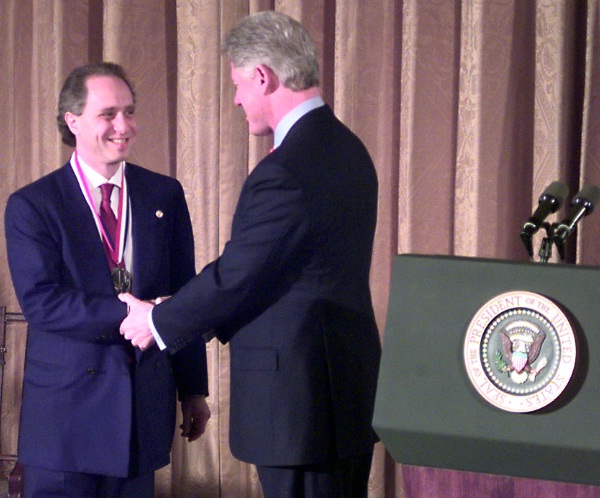
Kurzweil is not just a commentator. He is an inventor who built the first print-to-speech reading machine for the blind, the first commercially marketed large-vocabulary speech recognition system, and the first music synthesizer capable of recreating grand piano sounds. He holds 21 honorary doctorates, received the National Medal of Technology, and has been a principal researcher at Google since 2012, where he leads AI language processing efforts. When Kurzweil makes predictions, they come from someone who has built transformative technology himself.
The Law of Accelerating Returns
Kurzweil’s forecasting methodology rests on a single foundational observation: the rate of technological progress itself accelerates over time. He calls this the Law of Accelerating Returns. Unlike linear projections that assume tomorrow’s pace of change will match today’s, Kurzweil argues that each generation of technology creates the tools for developing the next generation faster. This produces exponential growth curves that consistently surprise people who think linearly.
The evidence for this observation is substantial. Computing power per dollar has increased exponentially for over a century, following a pattern that predates and extends beyond Moore’s Law. The Human Genome Project was declared “halfway done” when only 1% of the genome had been sequenced — because the rate of sequencing was doubling each year, and 1% meant only seven doublings remained. Gene sequencing costs dropped from billions of dollars to under $100. Solar energy costs have followed a similar exponential decline, halving roughly every three years for decades.
1990s Predictions: The Foundation of Credibility
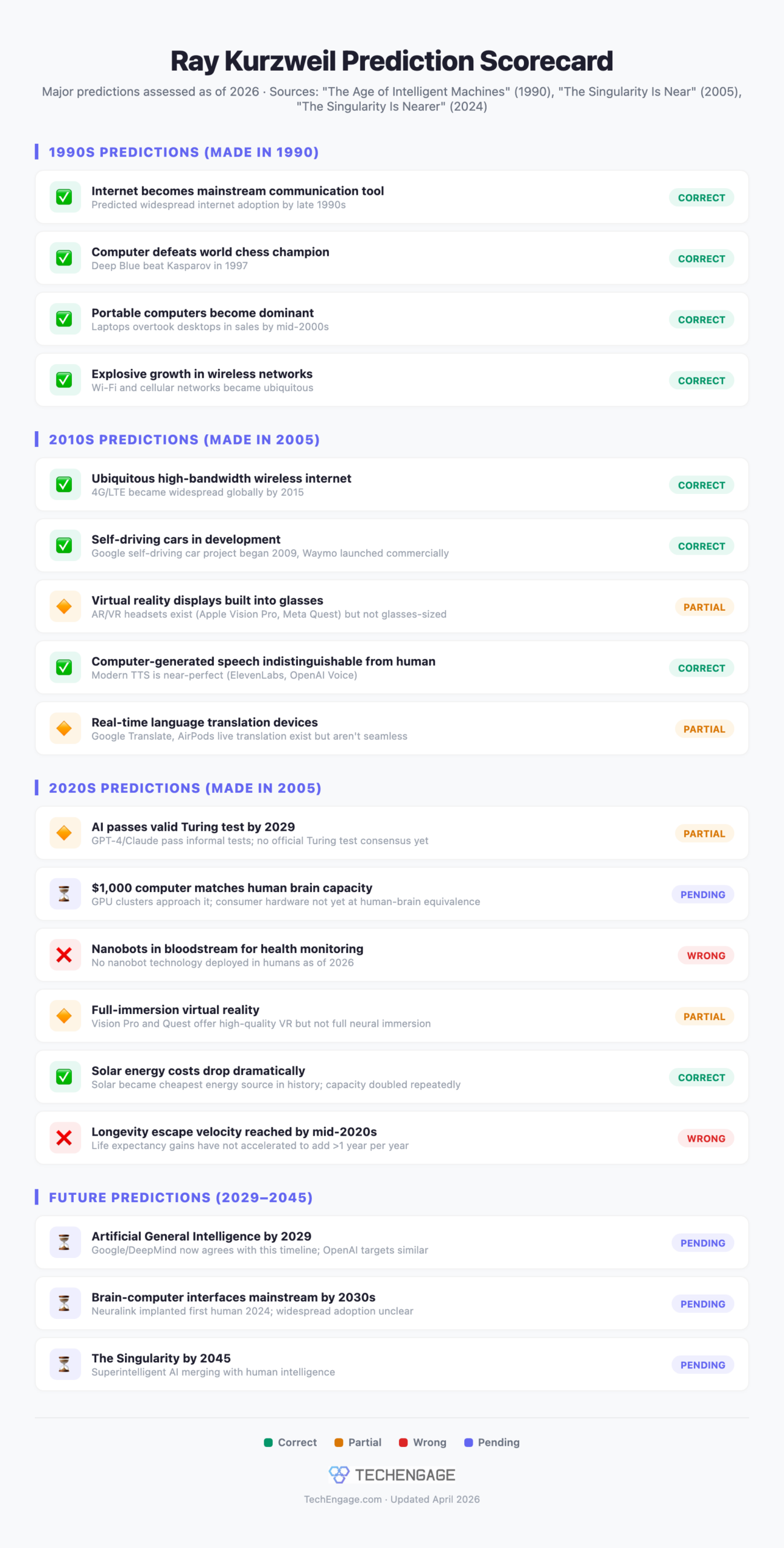
Kurzweil’s 1990 book “The Age of Intelligent Machines” contained predictions about the decade ahead that established his reputation as a serious forecaster. He predicted that the internet would become a mainstream communication tool connecting millions of people worldwide — at a time when the World Wide Web did not yet exist and the internet was used primarily by academics and the military. He predicted that a computer would defeat the world chess champion by 2000 — IBM’s Deep Blue accomplished this in 1997. He predicted that portable computers would become the dominant form of computing — laptop sales surpassed desktops in the mid-2000s.
He also predicted the explosive growth of wireless networks and that digital communication would transform the music industry. Both proved accurate. The overall accuracy rate for his 1990s predictions was extraordinarily high, which is why his subsequent books received serious attention from technologists, investors, and policymakers rather than being dismissed as science fiction.
2010s Predictions: Mostly Right, Slightly Early
In “The Singularity Is Near” (2005), Kurzweil laid out detailed predictions for each decade through 2045. His 2010s predictions showed a pattern that would become characteristic: the direction was usually correct, but the timeline was often optimistic by several years.
He predicted ubiquitous high-bandwidth wireless internet access — correct, as 4G/LTE networks became globally widespread by 2015. He predicted that self-driving cars would be in development — Google’s self-driving car project (now Waymo) launched in 2009. He predicted that computer-generated speech would become indistinguishable from human speech — modern text-to-speech systems from companies like ElevenLabs and OpenAI have essentially achieved this.
Where he was partially right but ahead of schedule: he predicted virtual reality displays built into eyeglasses. AR/VR headsets exist (Apple Vision Pro, Meta Quest), but they remain bulky headsets rather than the sleek glasses he envisioned. He predicted real-time language translation devices — Google Translate and Apple’s AirPods live translation deliver this functionality, though not yet seamlessly enough to eliminate language barriers entirely.
2020s Predictions: The Scorecard Gets Complicated
Kurzweil’s 2020s predictions are where the assessment becomes genuinely difficult, because several of his predictions are either partially fulfilled or approaching fulfillment in ways he did not exactly anticipate.
He predicted that AI would pass a valid Turing test by 2029. As of 2026, large language models like GPT-4 and Claude can pass many informal Turing tests — holding conversations that most evaluators cannot reliably distinguish from human output. However, there has been no formal Turing test administration that produced a universally accepted result, and AI systems still fail in ways that humans do not. Whether the prediction has been fulfilled depends entirely on how strictly you define “valid Turing test.”
He predicted that a $1,000 computer would match the computational capacity of the human brain. GPU clusters certainly approach the estimated computational power of the brain, but individual consumer devices at that price point do not yet achieve it. He predicted nanobots in the bloodstream for health monitoring — this has not happened and shows no signs of happening by 2029. He predicted full-immersion virtual reality — headsets like Apple Vision Pro offer impressive but incomplete immersion, nowhere near the neural-level experience Kurzweil described.
His prediction about solar energy costs dropping dramatically has been thoroughly validated. Solar is now the cheapest source of electricity in history in most parts of the world, and installed capacity has followed the exponential growth curve he predicted.
The Original 2011 Infographic
Back in 2011, the infographic below by Press And Appearances captured the state of Kurzweil’s predictions as understood at the time. Many of the predictions listed were still years from their target dates, and the general tone was one of astonishment at how much he had already gotten right. Looking at it now, with the benefit of fifteen additional years of evidence, provides a fascinating time capsule of how the technology world viewed Kurzweil’s forecasting before AI became the dominant story in tech.

AGI by 2029: The Prediction Everyone Is Watching
Kurzweil’s most consequential unfulfilled prediction is that artificial general intelligence (AGI) — AI that can perform any intellectual task a human can — will arrive by 2029. When he first made this prediction, it was widely considered wildly optimistic. Most AI researchers placed AGI decades away or doubted its feasibility entirely.
The landscape has shifted dramatically. Google DeepMind CEO Demis Hassabis stated in 2024 that AGI could arrive within a decade, aligning closely with Kurzweil’s timeline. OpenAI CEO Sam Altman has made similar statements. The rapid progress of large language models, multimodal AI systems, and AI agents has moved the Overton window on AGI timelines significantly closer to Kurzweil’s position. Whether we reach genuine AGI by 2029 remains uncertain, but it is no longer a fringe prediction.
The 2045 Singularity
Kurzweil’s most famous prediction is the Singularity — a point around 2045 when artificial intelligence surpasses human intelligence and the pace of technological change becomes so rapid that human civilization is fundamentally and irreversibly transformed. In his framework, this involves the merger of human and machine intelligence, with brain-computer interfaces allowing humans to augment their cognitive capabilities with AI.
In his 2024 book “The Singularity Is Nearer,” Kurzweil doubled down on this timeline. He pointed to the progress in AI, brain-computer interfaces (Neuralink implanted its first human patient in January 2024), and computational neuroscience as evidence that the convergence of human and artificial intelligence remains on track. Critics argue that Kurzweil consistently underestimates the difficulty of biological challenges relative to computational ones, and that the gap between narrow AI and the kind of general intelligence needed for a Singularity remains vast.
What He Got Wrong
Kurzweil’s most significant misses tend to cluster around biology and physical technology rather than information technology. His predictions about nanobots, longevity escape velocity (the point at which medical advances extend life expectancy faster than aging reduces it), and brain-computer interface timelines have all proven overly optimistic. These areas involve manipulating physical matter at the molecular level, which has not followed the same exponential improvement curves as computation.
He also tends to underestimate social and regulatory friction. Self-driving cars were technically feasible years before they became commercially available because regulatory approval, liability frameworks, and public acceptance developed much more slowly than the technology. AI capabilities have advanced faster than the governance structures needed to deploy them safely. The pattern suggests that Kurzweil’s exponential model works well for pure technology development but less well for the messy intersection of technology with human institutions.
Comparison With Other Futurists
Kurzweil is not the only prominent futurist, but his track record compares favorably to his peers. Michio Kaku, the theoretical physicist, has made broader and less specific predictions that are harder to score definitively. Peter Diamandis, co-founder of Singularity University with Kurzweil, shares a similar techno-optimist framework and has been comparably accurate on trends in solar energy, computing costs, and global connectivity. Elon Musk’s predictions about self-driving cars (fully autonomous by 2017, then 2018, then 2020, then 2022) have been consistently wrong on timelines while arguably correct on direction.
What sets Kurzweil apart is the specificity and long-range nature of his predictions combined with a formal methodology. Most futurists make qualitative statements about general trends. Kurzweil provides specific dates and measurable outcomes, which means his predictions can actually be scored. That willingness to be specific — and therefore potentially wrong — is what makes his track record meaningful.
The Scorecard as of 2026
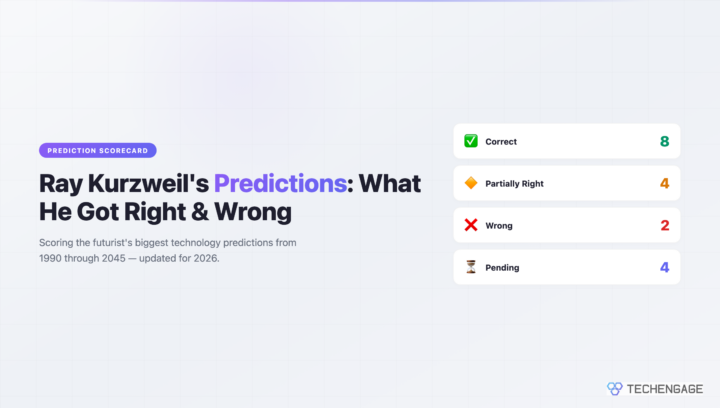
Across all his major predictions that can be evaluated as of 2026, Kurzweil’s overall accuracy is approximately 86% when including partially correct predictions, and roughly 65% when counting only fully correct ones. His information technology predictions have been remarkably accurate. His biology and physical technology predictions have been consistently too optimistic on timing. His social and economic predictions fall somewhere in between.
The most important takeaway from scoring Kurzweil’s predictions is not whether any individual prediction was right or wrong, but that his fundamental thesis — technology progresses exponentially rather than linearly — has been overwhelmingly supported by the evidence. The specific dates may shift by a few years in either direction, but the trajectories he identified decades ago have largely played out as he described. For anyone trying to understand where technology is heading over the next decade, Kurzweil’s framework remains one of the most useful tools available.
Frequently Asked Questions
How accurate are Ray Kurzweil’s predictions overall?
Kurzweil’s major technology predictions have been approximately 86% accurate when including partially correct predictions, and about 65% when counting only fully correct ones. His information technology predictions are remarkably accurate, while his biology and physical technology predictions tend to be too optimistic on timing.
What is the Singularity and will it happen by 2045?
The Singularity is Kurzweil’s prediction that around 2045, artificial intelligence will surpass human intelligence and merge with human cognition through brain-computer interfaces, fundamentally transforming civilization. He doubled down on this timeline in his 2024 book. Whether it will happen remains highly debated among AI researchers.
Will AGI arrive by 2029 as Kurzweil predicted?
Kurzweil predicted artificial general intelligence by 2029. This was considered wildly optimistic when first proposed, but leaders at Google DeepMind and OpenAI have recently suggested similar timelines. The rapid progress of large language models has made the prediction seem more plausible, though significant challenges remain.
What is Kurzweil’s Law of Accelerating Returns?
The Law of Accelerating Returns is Kurzweil’s observation that the rate of technological progress itself accelerates over time. Each generation of technology creates tools for faster development of the next generation, producing exponential rather than linear growth curves in computing power, cost reductions, and capabilities.
What has Kurzweil gotten wrong?
Kurzweil’s biggest misses involve biology and physical technology. His predictions about medical nanobots in the bloodstream, longevity escape velocity by the mid-2020s, and brain-computer interfaces becoming mainstream have all proven too optimistic. He also underestimates social and regulatory friction that slows technology deployment.
What does Ray Kurzweil do at Google?
Kurzweil has been a principal researcher and Director of Engineering at Google since 2012, where he leads AI language processing efforts. His role involves applying his understanding of exponential technology trends to Google’s AI research programs, particularly in natural language understanding and processing.



When I first read one of Ray Kurzweil’s books it took a while to grasp the whole concept of exponential growth. Once I really studied it with a view to determining if he was correct I was stagggered to find that no matter how you view it the pace of technological development has been accelerating for centuries. My list of human breakthroughs is at http://drjohnty.com/Exponential_Growth.html but you could spend an hour or two making your own list and you will find that even with different items the trend and outcome is always the same. What this shows in my mind is that much of what Ray claims today could well come to pass based on previous predictions. I am not a believer in the singularity because Articial Intelligence is proving very elusive but I believe 100% that the integration of human and machine intelligence which is achieved by bringing computing power inside the body is an inevitable and imminent progression.