

Disclosure: TechEngage is a participant in the Amazon Services LLC Associates Program, an affiliate advertising program designed to provide a means for sites to earn fees by linking to Amazon.com and affiliated sites. We may earn a commission when you buy through links on this page, at no extra cost to you. Our editorial picks are made independently of these partnerships.
In January 2011, we first reported on something that seemed small but carried enormous implications: Google was quietly removing torrent-related keywords from its autocomplete and Instant Search features. No announcement. No press release. Just a silent edit to the suggestions engine that billions of people rely on daily.
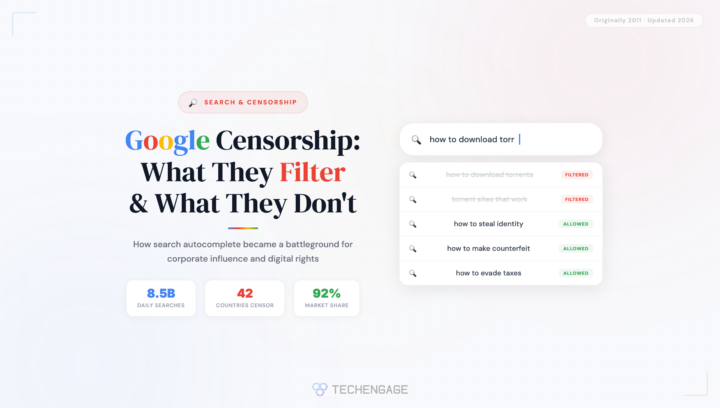
The original article pointed out an uncomfortable hypocrisy. While Google filtered suggestions for “BitTorrent” and other file-sharing terms, it happily autocompleted searches for objectively more harmful activities. The piece went viral, generating thousands of comments and sparking a debate that, fifteen years later, has only grown more relevant.
Because Google’s censorship practices didn’t stop at torrents. They expanded, evolved, and became a template for how the world’s dominant search engine decides what 8.5 billion daily searches should and shouldn’t see.
The Original Discovery: Torrent Autocomplete Filtering
The observation in 2011 was straightforward. If you typed “BitTorren” into Google, omitting just the final letter, the autocomplete engine returned nothing useful. For nearly every other partial word in the English language, Google’s predictive text would complete it. But torrent-related terms were treated differently. They were deliberately excluded from suggestions.
Google wasn’t blocking search results. You could still type “BitTorrent” in full, press enter, and get 76 million results. The filtering happened at the suggestion layer, the part of the experience that guides what most people search for. It was a subtle form of influence rather than outright suppression, but the effect was real: if a search term never appeared as a suggestion, fewer people would search for it.
The reason was corporate pressure. The RIAA (Recording Industry Association of America) and MPAA (Motion Picture Association of America) had been lobbying tech companies to curb access to piracy-related tools. Google, facing potential legal action and wanting to maintain relationships with content industries, complied. But they did it quietly, without transparency about what was being filtered or why.
The Seven Things Google Didn’t Censor
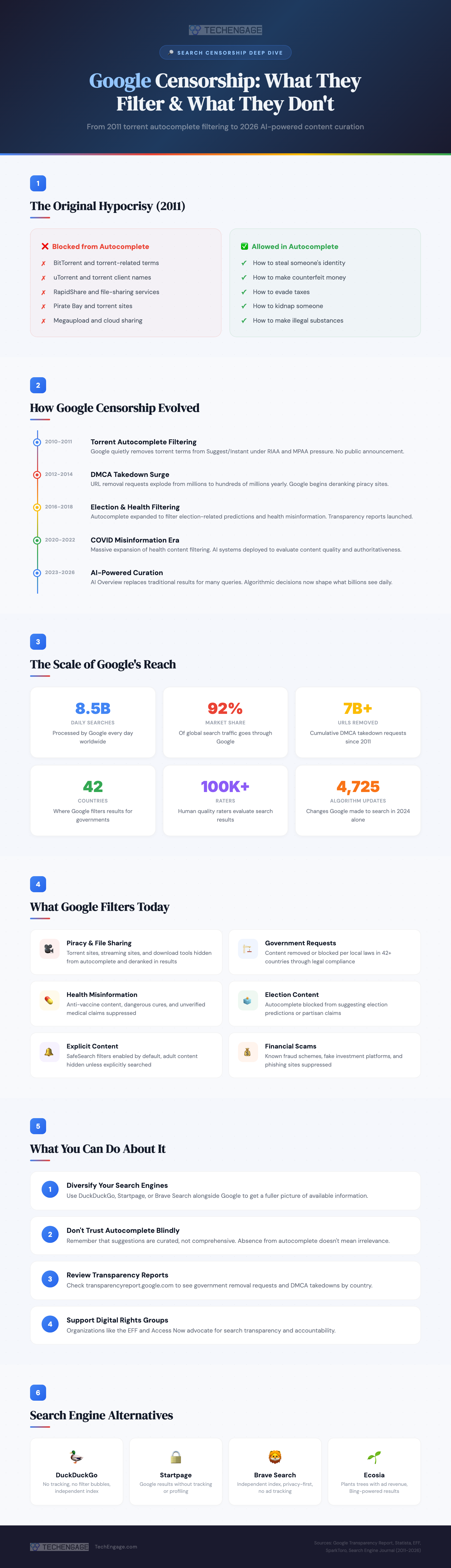
What made the original article resonate so strongly was the contrast. While Google removed autocomplete suggestions for file-sharing tools (which have numerous legal uses), it readily suggested searches for activities that are unambiguously harmful or illegal. The 2011 examples included searches related to identity theft, making counterfeit currency, tax evasion, drug manufacturing, and kidnapping, all of which Google’s autocomplete was perfectly willing to assist with.
The implication was clear: Google’s filtering wasn’t driven by concern for public safety or legality. It was driven by which industries had enough lobbying power to pressure changes. The entertainment industry could afford lawyers and lobbyists. Potential victims of identity theft or drug manufacturing couldn’t exert the same pressure on a tech company’s search algorithm.
This selective approach to filtering revealed something fundamental about how technology companies make decisions about information access. The question was never “what’s harmful?” It was “who’s complaining loudly enough?”
How Google Censorship Has Evolved Since 2011
The torrent autocomplete filtering was just the beginning. Over the past fifteen years, Google’s approach to controlling what users see has expanded dramatically in scope and sophistication.
Content deranking and removal. Google now actively removes entire URLs from search results in response to DMCA takedown requests. According to Google’s own transparency report, the company has processed over 7 billion URL removal requests since it started tracking in 2011. The volume has grown exponentially, from a few million per year to hundreds of millions annually.
Government censorship compliance. Google operates localized versions of its search engine in countries with strict censorship laws. In at least 42 countries, Google filters results based on government requests. While Google pulled its search engine out of mainland China in 2010, the company continues to comply with censorship requirements in dozens of other markets, often with minimal public disclosure about what’s being hidden.
Autocomplete manipulation has expanded. Beyond torrent terms, Google now filters autocomplete suggestions related to election content, health misinformation, explicit material, and various other categories. The company published broad guidelines about what it filters but doesn’t provide specific lists of suppressed terms. The lack of transparency that characterized the 2011 torrent filtering remains a defining feature of Google’s approach.
AI-powered content curation. Google’s search algorithms have become far more sophisticated. AI systems now evaluate content quality, authoritativeness, and potential for harm. While these systems have genuine benefits (reducing the visibility of misinformation, for example), they also give Google unprecedented power to shape what information reaches the public, with limited external oversight of how that power is exercised.
The Free Speech Debate
The comments on the original 2011 article captured a debate that still rages today. Some readers argued that a private company has every right to decide what appears in its products. Others countered that when a single company controls 92% of the global search market, its editorial decisions carry the weight of censorship regardless of legal definitions.
The legal framework is clear: the First Amendment protects individuals from government censorship, not from a corporation’s product decisions. Google can legally filter whatever it wants from autocomplete. But the ethical and societal implications extend far beyond legal technicalities.
When one company processes 8.5 billion searches per day and controls how suggestions are presented for the vast majority of those queries, the distinction between “editorial discretion” and “information gatekeeping” becomes uncomfortably thin. As one commenter on the original article noted, if Google can remove torrent suggestions under corporate pressure today, what stops them from manipulating suggestions about political candidates, competing products, or uncomfortable truths tomorrow?
The Broader Pattern of Tech Censorship
Google’s search filtering didn’t happen in isolation. It fits into a broader pattern of technology companies exercising editorial control while maintaining the public image of neutral platforms.
Facebook (now Meta) has its own content moderation policies that determine what 3 billion users see in their feeds. Apple controls what apps can appear in its App Store, effectively deciding what software is available to over a billion iPhone users. Amazon decides which products get prominent placement in search results, shaping purchasing decisions at massive scale.
The pattern is consistent: these companies make content filtering decisions based on a combination of legal pressure, advertiser preferences, and internal policy, rarely with meaningful transparency about the criteria or the specific content affected. The torrent autocomplete filtering that seemed like a minor issue in 2011 was actually an early signal of how platform power would reshape information access globally.
What This Means for Users Today
Understanding that Google filters its suggestions and results isn’t a reason to abandon the search engine. It’s a reason to use it more thoughtfully. Here are practical takeaways.
Diversify your search engines. Use alternatives like DuckDuckGo, Startpage, or Brave Search for sensitive queries. Each engine has different filtering policies, so cross-referencing results gives you a more complete picture.
Don’t rely on autocomplete as a complete picture. Remember that suggestions are curated, not comprehensive. If a topic doesn’t appear in autocomplete, that doesn’t mean it’s irrelevant or nonexistent. It may mean someone decided you shouldn’t see it.
Check Google’s transparency reports. Google publishes regular reports about government removal requests, DMCA takedowns, and other content actions. These reports, available at transparencyreport.google.com, provide at least partial visibility into how filtering decisions are made.
Support digital rights organizations. Groups like the Electronic Frontier Foundation (EFF) and Access Now advocate for transparency and accountability in how technology companies handle information access. Their work is more important now than it was in 2011.
The Irony That Persists
Perhaps the most striking thing about revisiting this topic fifteen years later is how little the core irony has changed. Google still filters suggestions for content that powerful industries object to while readily suggesting searches that could facilitate genuine harm. The specifics have shifted. Torrent filtering is now just one small piece of a much larger content moderation apparatus. But the fundamental dynamic remains: corporate influence shapes what you see in the search bar more than any concern for public welfare.
The original article’s conclusion still holds: Google has every legal right to filter its products however it chooses. And users have every right to be aware that those filters exist, to question who benefits from them, and to seek information through multiple channels rather than trusting any single gatekeep with the entirety of human knowledge.
Frequently Asked Questions
Does Google censor its search autocomplete suggestions?
Yes. Google filters certain keywords and phrases from its autocomplete and search suggestion features. This includes torrent-related terms, explicit content, certain health misinformation, and content flagged through legal or corporate pressure. While full search results may still appear when you press enter, the suggestion layer is curated to exclude specific topics.
Why does Google censor torrent-related search suggestions?
Google began filtering torrent-related autocomplete suggestions around 2010-2011 in response to pressure from the RIAA and MPAA, which argued that autocomplete suggestions for torrent sites facilitated copyright infringement. Google complied to avoid potential legal action and maintain relationships with the entertainment industry. This filtering continues in 2026.
Is Google’s autocomplete filtering considered censorship?
This is debated. Legally, the First Amendment only protects against government censorship, not private company decisions. However, given that Google controls approximately 92% of the global search market and processes 8.5 billion searches daily, many digital rights advocates argue that its filtering decisions have the practical effect of censorship, even if they don’t meet the strict legal definition.
How many countries does Google censor search results in?
Google filters or removes search results in response to government requests in at least 42 countries. The company publishes transparency reports detailing these requests at transparencyreport.google.com. Since 2011, Google has processed over 7 billion URL removal requests globally.
What are the best alternatives to Google for uncensored search?
DuckDuckGo, Startpage, and Brave Search are popular alternatives that emphasize privacy and reduced filtering. DuckDuckGo doesn’t track users or personalize results. Startpage delivers Google results without the tracking. Brave Search uses its own independent index. Using multiple search engines gives you the most complete picture of available information.
Has Google’s search censorship gotten better or worse since 2011?
The scope of filtering has expanded significantly. While autocomplete filtering was limited primarily to torrent and explicit terms in 2011, Google now filters suggestions across many more categories including election content, health topics, and various legally contested subjects. Google’s transparency reports provide more visibility than before, but the specific criteria for filtering remain largely opaque.





Your article does have one thing going for it: nice picture. Otherwise, like the other readers said, its a bogus load of crap. Perhaps maybe you should work for TechCrunch 🙂
This is very sad. We are more concerned about digital copyrights of corporate empires, rather than basic humanitarian and ethical principals. I’m really looking forward to the political and economic changes happening right now, perhaps some time in the near future we will have a sensible political system (in the US) that is not sponsored by the corporate world and is not solely focused on pressuring other entities (eg. Google) to implement policies for the benefit of corporate empires
Hahaha! Yeah right, like that’s going to happen…
That is the problem.
And the common person doesn’t even notice how their basic human rights and privacy rights are being violated, for no other reason, than rich companies with people in powerful positions, doing so because they can.
Those are fairly suspicious, but in Google’s defense searching for “Bittorrent” (and pressing ‘enter’) does return results. It did correct “Bitorren” and came up with Bittorrent for the first result under “bitt” as a search.
Just doing the devil’s advocate thing.
Not true. I just googled bittorrent form google and with chrome and got this:
About 76,000,000 results (0.14 seconds)
Search Results
BitTorrent
Free, open source file-sharing application effective for distributing very large software and media files. Documentation, FAQ, search-engine.
http://www.bittorrent.com/ – Cached – Similar
Get BitTorrent
Download
Directory Index of Downloads
What Is BitTorrent? | BitTorrent
Got BitTorrent | BitTorrent
BitTorrent Users
Open Source
BitTorrent DNA
More results from bittorrent.com »
►
Get BitTorrent | BitTorrent
The new BitTorrent 6 for Windows brings together BitTorrent’s proven …
http://www.bittorrent.com/btusers/download – Cached
What Is BitTorrent? | BitTorrent
BitTorrent is the global standard for delivering high-quality files over the …
http://www.bittorrent.com/btusers/what-is-bittorrent – Cached – Similar
Show more results from bittorrent.com
Seriously, how is it possible to be as retarded as you, and all the other morons who didn’t AT ALL get what this article was about.
It’s really simple and there is nothing that can be misunderstood.
He never said one thing about google not showing you torrent results you moron.
This is totally bogus. If I type “bittorrent” it gives me suggestions. If I type “torrent” it gives me suggestions. If I type “utorrent” it gives me suggestions. Are you complaining because they won’t give you suggestions on misspellings? Shame on you, find something else to meaninglessly target,
They aren’t saying you can’t search the word, they are saying Google won’t auto complete anything with those words in it because corporations are threatening to sue if they do.
You are clearly retarded. What you just wrote is not even related to what this article is about.
Holy Papyrus, Batman!
hmmm.. google still corrected me when i searched “BitTorren”
I just tried “BitTorren” in my google via Chrome and it completed just fine.
there are alternatives to the censors
https://ssl.scroogle.org/
I just did a search for torrents on Google and had NO such issues, Please explain.
The explanation is that you didn’t understand what you just read.
This info graphic made my eyes BLEED.
Of course, the RIAA doesn’t care if you kidnap children.
except that they show plenty of links once you finish typing all of them. my sense of outrage is underwhelmed.
EFF U GOOGLE. ok that was a bit harsh. i love google, they seem like a legit company, they just need to sort their priorities
Wow, you’re pretty dumb. They didn’t censor anything. They leave it out of the suggestions now. All you have to do is press the “enter” button. Or are you just that lazy?
Leaving out suggestions intentionally is a form of censorship.
No, a government’s use of its coercive power to prohibit suggestions is censorship. A private company leaving out suggestions intentionally is a business decision.
Actually that would be censorship by a corporation. It’s done all the time on ingredient labels, press releases, etc. etc. The difference it that when done by a business as opposed to a government the motives and reasoning tends to be profit driven as opposed to morally driven. It seems to me that this is what the authour is pointing out. I think it’s certainly a valid observation.
“A private company leaving out suggestions intentionally is a business decision”
hahahaha stupid.
Bingo. It cracks me up how few people know what the 1st Amendment really says. You’re protected under the constitution against the government censoring any speech that doesn’t incite violence. A private company is well within its right to decide what is and what isn’t included in their products. I’m a proud Bittorrent-er and I also refuse to pretend to be a victim.
My issue with this is that as far as i know Google doesn’t filter words in context. They just filter words.
So in some cases it may make sense to filter “Meth”
They can’t really filter “kidnap” or “steal” those are very common words.
And it’s not like they are filtering “bittorrent” from their search, their filtering form their auto complete.
I think it’s meant more as a deterrent, If you don’t see ‘ironman torrent” maybe you will be less likely to download it. While if you are going to search “Ironman torrent” anyway auto complete really doesn’t matter.
That is quite possibly the worst graphic I have ever seen. Did you want people to read it and understand it, or did you just want to punch people in the brain with poor design? AND WHY IS IT STARTING TO TILE?
Well, if you are not lazy and type out the full word (bittorrent), then google will give you the results and suggestions.
They aren’t saying you can’t search the word, they are saying Google won’t auto complete anything with those words in it because corporations are threatening to sue if they do.
And yet Google Reader will still quite happily recommend torrent related posts. Odd.
I wasn't believin' …then I tryed…
and is SO TRUE!
I tryed all the ways he listed…
Im from Brazil and google is doing this to torrent users for REAL!
Damm…¬¬
Apparently this is not true but even if it were true I dont see why google should first censor what you think they should before censoring bittorrent. I personally would be delighted not to see torrent links flood my search results.
you people are missing the point. the op is not being lazy and complaining that it won’t autocomplete and that he *has* to hit enter, he’s making a point that google censors words from their autocomplete dictionary, and the dichotomy (look it up) of the harmlessness of word(s) that are censored versus the potentially harmful words/phrases that are not censored.
obviously they can do whatever they like, since it’s their product, but it is an interesting that suggest will suggest things that are blatantly illegal, while censoring terms that are not necessarily illegal.
They need to censor your use of Papyrus.
You use Papyrus, therefore your argument is invalid.
ROFL 🙂 Good Point
Worst article of January 2011 on the internet.
If I go to google.ca, right now, and type in “bittorrent” it gives me nothing… even when I complete the word; same goes for all the other words he listed.
I can guarantee to you, it’s blocked where I am… tried two other computers, got a mac user friend to do it, tried it on firefox, IE, chrome and asked a friend to try Opera just for completeness.
No suggestions.
Hell, it was obvious that Bush and Blair and Howard were lying their butts off about Iraq, and committing vast war crimes…the evidence was all there, they seemed to revel in their villainy, and it was clear they were criminals, yet what did you people do? NOTHING. Ah, but the minute you think someone might be threatening your ability to steal the new Kings Of Leon album or the latest misogynistic torture porn movie, and you’re suddenly Che Guevara fighting for freedom. Hypocrites.
Many of these comments re-enforce the sad fact that people tent to comment on articles they haven’t actually read… I was able to get suggestions from google all the way up to “Bit”, but as soon as I typed “Bitt” the suggestions stopped. Same for other torrent-related searches; the minute that a torrent-related result was the only option the suggestions clearly stopped. This is different from typing in “Bittoren” and getting bittorent results when you finally click “search”. This article is about google suggestions, not google results, and is both accurate and very telling about Google’s priorities.
No to go find that formula for meth…
sorry I just typed bittorren into google and it gave me all sorts of bittorrent results and assumed I’d meant bittorrent. I got 77,7000,000 results. Sorry article is a FAIL!
Read the article and Motorsheep’s comment. This article is about Google suggestions and not searches.
Sorry, you fail…
If you believe in free speech and freedom of information NOTHING SHOULD BE BANNED, Freedom of expression protects what you don’t want to hear or see.
“Try typing in “BitTorren” without the last “t” into Google.”
I did, & got a ton of torrent suggestions. Maybe the author should try it before stating the contrary.
The author knows what his doing.
“In essence, Google is removing keywords from their Suggest and Instant results so that they are no longer recommended when people start typing them.”
Hey guys, it just started with autocomplete. Sure they will censor the results sooner or later.
Yes, they will. Why should MPAA and RIAA. say – “ok, it´s enough”?
In the Italian version of google, if I type “come si fa a f” (“how do I do to m”), one of the autocompletions is “come si fa a fare una pompa” (“how do I do to make a blowjob”).
Hahahah!
Hi,
Censorship in this sense would not be showing you results from your search. Not showing you results live while you type them in is something entirely different, since the information AT THE END OF YOUR SEARCH is still the same.
That this is even being called censorship is completely harebrained and retarded. Get the fuck over it, there is SO MUCH WORSE going on than you not being able to get live results for a search when you type the word ‘titties’ into Google’s search engine.
“So much worse going on”? Do you work in charity and helping save lives? Sounds like you are doing something considered “worthwhile”. Everyone has their own jobs to do.
I think the point is that google’s suggest feature is deemed useful by people. So if you’re telling people that they should stop being lazy, you’re missing the point.
It is a little ridiculous. “ubuntu torr” comes up empty. It is a shocking case of the priorities of $multi-million corporations far outweighing the voices of decent human beings. After all, where’s the profit in saving lives?
It’s certainly not autocompleting for me (www.google.com from the UK):
Love the examples used in the article, it really shows how petty this is. Can we get the State to threaten to sue for all the other illegal stuff you can search for?
(er, hell no BTW)
Come on people, read the article. If you’re not familiar with Google’s Instant or Suggest features, figure that part out first.
I just did a search on “bit tor” and the 1st result was bittorrent.com.
big deal if it doesn’t autocomplete. the info it’s still there. that’s like complaining that these spam companies send me mails to enlarge my schlong but they don’t send me love poems, which is what i really want.
lame.
I see the points of those saying “it’s not really censorship since they don’t block search results”, and if the item in question (bittorrent) was unquestionably and unambiguously illegal, I wouldn’t really have a problem with Google’s position. However, what some people seem to forget is that downloading media is not inherently illegal in any way shape or form. Yes yes, I know people will probably throw figures and statistics at me (most of which are likely made up and have no verification or citation), explaining that the vast majority of downloading is illegal, but if you’ve spent any time browsing Legal Torrents or other similar sites, legally offering content, with the consent and blessing of the owners of said content, and if you’re heard the commentaries from musicians and others who argue that the downloading culture has actually generated fans for them (and revenue as a result, in many cases)… let’s just say this is about as stupid as adding an extra tax on blank tapes (anyone else remember the 80s) or blank CDs. Plain and simple, it’s punishing those who use the process legitimately. I’ve seen this time and time again: 1) make a problem seem worse than it is, especially when the only so-called victims don’t really need any help, 2) offer a solution that make it seem like you’re helping to solve the “problem”, 3) ignore the fact that the solution doesn’t actually solve anything in a practical sense.
Actually #37 this is the very definition of censorship. Censorship is any attempt to filter or remove information from consciousness. Of course there are ways around censorship, there have always been. The point is that it is happening one step at a time. It’s not a question of being “too lazy” to hit the enter key or the fact that they are censoring autocomplete instead of results. The point is that a private corporation is censoring media under pressure from another private organization.
It is a big deal mainly because this is the exact foot-in-the-door the RIAA and MPAA needed. By censoring torrents, Google sent the world several messages; the most prominent of which is that torrents (and the websites who host them) are illegal.
Autocomplete/Autosuggest only provides 5 suggestions anyway. Are we saying any possibly relevant suggestion that doesn’t make it into that top 5 is censorship? Hey, I typed “bit” and it didn’t suggest “bittern” to me – why is Google censoring birds?!?
I call bullshit on this article. It auto-completed fine, It returned tens of millions of resluts once entered. Why is he trying to spread these lies?
Certainly I don't understand such arrival on Torrent. Probably it is connected with pressure from legal owners. After such statement I for myself have found torrent search engine . Fortunately today it is a lot of them. Thus I have solved for myself a problem of search of torrent-files.
thank you for pointing this out!
I probably never would have noticed otherwise
‘rapidshare’ and ‘megaupload’ also not auto-completed wowow
UGH the Internet is so awesome/weird/maddening
FYI when u try to post this link on facebook it soesnt show any pictures or any of the story like it does with other links maybe to make it look less interesting so people wont click on it.
OMG you serious? Facebook and Google are conspiring, Lmao
i also don’t agree to all this they don’t even ban “how to hack gmail password”, have look here: http://img248.imageshack.us/i/20110129093544.png/
Google stops auto-suggesting if the RESULTS brings up dodgy stuff, it’s the same with google instant. Does the same for some swear words. You can search for it, but it won’t auto-suggest.
You are comparing auto complete on frases with auto complete on a single word…
If you type “torrent ava” it will suggest “torrent avatar” and “torrent avatar the last airbender”.
People really like to make up conspiracy stories… Just get a life.
So you want google to be your nanny ? instead of fighting for allowing search for EVERYTHING you want them to censor more ? Sheep.
so just because you can’t auto-complete the words it means that they’re censoring it? I tried it out myself and you can still search for and find the websites
The picture showing the list is missing…
Just tried it out, it’s true, no auto-completion. Only when full word is typed, results appear…
Try “rapidshare”, the same happens…
You should probably learn to spell “past” before creating more graphics.
Okay next person who refutes this article by mentioning search results or spelling suggestions instead of the AUTO-COMPLETE behavior gets an idiot badge.
Yep, it made me type in all of bittorrent but to be fair, I typed P and piratebay was suggested str8 away.
You people talk about this being a business decision, well that’s exactly what it is. It’s a consumer decision to point these things out on a blog. The point is Google claims to be an organic search engine, when really that is less and less true everyday. As more and more people that realize this, Google might make a different business decision.
As long as the corporations don’t lose money, people can steal money, kidnap children, make meth, and dodge taxes. nice
um, just tiped “bit” into the Search bar and the first suggestion is … bittorrent !! … i don’t use google.com, i use http://www.google.ro/ig?hl=ro, and i also tried on google.com and still the first suggestion is bittorrent … this could be because of the region, or the language, or because i’m using Chrome … or because this whole thing is f***ed up !!
I’m sorry, but this is a non-issue. So torrents aren’t offered as autosuggestions–so WHAT? There’s effectively no censorship going on, so I acutally resent the implication of there being one. If you search for torrents, you get results, so where’s the crime (heh heh, get it, the “crime”?)? You’re making a big deal out of the fact that they’re not listed under autosuggestions? That’s petty, and ultimately pointless. And better Google should deal with the torrent issue in this manner than outright banning torrent-related search results altogether, don’t you think? GOD, the crap that makes it into articles sometimes, I mean, really now…
But Google is reinforcing the notion that torrents can only be used for illegal purposes. It’s a small gesture towards keeping torrents taboo, but one that hundreds of millions of people are exposed to daily.
ArchK, you are a total retard.
That is 100% censorship. They are indirectly trying to prevent people
from finding out about torrents, and to make it harder for the people
who already know.
Because of what? Because some powerful companies push them to.
Where does it stop? Next they might remove the name of a presidential candidate from the suggestions, to try to affect an election.
If they are doing this already, what are they also filtering out of their search results? You would never know what manipulations they are doing to the search results.
So get it into you teeny mind, that this is about more than just torrents.
Google recently introduced Instant Searches, way for people to easily search without completing the whole keyword or term that you want to search. Although I understand the validity of comments here saying to just complete the whole word and get it over with, I think the author has a point. With Google introducing this new way of searching, they are actually making people get used to not completing keywords and rely more on their recommended instant search results. If this happens, those filtered by the instant search gets no traffic unless they key in the whole term and press enter.
Google also have Google TV.. and in a way the torrent censoring will support Google TV because lots of torrent are also movies and tv shows.
I have always loved google and still do but I can’t condone their decision while so many other things are not censored. There should be no censorship at all. Google bending to the will of the MPA and the RIAA is disappointing and has made me switch to another search engine. Sure they don’t care what I think and many others may would say well if you are not going to use google search you should stop using all their products. Maybe that will happen in time, for now, just the search engine. Consumers vote for what they want with their dollars and in this case, its with their default home page and search engine.
sad
If they want to curb piracy, they should censor “warez”, “rom”, “crack”, “keygen”, and others. Because typing the name of a popular game all too often has a rom of the game on its suggest list. Then youngsters will learn that you can get the game for free, and then new pirates will be born.
please do the world a favor and never use papyrus again…
This just isn’t even true.
The censoring part i mean.
FUCK google, at least they don’t censor as bad as bing.
I came across this article doing a google search for your books torrent. I can’t find it but this article was very interesting.
eh, that’s ok, if the government get their way, they will be censoring the websites you can get to on the web anyways, so much for freedom….
Have you thought that maybe they are just trying to not get sued by the evil RIAA or litigious porno producers ? Facebbok did something similar in removing all links to TPB. I doubt that was censorship. Its just their lawyers watching their own AS*!
And please stop whining about your rights being threatened when you feel threatened that you thievery may one day come to an end.