

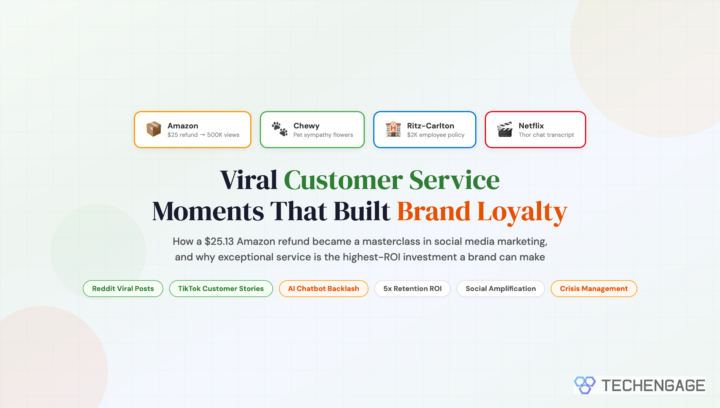
In October 2011, a Reddit user named zambuka42 posted a screenshot of an Amazon customer service chat. The details were ordinary: a package shipped to his parents’ house got lost by USPS while being forwarded to Tanzania, where he was volunteering. He contacted Amazon hoping for a simple way to reorder. What happened instead was that the customer service agent, named Karthikeyan, offered a full refund for the $25.13 order without hesitation, even though the shipping failure was entirely USPS’s fault.
The screenshot hit the front page of Reddit. Half a million people viewed it within days. Over a thousand comments piled up, most of them sharing their own positive Amazon experiences. An Amazon representative contacted the original poster, confirmed the story, and said they planned to use it in customer service training.
Cost to Amazon: $25.13. Value of the exposure: incalculable.
That interaction became one of the earliest viral demonstrations of a principle that has only grown more powerful in the years since. In a world where every customer carries a broadcast studio in their pocket, a single exceptional service moment can generate more authentic brand goodwill than millions of dollars in advertising.
Amazon’s Customer Obsession Philosophy
The zambuka42 story didn’t happen by accident. Amazon’s customer service philosophy was architected from the top. Jeff Bezos’s first shareholder letter in 1997 used the phrase “customer obsession” and it appeared in every annual letter afterward. Amazon’s Leadership Principles, posted publicly and used in every hiring decision, list “Customer Obsession” as principle number one, ahead of “Ownership,” “Invent and Simplify,” and all others.
In practice, this translated to policies that would horrify a traditional retailer. Amazon accepts returns on almost anything with minimal friction. It refunds orders lost by carriers even when Amazon isn’t at fault (exactly what happened in the Reddit story). It proactively issues credits when delivery estimates are missed. Jeff Bezos famously kept an empty chair in meetings to represent the customer.
Under Andy Jassy, who took over as CEO in July 2021, the customer obsession rhetoric continues, though the company has faced growing criticism about warehouse worker conditions creating tension between customer experience and employee experience. That contradiction is worth noting: Amazon’s customer-facing service remains exceptional while its internal labor practices draw consistent scrutiny from outlets like The New York Times and labor organizations.
The Brands That Turned Service Into Marketing
Amazon wasn’t alone. Several companies have built their entire brand identity around customer service moments that go viral organically.
Chewy: The Pet Sympathy Package
Chewy, the online pet retailer acquired by PetSmart for $3.35 billion in 2017, became famous for sending handwritten sympathy cards and flowers to customers who reported a pet’s death. Customers who called to cancel auto-ship orders for deceased pets received not just immediate cancellation (no retention attempts) but often a hand-painted portrait of their pet mailed weeks later.
These stories flood Reddit, X, and TikTok regularly. A single Chewy sympathy post on Reddit in 2022 received over 80,000 upvotes. The company spends real money on this (custom pet portraits aren’t cheap at scale), but the earned media value dwarfs the cost. Chewy’s customer retention rates consistently exceed industry averages, and their Net Promoter Score ranks among the highest in e-commerce.
Ritz-Carlton: The $2,000 Rule
The Ritz-Carlton hotel chain empowers every single employee, from front desk staff to housekeeping, to spend up to $2,000 per guest per incident to resolve a problem or enhance an experience, without manager approval. A housekeeper can order a birthday cake. A bellhop can rebook a flight. A front desk agent can comp a night’s stay.
The most famous Ritz-Carlton story involves a family who left their child’s stuffed giraffe at the hotel. Not only did the staff find and return it, but they photographed the giraffe “enjoying” hotel amenities (lounging by the pool, getting a spa treatment, relaxing at the bar) and sent the photos along with the stuffed animal. That story has been told in business schools, keynote speeches, and customer service training programs for over a decade.
Netflix: The Thor Chat Transcript
In 2014, a Netflix customer service chat went viral when the support agent introduced himself as “Captain Mike of the good ship Netflix” and asked the customer to role-play as Thor, god of thunder, for the duration of the support interaction. The entire conversation was conducted in character, with both parties maintaining the bit while actually resolving the technical issue. The screenshot spread across Tumblr, Reddit, and Twitter, generating millions of impressions.
Netflix didn’t script this. They created an environment where a support agent felt safe being creative and fun during a routine interaction. That cultural permission, not a specific policy, is what separates companies that generate viral service moments from those that don’t.
The Math Behind Exceptional Service
The business case for over-the-top customer service isn’t just about viral moments. The underlying economics strongly favor retention over acquisition.
According to research published by the Harvard Business Review, acquiring a new customer costs five to twenty-five times more than retaining an existing one. A study by Bain & Company (the consulting firm that developed the Net Promoter Score) found that increasing customer retention rates by just 5% increases profits by 25-95%.
That Amazon refund of $25.13? The lifetime value of an Amazon Prime member is estimated at $2,500+ per year in spending. Losing a customer over a $25 dispute would be financially absurd. The refund wasn’t generosity. It was basic math. Every company that invests in service quality is making the same calculation, whether they articulate it that way or not.
Social media amplifies this math dramatically. A single positive service interaction posted on Reddit, X, or TikTok can reach millions of people at zero media cost. Sprout Social’s 2024 Index found that 76% of consumers notice and value when companies prioritize customer support on social platforms, and 70% expect a response to service complaints on social media within 24 hours.
How Reddit, X, and TikTok Changed the Stakes
When the original Amazon/Reddit story went viral in 2011, Reddit was a niche platform with a few million active users. By 2026, Reddit has over 70 million daily active users and went public on the NYSE. X (formerly Twitter) reaches hundreds of millions. TikTok has over a billion monthly active users globally.
The amplification effect works in both directions. Positive stories go viral and build goodwill. Negative stories go viral and destroy brands. The asymmetry is important: research consistently shows that negative experiences are shared more widely than positive ones (by a ratio of roughly 2:1), and they stick in memory longer.
Companies that have learned this the hard way include United Airlines (the 2017 passenger dragging incident, viewed over 100 million times on social media, costing the company an estimated $1.4 billion in market cap within days), Comcast (the 2014 retention call recording, where an agent refused to cancel service for eight minutes, became a symbol of everything wrong with cable companies), and more recently, several airlines and telecom companies whose automated phone trees and chatbot dead-ends regularly go viral on TikTok.
AI Chatbots vs. Human Support: The Growing Backlash
The rise of AI-powered customer service chatbots since 2023 has created a new tension in the service landscape. Companies including Klarna have publicly touted their AI chatbots handling millions of conversations and replacing hundreds of human agents. Klarna’s CEO claimed their AI assistant does the work of 700 agents.
The cost savings are real. The customer satisfaction impact is mixed at best. A 2025 Gartner survey found that 64% of customers prefer that companies don’t use AI for customer service, and 53% said they would consider switching to a competitor if they learned a company was using AI for support. The frustration isn’t with AI in principle but with AI as a barrier: chatbots that can’t resolve complex issues but also won’t escalate to humans, creating loops that waste customers’ time.
The irony is that the very companies that built their brands on exceptional human service are the ones most tempted by chatbot cost savings. There is a direct conflict between the “customer obsession” philosophy and the “replace humans with AI to improve margins” strategy that has dominated corporate tech spending since 2023. The brands that navigate this well (using AI for simple queries while preserving human agents for complex and emotional situations) will likely outperform those that go all-in on automation.
How Small Businesses Can Compete on Service
The lesson from Amazon, Chewy, and Ritz-Carlton isn’t “spend more money.” It’s “empower your people to make decisions.” Small businesses actually have a structural advantage here because they have fewer layers of approval, more direct owner involvement, and the ability to personalize at a scale that large corporations can only simulate.
A local restaurant owner who personally calls a customer after a bad experience creates a viral moment just as easily as Amazon’s $25 refund. A small e-commerce shop that includes a handwritten thank-you note gets photographed and posted on social media constantly. The tools are the same; the scale is just different.
Practical steps that cost little but generate outsized returns: respond to every online review (positive and negative) within 24 hours, give front-line staff authority to resolve complaints up to a dollar threshold without approval, follow up after resolving issues to confirm satisfaction, and when you make a mistake, own it publicly and fix it visibly. Social media users can spot scripted corporate apologies instantly. Authentic responses from real humans resonate.
That Reddit post from 2011 is thirteen years old, and people still reference it in discussions about customer service. One $25 refund. One empowered agent. One screenshot. That’s all it takes.
Related reading on TechEngage:
- Why Your Business Only Needs Seven Social Media Accounts
- Meta’s Acquisition Strategy: What Facebook Bought and Missed
- Facebook’s Like Button Bait and Switch: A History of Meta’s Dark Patterns
Frequently Asked Questions
What was the famous Amazon Reddit customer service story?
In October 2011, Reddit user zambuka42 shared a screenshot of an Amazon customer service chat where agent Karthikeyan offered a full $25.13 refund for a package lost by USPS, even though it wasn’t Amazon’s fault. The post went viral with over 500,000 views and became one of the most-cited examples of how exceptional customer service generates massive organic marketing value through social media.
How much more does it cost to acquire a new customer vs retaining one?
According to Harvard Business Review research, acquiring a new customer costs five to twenty-five times more than retaining an existing one. Bain and Company research found that increasing customer retention rates by just 5% increases profits by 25-95%. These figures explain why companies like Amazon, Chewy, and Ritz-Carlton invest heavily in service quality rather than viewing refunds and accommodations purely as costs.
Why does Chewy send flowers when pets die?
Chewy sends handwritten sympathy cards, flowers, and sometimes custom hand-painted pet portraits to customers who report a pet’s death. This practice generates enormous organic social media exposure as customers share their experiences on Reddit, X, and TikTok. The cost is significant at scale but far less than equivalent paid advertising, and it drives industry-leading customer retention rates and Net Promoter Scores.
What is the Ritz-Carlton $2,000 employee empowerment rule?
The Ritz-Carlton hotel chain empowers every employee, from housekeeping to front desk staff, to spend up to $2,000 per guest per incident to resolve problems or enhance experiences without needing manager approval. This policy enables staff to make real-time decisions that create memorable experiences, like the famous story where staff photographed a child’s forgotten stuffed giraffe enjoying hotel amenities before returning it.
Are AI chatbots hurting customer service quality?
The impact is mixed. A 2025 Gartner survey found 64% of customers prefer companies not use AI for service, and 53% would consider switching to competitors that use AI support. The frustration centers on chatbots that cannot resolve complex issues but also refuse to escalate to human agents. Companies that use AI for simple queries while preserving human agents for complex and emotional situations tend to maintain higher satisfaction than those that automate aggressively.
How can small businesses compete with big brands on customer service?
Small businesses have structural advantages: fewer approval layers, direct owner involvement, and natural personalization that large corporations can only simulate. Practical high-impact steps include responding to every online review within 24 hours, giving front-line staff authority to resolve complaints up to a dollar threshold without approval, following up after issue resolution, and owning mistakes publicly and authentically. Social media users respond strongly to genuine human responses over scripted corporate messaging.


On the plus side it may make companies more inclined to help. On the negative it could see an increase in ‘markteers’ trying to game the system with fakes.
That actually sounds like it might work dude.
anon-web.es.tc
“TECHI READS REDDIT,
DOESNT GET IT ANYWAY”
hahahaha
I have to say that the few times I’ve needed Amazon customer service, they’ve always been amazing. This doesn’t surprise me at all. They’re one of the few large companies that actually try to make their customers happy.
Keep up the good work, Amazon, and Reddit!
This is a very poorly titled article. Amazon has always provided unparalleled customer service. Reddit didn’t teach it anything.
I don’t think Reddit teaches Amazon in this case. Amazon already knows this, that’s why they’re doing it in the first place. Could teach the rest of the world though 🙂
do you want to make $85 hourly and $7000 per month like me just working on laptop for few houres!Would you like to be your own boss!Opportunities like this don’t come by often.Don’t let this one pass you by!
More like Reddit teaches other companies. Amazon clearly figured it out already.
Did you also read that the people that were upvoting on reddit were amazon?
I’ve never seen such customer service. But would the entire Amazon customer service team be like this?
Interessting Example. I thank it should be standart.