

When Steve Jobs died on October 5, 2011, Apple lost its co-founder and the technology world lost perhaps its most influential figure. Within weeks, tributes began appearing across the globe — bronze statues, renamed streets, memorial services at Apple Stores, and digital tributes that spread across the internet. More than a decade later, these memorials have become permanent fixtures in the cultural landscape, reflecting not just what Jobs accomplished but how deeply his work affected people who never met him.
The scale of these tributes is unusual for a business executive. CEOs build companies, but they rarely inspire the kind of personal devotion that leads cities to erect statues or governments to issue postage stamps. Jobs managed to transcend the corporate world because his products felt personal. The iPhone in your pocket, the Mac on your desk, the way you listened to music — Jobs touched the daily rituals of billions of people. The memorials scattered around the world are a physical record of that impact.
The Budapest GRAPHISOFT Statue: The First Tribute
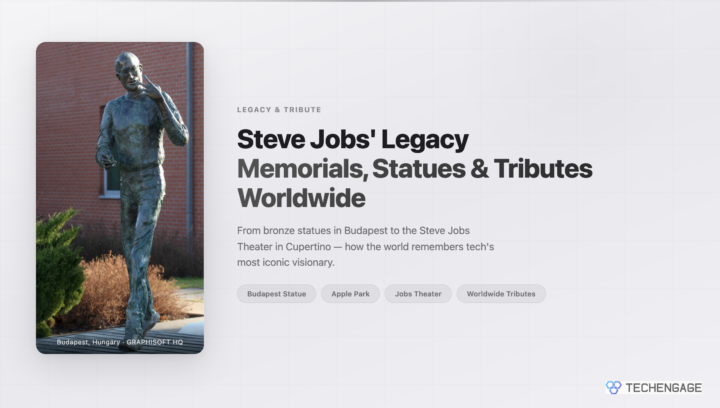
The first known statue of Steve Jobs was unveiled on December 21, 2011, barely two months after his death. It stands in front of the GRAPHISOFT headquarters in Budapest, Hungary — a choice that initially surprised many people. What did a Hungarian software company have to do with Steve Jobs?
The connection runs deep. GRAPHISOFT, founded by Gabor Bojar in 1982, was one of the earliest third-party developers for the Macintosh platform. Their flagship product, ArchiCAD, was among the first building information modeling applications, and it ran exclusively on Apple hardware for years. Bojar credited Jobs with creating the computing environment that made his company possible. When Jobs died, commissioning a statue felt like the natural response.
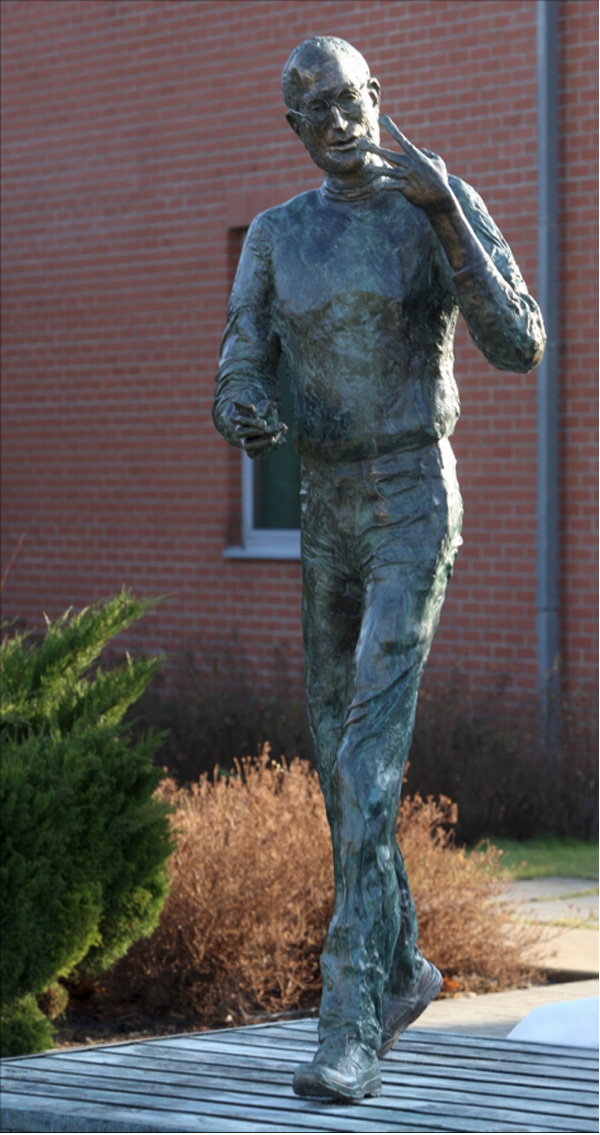
Hungarian sculptor Erno Toth created the life-size bronze piece. It depicts Jobs in his signature uniform — jeans, black turtleneck, and New Balance sneakers — striding forward with one hand raised in a characteristic gesture. The statue captures Jobs mid-thought, as if he were about to make a point during a product presentation. Toth spent weeks studying photographs and video of Jobs to capture his posture and mannerisms. The result is simultaneously lifelike and slightly larger than life, which was exactly the duality Jobs embodied.
The statue attracted international attention when it was unveiled, with reactions ranging from admiration to amusement. Some visitors found the pose dramatic and inspiring. Others thought it looked slightly unsettling. Regardless of aesthetic opinions, the Budapest statue established a precedent: Steve Jobs was not just a businessman worth remembering but a cultural figure worth immortalizing in bronze.
The Bratislava Statue and Other Physical Memorials
Budapest was not the only Central European city to honor Jobs with a statue. Bratislava, Slovakia, unveiled a 2-meter bronze sculpture that depicted Jobs holding an Apple product, positioned in a public space where residents and tourists would encounter it during daily life. The statue was commissioned by a local technology organization and reflected the broader tech community’s reverence for Jobs as a foundational figure.
In other parts of the world, smaller memorials appeared with less fanfare but equal sincerity. Apple enthusiasts in Russia created an iPhone-shaped memorial near a St. Petersburg university. A memorial bench was installed near Jobs’ childhood home in Mountain View, California. Street artists painted murals of Jobs in cities from San Francisco to Beirut, often depicting his face alongside his most famous quotes about creativity and following your heart.
San Francisco officially renamed a stretch of road near the Moscone Center — where Apple held many of its signature product launches — as Steve Jobs Way. The naming was approved by the city’s Board of Supervisors in 2019, making Jobs one of relatively few technology executives to have a street named after them in a major American city.
Apple Park and the Steve Jobs Theater
The most significant physical tribute to Steve Jobs is Apple Park itself. Jobs was deeply involved in the design of Apple’s Cupertino campus before his death, working closely with architect Norman Foster to create a building that reflected his obsession with elegant design and attention to detail. The circular main building, with its curved glass panels and integration with the surrounding landscape, is essentially a Steve Jobs product — a piece of hardware scaled up to building size.
Apple opened Apple Park in April 2017, and the campus quickly became a pilgrimage site for Apple fans and technology enthusiasts. The visitor center, with its Apple Store and rooftop terrace offering views of the ring-shaped main building, attracts hundreds of thousands of visitors annually. For many, visiting Apple Park is the closest they can get to experiencing Jobs’ vision firsthand.
The Steve Jobs Theater, located on a hilltop within the Apple Park campus, is where Apple now holds its major product launch events. The building is a masterpiece of architectural minimalism — a 165-foot-diameter carbon-fiber roof supported entirely by glass walls, with no visible structural columns. The theater seats approximately 1,000 people in an underground auditorium accessed by a dramatic spiral staircase. Tim Cook opened the theater in September 2017 by saying that the building represented Jobs’ vision for the future of Apple.
Every product Apple has launched from that stage since 2017 carries an implicit connection to Jobs. The “one more thing” tradition, the theatrical pacing, the reveal moments — these are all elements of the presentation style Jobs perfected, now performed in a building that bears his name. The Steve Jobs Theater is not just a venue. It is a statement that everything Apple does remains connected to its co-founder’s philosophy.
The Palo Alto Garage: Silicon Valley’s Most Famous Pilgrimage Site
The garage at 2066 Crist Drive in Los Altos, California, where Jobs and Steve Wozniak assembled the first Apple computers in 1976, has become one of the most visited locations in Silicon Valley. The Los Altos Historical Commission designated the Craftsman-style house and its garage as a historic resource in 2013, recognizing its significance in the history of personal computing.
The garage holds a special place in Silicon Valley mythology because it embodies the founding narrative that the tech industry loves to tell about itself: two young engineers starting a world-changing company with nothing but talent and determination. Whether that narrative is entirely accurate (Wozniak has said most of the actual engineering work happened in his own apartment and at Hewlett-Packard’s offices) is less important than what the garage represents. It is the physical origin point of the most valuable company in the world.
Visitors regularly photograph the garage from the street. Some leave flowers or Apple products as informal offerings. Google Maps reviews for the address include emotional tributes from people who traveled from other countries specifically to see where Apple began. The home remains privately owned and is not open to the public, but its significance as a cultural landmark is beyond question.
The 2013 Postage Stamp and Official Recognition
In 2015, the United States Postal Service issued a commemorative postage stamp honoring Steve Jobs. The stamp featured a black-and-white photograph of Jobs looking directly at the camera with his trademark intensity. It was part of the USPS series recognizing Americans who made significant contributions to society.
The stamp’s release was notable because the USPS typically waits at least five years after a person’s death before issuing a commemorative stamp, and the honor is usually reserved for figures with broad cultural significance rather than corporate executives. The fact that Jobs received this recognition reflected a consensus that his contributions extended far beyond business into the broader fabric of American culture.
Hollywood’s Tribute: The Steve Jobs Biopics
Two major biographical films about Jobs reached theaters, each reflecting different aspects of his legacy. The 2013 film “Jobs,” starring Ashton Kutcher, focused on Jobs’ journey from college dropout to Apple co-founder, emphasizing the early years and the founding mythology. The 2015 film “Steve Jobs,” written by Aaron Sorkin and starring Michael Fassbender, took a more experimental approach, structuring the entire film around three product launches (the Macintosh in 1984, NeXT in 1988, and the iMac in 1998).
The Sorkin film in particular captured something essential about Jobs that physical memorials cannot: the complexity of his personality. Fassbender’s portrayal showed Jobs as brilliant and cruel, visionary and petty, capable of inspiring devotion and causing deep personal harm. Critics praised the film for refusing to simplify Jobs into either a saint or a villain. It won widespread critical acclaim and earned Fassbender an Academy Award nomination.
Walter Isaacson’s authorized biography, published just weeks after Jobs’ death in 2011, became one of the best-selling biographies in publishing history. Isaacson conducted more than 40 interviews with Jobs over two years, and the resulting book became the definitive source for understanding Jobs’ life, philosophy, and contradictions. The biography has influenced virtually every subsequent portrayal of Jobs in media.
Tim Cook’s Annual Remembrances
Every year on October 5, Tim Cook posts a tribute to Steve Jobs on social media. These posts have become a quiet but consistent tradition that keeps Jobs’ memory present in public consciousness. Cook’s messages typically include a personal reflection on what he learned from Jobs, paired with a photograph or quote.
Cook’s remembrances serve a dual purpose. They honor Jobs as a mentor and friend, and they reinforce the narrative that Apple’s current direction remains connected to its founder’s vision. When Cook writes about Jobs’ passion for creating products that change people’s lives, he is implicitly arguing that Apple under his leadership carries forward that same mission. The October 5th posts are memorial and marketing simultaneously, which Jobs himself would probably have appreciated.
Other Apple executives and former colleagues regularly share their own remembrances. Jony Ive, who served as Apple’s chief design officer for decades, has spoken publicly about how Jobs influenced his approach to design. Former Apple engineer Andy Hertzfeld maintains a website called Folklore.org that preserves stories from the original Macintosh team, keeping alive the memories of working alongside Jobs during Apple’s formative years.
Apple Store Tributes and the Day the World Mourned
When Jobs’ death was announced on October 5, 2011, Apple Stores around the world became spontaneous memorial sites. People left flowers, candles, handwritten notes, and Apple products outside store entrances. The outpouring was unprecedented for a corporate figure. In New York, the Fifth Avenue Apple Store’s glass cube was surrounded by hundreds of tributes within hours. Similar scenes played out in London, Tokyo, Sydney, and dozens of other cities.
Apple’s website displayed a simple black-and-white photograph of Jobs with the text “Steve Jobs 1955-2011” on its homepage for several days — the longest the company had ever devoted its most valuable digital real estate to anything other than product promotion. The company also created a dedicated email address where people could share memories, and Apple said it received over a million messages.
Digital Memorials and the Fan Community
The internet’s tributes to Jobs were as varied as the platforms they appeared on. Artists created illustrations, animations, and digital portraits. Developers named open-source projects after him. YouTube filled with video tributes, compilation clips of his keynote presentations, and analysis of his design philosophy. The Stanford commencement address he delivered in 2005, in which he discussed death, purpose, and connecting the dots of life, saw a massive surge in views and has since been watched hundreds of millions of times.
Fan communities dedicated to preserving Jobs’ legacy continue to thrive in 2026. Websites archive his keynote presentations, interviews, and internal communications. Social media accounts share daily quotes and lesser-known stories about his career. Apple product collectors specifically seek out items from the Jobs era, treating original iMacs, iPods, and early iPhones as artifacts of a particular moment in technological history.
Jobs’ Influence on Silicon Valley’s Founder Mythology
The memorials dedicated to Jobs reflect something broader than one man’s legacy. They reflect the elevation of the technology founder to a cultural archetype. Before Jobs, people admired inventors and industrialists, but the idea that a CEO could become a beloved public figure on the level of an artist or statesman was unusual. Jobs changed that equation permanently.
After Jobs, the founder-as-visionary became the default narrative for Silicon Valley storytelling. Elon Musk, Mark Zuckerberg, and countless startup founders have been compared to Jobs — sometimes favorably, often unfavorably. The garage founding myth, the turtleneck uniform, the theatrical product launch — these are all elements of the Jobs template that other technology leaders have consciously or unconsciously adopted.
Whether this mythology is healthy for the technology industry is debatable. It tends to concentrate credit and attention on individual leaders while minimizing the contributions of the thousands of engineers, designers, and workers who actually build the products. But as a cultural phenomenon, the founder mythology that Jobs helped create remains one of the most powerful narratives in modern business. Every statue, street naming, and theater dedication reinforces it.
The Legacy in 2026
Fifteen years after his death, Jobs’ influence at Apple remains tangible. The product design philosophy he championed — simplicity, integration of hardware and software, obsessive attention to detail — continues to guide the company’s decisions. Apple Vision Pro, the company’s spatial computing headset launched in 2024, reflects Jobs-era thinking about controlling the entire user experience from chip to software to industrial design. Apple Intelligence, the company’s AI initiative, is being integrated into products with the same emphasis on user experience over technical specifications that defined Jobs’ approach.
Tim Cook has led Apple to become the world’s most valuable public company, a distinction it has held for much of the past decade. But the emotional connection that people feel toward the brand — the reason they line up for product launches, visit Apple Park, and still share Jobs quotes on social media — traces directly back to the culture and values that Jobs established. The memorials around the world are not relics of the past. They are reminders that the impact of a truly original thinker can outlast them by generations.
Frequently Asked Questions
Where is the first Steve Jobs statue located?
The first known Steve Jobs statue was unveiled on December 21, 2011, at the GRAPHISOFT headquarters in Budapest, Hungary. It was sculpted by Hungarian artist Erno Toth and commissioned by GRAPHISOFT founder Gabor Bojar. The life-size bronze statue depicts Jobs in his signature jeans and turtleneck.
What is the Steve Jobs Theater?
The Steve Jobs Theater is an auditorium located within Apple Park in Cupertino, California. It features a 165-foot-diameter carbon-fiber roof supported by glass walls with no visible columns. Apple uses it for major product launch events. Tim Cook opened it in September 2017 as a tribute to Jobs’ vision.
Can you visit the garage where Apple was founded?
The garage at 2066 Crist Drive in Los Altos, California, where Jobs and Wozniak assembled the first Apple computers in 1976, is designated as a historic resource. The home remains privately owned and is not open to the public, but visitors regularly photograph it from the street.
Did Steve Jobs appear on a US postage stamp?
Yes. The United States Postal Service issued a commemorative Steve Jobs stamp in 2015, featuring a black-and-white photograph of Jobs. The USPS typically waits at least five years after a person’s death before issuing a commemorative stamp, and the honor reflected Jobs’ broad cultural significance.
Why does Tim Cook post about Steve Jobs every October 5th?
October 5 is the anniversary of Steve Jobs’ death in 2011. Tim Cook has made it an annual tradition to post a personal tribute on social media, sharing reflections on what he learned from Jobs and reinforcing the connection between Apple’s current direction and its founder’s vision.
How many Steve Jobs movies have been made?
Two major biographical films were released: ‘Jobs’ (2013) starring Ashton Kutcher, which focused on the founding years, and ‘Steve Jobs’ (2015) written by Aaron Sorkin and starring Michael Fassbender, which was structured around three product launches. The Sorkin film earned widespread critical acclaim and an Oscar nomination for Fassbender.





Why is Steve throwing up a gang sign?
Looks like he’s in the projects.
Wow, that looks really creepy. Why would they chose post cancer image of Jobs?