

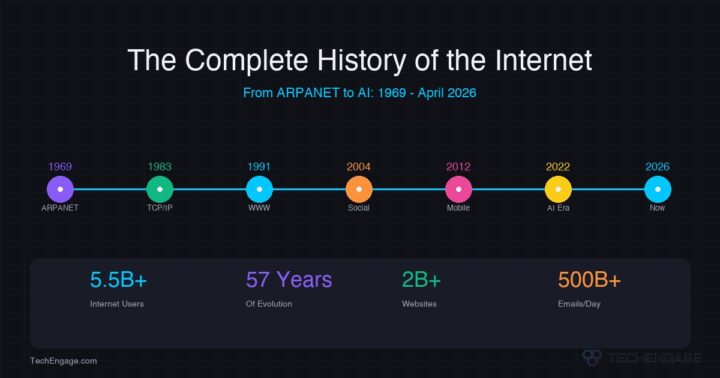
Fifty-seven years ago, a computer at UCLA tried to send the word “LOGIN” to a machine at Stanford. It managed two letters before crashing. That two-character hiccup on October 29, 1969, accidentally became the most consequential message in human history. From that stumbling first transmission on ARPANET to a world where 5.56 billion people carry the entire internet in their pockets, the story of how we got here reads like science fiction written by an impatient committee.
This is the complete visual history of the internet, spanning every major milestone from the 1960s through April 2026. We built this timeline because most “history of the internet” articles stop somewhere around 2010, conveniently skipping the most transformative decade in networking history: the age of AI, global pandemics reshaping how we work, and the race to connect the remaining 2.5 billion people still offline.
Each era below includes its own infographic card. Bookmark this page if you want a single reference that covers everything from ARPANET’s Cold War origins to GPT-4’s two-month sprint to 100 million users.
Era 1: The Birth of Networking (1960s – 1970s)
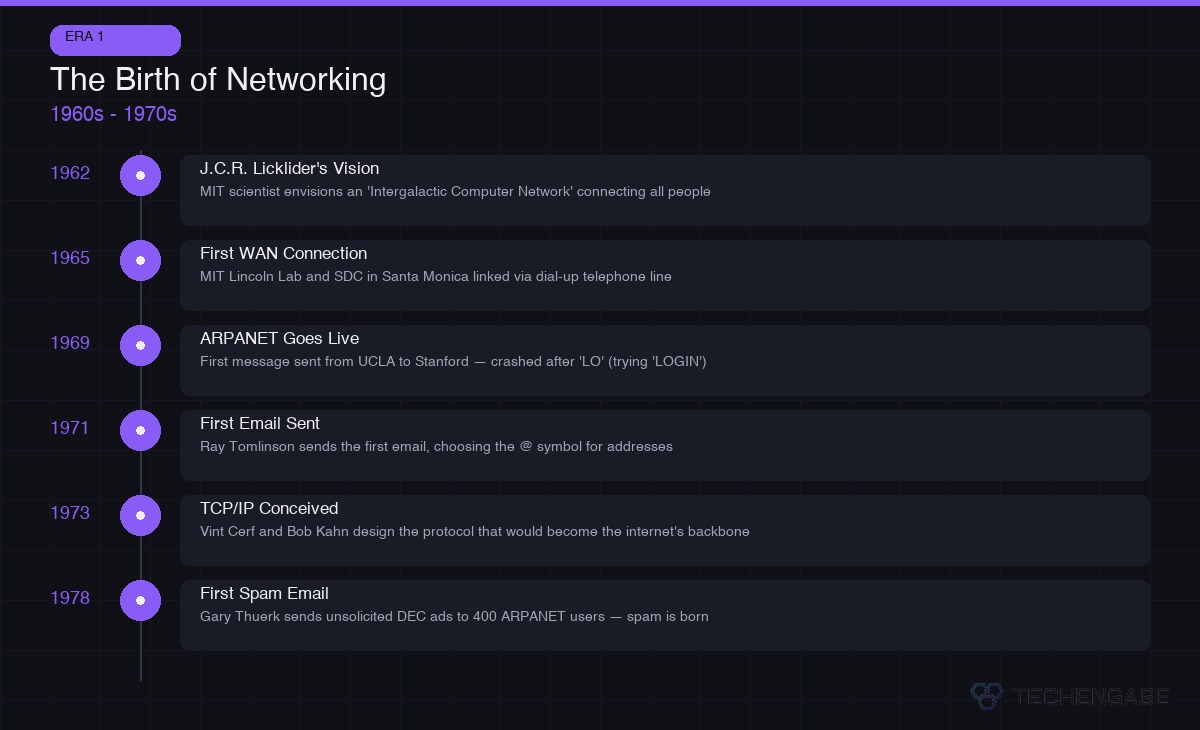
The internet didn’t start in a garage or a dorm room. It started in the offices of the U.S. Department of Defense’s Advanced Research Projects Agency (ARPA), where Cold War anxiety about nuclear-resilient communications met genuine academic curiosity about connecting distant computers.
1962: The Vision Takes Shape
J.C.R. Licklider at MIT wrote a series of memos describing his concept of an “Intergalactic Computer Network,” where all computers worldwide could communicate and share data. The name was tongue-in-cheek. The ambition was dead serious. Licklider later became the first head of ARPA’s computer research program, putting him in a position to actually fund this vision into reality.
1965: First Wide-Area Computer Link
Researchers connected a TX-2 computer at MIT’s Lincoln Lab to a Q-32 at System Development Corporation in Santa Monica, California. The connection used a standard telephone line. It was agonizingly slow and proved that circuit-switched telephone networks were fundamentally wrong for computer communication. That failure turned out to be incredibly productive, because it pushed researchers toward packet switching.
1969: ARPANET’s First Message
On October 29, Charley Kline at UCLA attempted to send “LOGIN” to a computer at Stanford Research Institute. The system crashed after transmitting “LO.” An hour later, the full connection worked. Four nodes were online by December: UCLA, Stanford, UC Santa Barbara, and the University of Utah. The network that would eventually become the internet had its first heartbeat.
1971: Email Is Born
Ray Tomlinson, working on ARPANET at BBN Technologies, sends the first network email. He chose the @ symbol to separate user names from computer names because, as he later explained, “it was the only preposition on the keyboard.” The first message was something unmemorable like “QWERTYUIOP.” Nobody thought to save it. Over fifty years later, 350 billion emails cross the internet every single day.
1973-1978: TCP/IP and the Birth of Spam
Vint Cerf and Bob Kahn published their design for TCP (Transmission Control Protocol) in 1974, creating the common language that allowed different computer networks to interconnect. The “inter-net” concept was born right there in the protocol’s name. Five years later, Gary Thuerk sent an unsolicited advertisement for DEC computers to 400 ARPANET users in 1978. The first spam email generated roughly $12 million in sales and an avalanche of complaints. Some things never change.
Era 2: The Foundation Years (1980s – 1990)
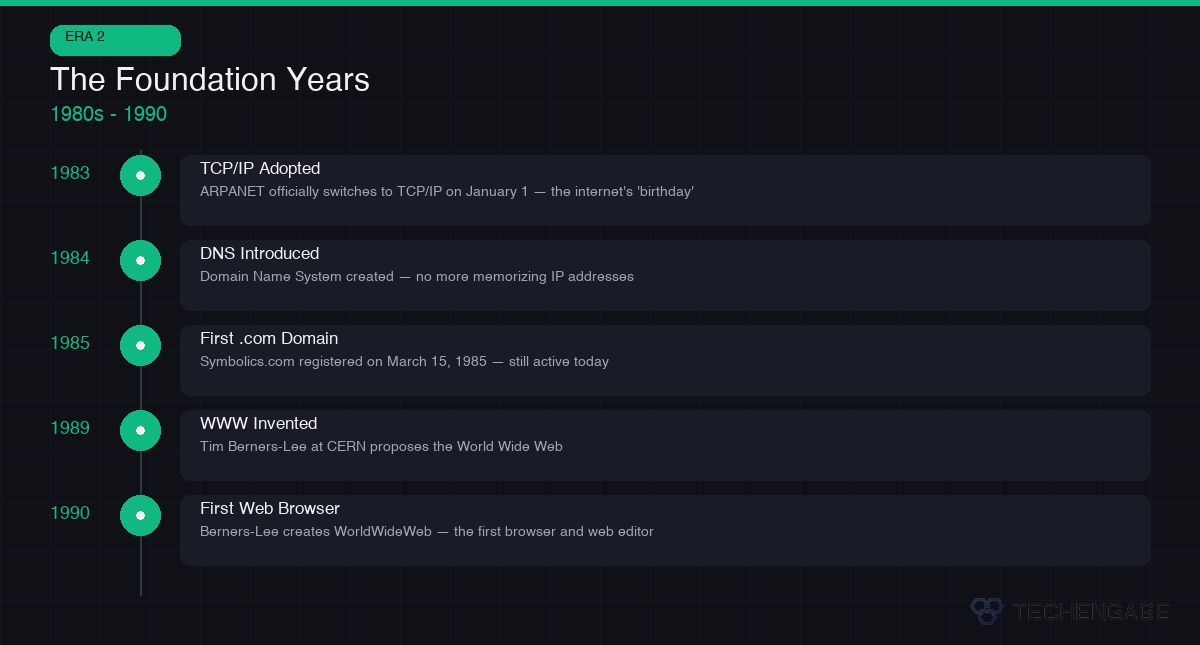
The 1980s transformed the internet from a military and academic curiosity into infrastructure. These were the years when the protocols, naming systems, and foundational technologies were locked in, creating the architecture that still runs beneath every website you visit today.
1983: The Internet’s Official Birthday
On January 1, 1983, ARPANET officially switched from the older NCP protocol to TCP/IP. Every connected computer had to adopt the new standard or be cut off. This “flag day” is often cited as the birth of the internet as we know it, because TCP/IP allowed previously incompatible networks to communicate freely for the first time.
1984: DNS Changes Everything
Paul Mockapetris introduced the Domain Name System, translating human-readable names (like “stanford.edu”) into IP addresses (like 171.67.215.200). Before DNS, users had to maintain local files mapping hostnames to numbers. For a network of dozens or hundreds of computers, that was manageable. For millions? Impossible. DNS made scaling the internet practical.
1985: The First .com
Symbolics, Inc., a Massachusetts computer manufacturer, registered symbolics.com on March 15, 1985. It was the first .com domain name ever registered. The company went bankrupt in the 1990s, but the domain changed hands and still resolves today. Only six .com domains were registered in all of 1985. By 2026, there are over 160 million .com registrations active.
1989-1990: Tim Berners-Lee Invents the Web
Working at CERN in Switzerland, Tim Berners-Lee proposed a hypertext system for sharing research documents across the internet. In 1990, he built the first web browser (called “WorldWideWeb,” one word), the first web server, and the first web page. He also created HTML, HTTP, and URLs. One person, working essentially alone, invented the entire World Wide Web stack. CERN made the technology freely available in 1993, which is the single most important decision in the web’s history.
Era 3: The Web Explodes (1991 – 1999)
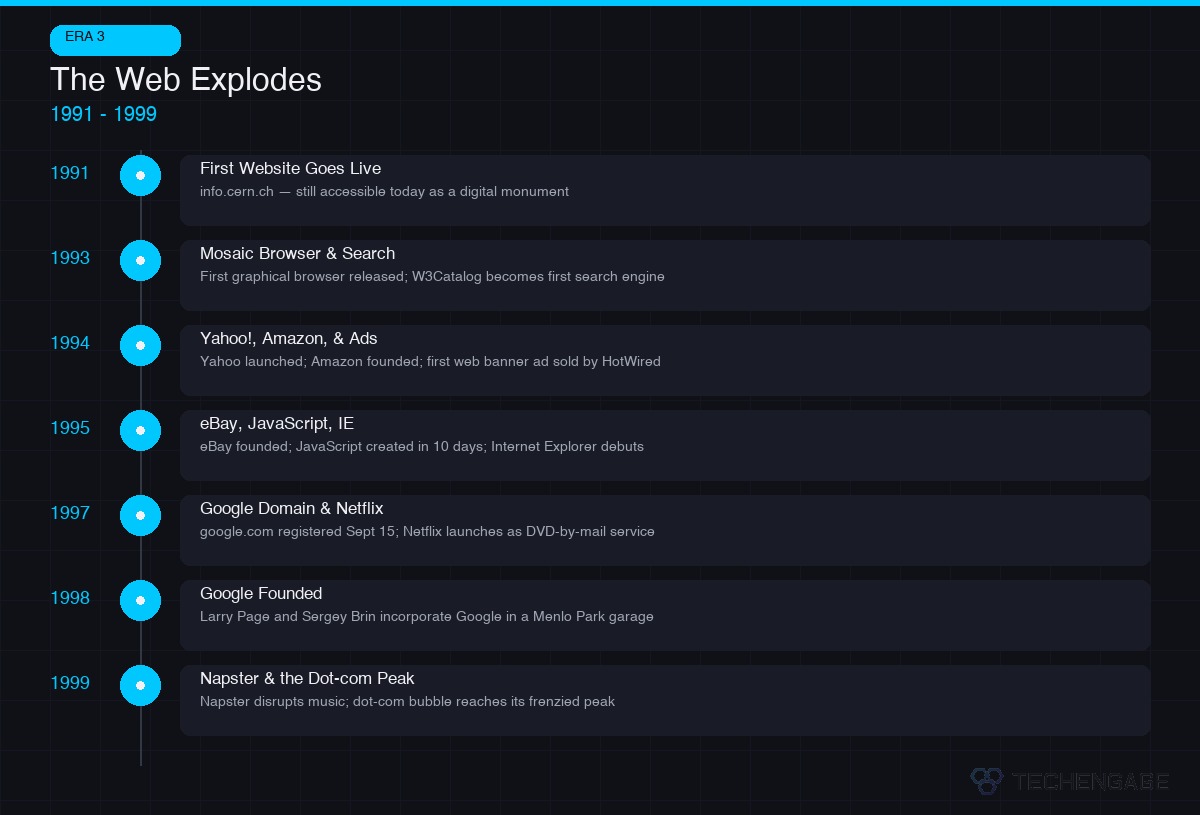
The nineties were when the internet stopped being something for researchers and became something for everyone. Between 1991 and 1999, online users grew from roughly 4 million to over 280 million. Every major paradigm of the consumer internet was invented in this decade: web browsing, search engines, e-commerce, web advertising, streaming, and online auctions.
1991: The First Website
On August 6, 1991, Tim Berners-Lee published the first public web page at info.cern.ch. It described the World Wide Web project itself. You can still visit a restored version of that original page today. It’s plain text with blue hyperlinks on a gray background. No images, no CSS, no JavaScript. Just information connected by links. The entire web was one page.
1993: Mosaic Makes the Web Visual
The Mosaic browser, developed at the National Center for Supercomputing Applications (NCSA), was the first browser to display images inline with text. Before Mosaic, images opened in separate windows. That seemingly small UX decision made the web feel like a magazine instead of a terminal. Mosaic’s lead developer, Marc Andreessen, later co-founded Netscape. Also in 1993: W3Catalog became the first primitive search engine, followed quickly by Aliweb in November.
1994-1995: Commerce Arrives
Jerry Yang and David Filo created Yahoo! as a directory of websites in January 1994. Jeff Bezos founded Amazon in July 1994 to sell books online. The first e-commerce transaction on the open web happened on NetMarket on August 11, 1994. HotWired (Wired magazine’s website) sold the first banner ad to AT&T in October 1994; 44% of people who saw it clicked on it. (Modern banner ads get about 0.05%.)
By 1995, eBay was auctioning goods peer-to-peer, Brendan Eich created JavaScript in 10 days at Netscape, and Microsoft launched Internet Explorer, beginning the browser wars that would shape the web for a decade.
1997-1998: Google Changes Search Forever
The domain google.com was registered on September 15, 1997. A year later, Larry Page and Sergey Brin, two Stanford PhD students, incorporated Google in a Menlo Park garage. Their PageRank algorithm, which ranked pages by how many other pages linked to them, was a fundamentally better approach than keyword matching. Within two years, Google handled over 60 million searches per day. Netflix also launched in 1997 as a DVD-by-mail rental service, with no idea it would eventually stream to 300+ million subscribers.
1999: The Dot-Com Peak
Napster launched in June 1999, letting users share MP3 files peer-to-peer and terrifying the music industry. The NASDAQ hit 5,048 in March 2000 before the dot-com bubble burst, wiping out $5 trillion in market value over two years. Companies like Pets.com, Webvan, and eToys evaporated. But the infrastructure they built, and the lessons they taught, laid the groundwork for everything that followed.
Era 4: The Social & Mobile Revolution (2000 – 2012)
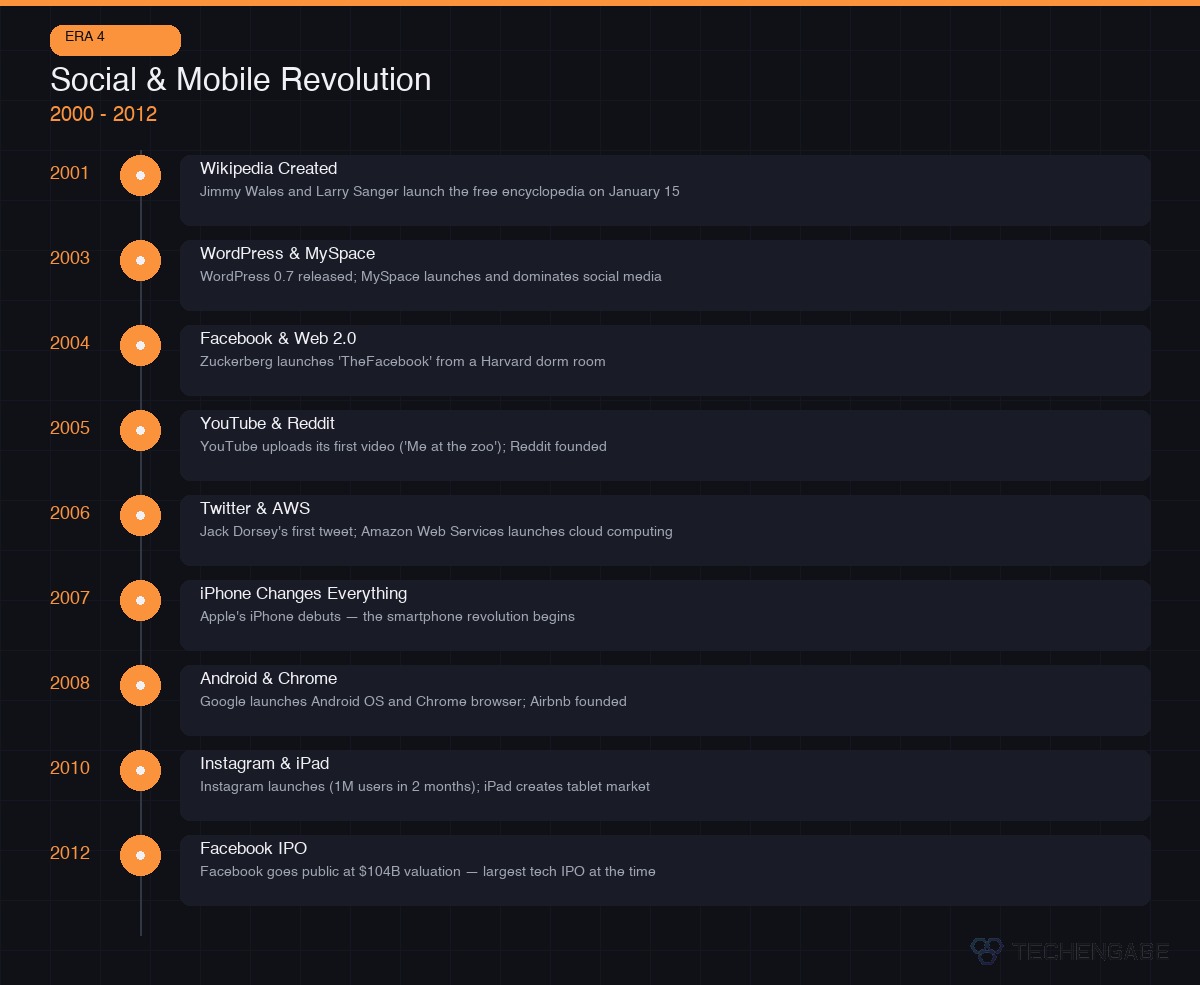
After the dot-com crash, the surviving companies built the real internet economy. This era introduced two forces that permanently changed how humans interact: social networks and smartphones. By 2012, the internet was no longer something you “went to.” It was something you lived inside.
2001-2003: Rebuilding From the Wreckage
Wikipedia launched on January 15, 2001, with the radical idea that anyone could edit an encyclopedia. The skeptics were loud (and they weren’t entirely wrong about quality concerns), but the concept worked at a scale no one predicted. Wikipedia now has over 63 million articles in 300+ languages.
WordPress released version 0.7 in 2003, democratizing web publishing. MySpace launched the same year and quickly became the most visited website in the United States by 2006. The era of user-generated content had begun, and the phrase “Web 2.0” entered the lexicon.
2004-2006: The Social Network Era Begins
Mark Zuckerberg launched “TheFacebook” from his Harvard dorm room on February 4, 2004. It was limited to Harvard students, then expanded to other Ivy League schools, then all colleges, then everyone. By the time Facebook opened to the general public in September 2006, it had 12 million users. (It has over 3 billion monthly active users as of early 2026.)
YouTube uploaded its first video (“Me at the zoo”) on April 23, 2005. Reddit launched that June. Twitter followed in 2006, with Jack Dorsey posting the first tweet: “just setting up my twttr.” Also in 2006, Amazon Web Services launched its Elastic Compute Cloud (EC2), quietly creating the cloud computing market that would eventually underpin the entire modern web.
2007: The iPhone Moment
On January 9, 2007, Steve Jobs walked on stage at Macworld and said, “Today, Apple is going to reinvent the phone.” He wasn’t exaggerating. The iPhone’s multi-touch screen, real web browser, and app ecosystem didn’t just create a new phone category. They created a new computing paradigm. Mobile internet usage overtook desktop in 2016, and by 2026, mobile accounts for roughly 60% of all web traffic globally.
2008-2012: Apps, Cloud, and Going Public
Google launched both the Android operating system and the Chrome browser in 2008, establishing duopolies in mobile OS and browser markets that persist today. Airbnb founded that same year, proving the “sharing economy” model. Instagram launched in October 2010 and hit 1 million users in two months. Apple’s iPad, also in 2010, created the tablet category overnight.
The era culminated with Facebook’s IPO on May 18, 2012, valued at $104 billion, the largest technology IPO in history at that time. The internet’s social layer was no longer a startup experiment; it was the core of a trillion-dollar economy.
Era 5: Streaming, Privacy & Crypto (2013 – 2019)
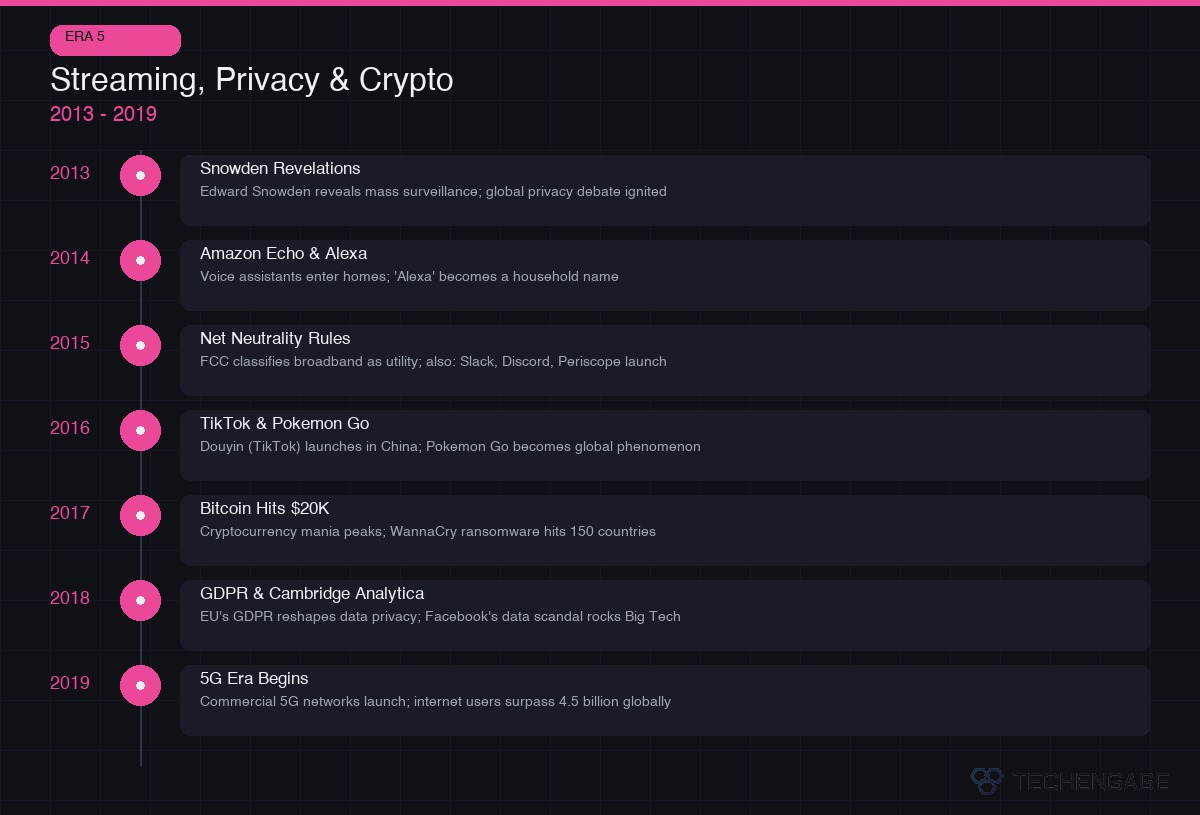
This period brought a reckoning. The internet’s power became undeniable, and so did its dangers. Mass surveillance, data harvesting, cryptocurrency speculation, and platform monopolies forced regulators, users, and technologists to confront questions they’d been dodging since the 1990s.
2013: The Snowden Effect
Edward Snowden’s revelations about NSA surveillance programs (PRISM, XKeyscore, and others) shocked the world in June 2013. The disclosure that governments were systematically collecting internet communications at scale triggered a global privacy movement. HTTPS adoption accelerated dramatically. End-to-end encryption went from a niche concern to a mainstream feature. Signal, WhatsApp, and other encrypted messengers gained millions of users.
2014-2016: Voice, Video, and Virality
Amazon launched the Echo speaker and Alexa voice assistant in November 2014, bringing AI into living rooms (even if early Alexa mostly handled weather and timers). The FCC enacted net neutrality rules in 2015, classifying broadband as a public utility, though the rules were later rolled back in 2017.
Douyin (later known internationally as TikTok) launched in China in September 2016, and its short-form video format would reshape content creation, music discovery, and social media algorithms within three years. Pokemon Go, also 2016, demonstrated augmented reality’s mass-market potential when it peaked at 232 million monthly active users.
2017-2018: Crypto Mania and the Privacy Reckoning
Bitcoin hit nearly $20,000 in December 2017, turning “blockchain” into a buzzword and spawning thousands of altcoins, ICOs, and eventually DeFi protocols. The same year, the WannaCry ransomware attack hit over 200,000 computers across 150 countries, demonstrating the internet’s vulnerability at scale.
2018 brought the EU’s General Data Protection Regulation (GDPR) into effect on May 25, giving European users sweeping new rights over their personal data. Within the same week, the Cambridge Analytica scandal revealed that Facebook had allowed political operatives to harvest data from 87 million users. The coincidental timing made 2018 the year “data privacy” entered mainstream vocabulary.
2019: 5G and the 4.5 Billion Mark
Commercial 5G networks launched in South Korea, the United States, and several other countries throughout 2019, promising speeds 10-100x faster than 4G. Internet users surpassed 4.5 billion for the first time. TikTok hit 1 billion downloads globally. Disney+ launched in November and hit 10 million subscribers on day one. The streaming wars were fully underway.
Era 6: The AI Revolution (2020 – April 2026)
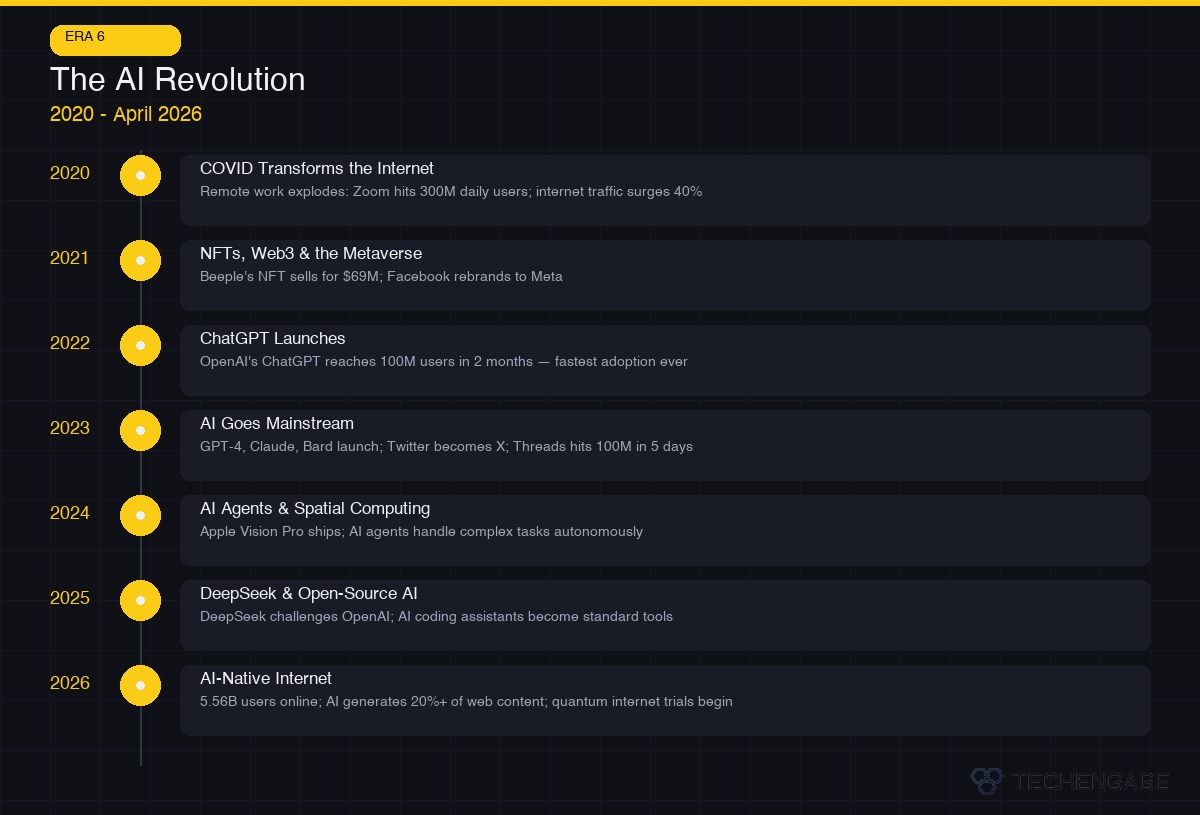
The internet’s most recent chapter has been defined by two seismic events: a pandemic that forced the entire world online overnight, and an AI revolution that is fundamentally changing how content is created, consumed, and discovered.
2020: COVID-19 Stress-Tests the Internet
When lockdowns hit in March 2020, internet traffic surged 40% almost overnight. Zoom went from 10 million daily meeting participants in December 2019 to 300 million by April 2020. Microsoft Teams, Google Meet, and Slack saw comparable spikes. The pandemic compressed a decade of digital transformation into months, as remote work, telehealth, online education, and grocery delivery went from niche services to essential infrastructure.
Remarkably, the internet held up. Despite fears of widespread outages, the redundant, decentralized architecture that engineers had been building since the 1960s proved resilient enough to handle the biggest sudden traffic increase in history.
2021: NFTs, Web3, and Meta
Digital artist Beeple sold an NFT for $69.3 million at Christie’s in March 2021, igniting a frenzy around non-fungible tokens and “Web3,” a loosely defined vision of a decentralized internet built on blockchain technology. Facebook rebranded to Meta in October, betting the company’s future on the metaverse. The bet remains a work in progress, with Meta’s Reality Labs division spending over $50 billion on the effort through 2025.
2022: The Year AI Broke Through
OpenAI released ChatGPT on November 30, 2022. It reached 1 million users in five days and 100 million in two months, making it the fastest-growing consumer application in history. Generative AI wasn’t entirely new (GPT-3 launched in 2020, and DALL-E in 2021), but ChatGPT made it accessible to non-technical users for the first time. The race to build and deploy large language models accelerated immediately across every major tech company.
2023: AI Goes Mainstream
GPT-4 launched in March 2023, followed by Anthropic’s Claude, Google’s Bard (later Gemini), and Meta’s LLaMA open-source models. AI-generated text, images, and code became commonplace. Twitter rebranded to X under Elon Musk. Meta launched Threads as a Twitter/X competitor, gaining 100 million users in five days. The internet’s information ecosystem was shifting faster than regulators could follow.
2024: Spatial Computing and Autonomous AI
Apple shipped the Vision Pro in February 2024, its first spatial computing device, creating a new product category that blended AR and VR. AI agents capable of browsing the web, writing code, and handling multi-step tasks autonomously became commercially viable. Google’s Gemini, OpenAI’s GPT-4o, and Anthropic’s Claude 3 pushed multimodal AI (text, image, audio, and video understanding) into production applications.
2025: Open-Source AI and the 5.5 Billion Mark
DeepSeek, a Chinese AI lab, released competitive open-source models that challenged the dominance of closed-source providers like OpenAI. AI coding assistants became standard developer tools; GitHub Copilot crossed 2 million paid subscribers. Internet users hit 5.5 billion, meaning two-thirds of all humans on Earth were online. The remaining digital divide was increasingly about economics and infrastructure, not technology.
2026: The AI-Native Internet
As of April 2026, we’ve entered what some researchers are calling the “AI-native internet.” Estimates suggest that over 20% of new web content is now AI-generated or AI-assisted. Search engines are becoming answer engines, with Google’s AI Overviews and ChatGPT’s browsing mode changing how people find information. Quantum internet experiments, while still in early stages, have achieved entanglement-based key distribution over fiber networks exceeding 500 km. The internet’s next fifty years may be as unrecognizable from today as today is from that two-letter message in 1969.
The Internet in Numbers: April 2026
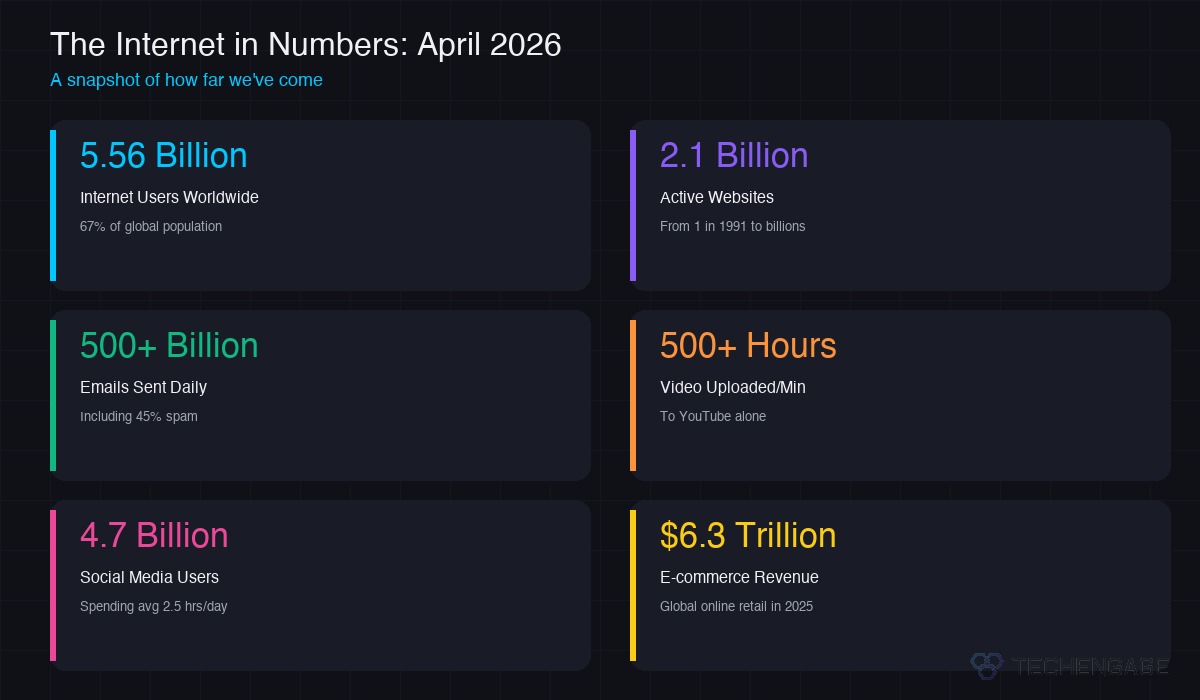
Numbers tell a story that words sometimes can’t. Here’s where the internet stands as of spring 2026:
- 5.56 billion internet users, roughly 67% of the global population of 8.2 billion
- 2.1 billion active websites, though fewer than 400 million are actively maintained
- 350+ billion emails sent daily, with roughly 45% classified as spam
- 500+ hours of video uploaded to YouTube every minute
- 4.7 billion social media users spending an average of 2 hours and 24 minutes per day on platforms
- $6.3 trillion in global e-commerce revenue in 2025, up from $4.9 trillion in 2021
- Over 1.1 billion websites use HTTPS, up from roughly 40% in 2018 to over 85% today
- Global internet traffic exceeds 5 zettabytes per year (that’s 5 trillion gigabytes)
What Comes Next?
Predicting the internet’s future has a terrible track record. (Bill Gates himself famously underestimated the web in his 1995 book “The Road Ahead.”) Still, several trends seem durable enough to bet on:
AI integration will deepen. We’re past the novelty phase. AI is embedding itself into search, content creation, customer service, software development, and scientific research. The question isn’t whether AI will transform the internet but how quickly and at what cost to existing business models.
The last 2.5 billion will come online. Satellite internet (Starlink, Amazon’s Project Kuiper) and expanding 5G coverage will connect people in rural and developing regions. Each new billion users historically reshapes the internet’s culture and economics.
Privacy and regulation will intensify. GDPR was the beginning, not the end. The EU’s AI Act, digital identity frameworks, and data sovereignty laws in dozens of countries are creating a more regulated internet. Whether that makes the internet better or just more fragmented depends on who you ask.
Quantum networking will emerge. Quantum key distribution and quantum internet protocols are moving from laboratory experiments to pilot programs. A full-scale quantum internet is likely decades away, but the research investments happening now will define its architecture.





Share Your Thoughts