

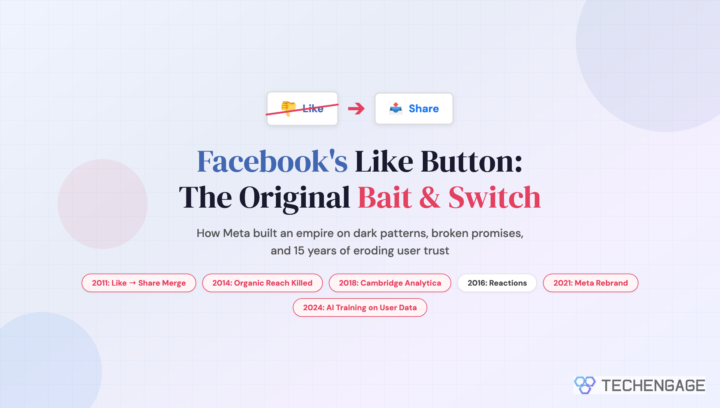
On a quiet Oscar Sunday in February 2011, Facebook pulled off one of the most calculated product changes in social media history. Without warning, without a blog post, without so much as a tooltip notification, the company merged the Like button’s functionality with the Share button. One click, and whatever a website stuffed into its meta tags got blasted across your wall and into every friend’s News Feed. No editing. No preview. No consent beyond the click itself.
That single move set the template for everything Facebook (now Meta) would do for the next fifteen years: ship changes that benefit the platform’s engagement metrics, bury them under distractions, and force users to accept the new reality before they even realize what happened.
The Like button bait-and-switch was not an isolated incident. It was chapter one.
The Original Like Button Trick (2011)
Before February 2011, Facebook’s Like button and Share button served distinct purposes. Liking a page registered a quiet endorsement, a small signal visible mostly on the source page’s counter and occasionally in a friend’s sidebar feed. Sharing opened a dialog box where you could write a comment, edit the preview, and decide exactly what appeared on your wall.
Facebook combined these without telling anyone. A Like now published the full Open Graph metadata (title, image, description) directly to your timeline, identical to a Share. The only functional difference? Sharing at least gave you a dialog box. The Like just… posted.
The timing was surgical. Rolling it out on Academy Awards night meant peak social activity and minimal tech press coverage. People were Liking Oscar clips, red carpet photos, and celebrity tweets all evening, unknowingly broadcasting full posts to their entire friend list. By Monday morning, millions of wall posts had been generated that never would have existed under the old system.
Facebook got exactly what it wanted: a massive spike in content distribution with almost no backlash. The few tech outlets that noticed (like Mashable) were drowned out by Oscar chatter.
Why This Pattern Kept Repeating
The Like button change worked so well that it became Facebook’s default playbook. The pattern is remarkably consistent across fifteen years of product decisions:
Step 1: Introduce a feature that users and businesses adopt enthusiastically.
Step 2: Wait until adoption is deep enough that switching costs are high.
Step 3: Change the rules in ways that benefit the platform at users’ expense.
Step 4: Frame the change as an improvement. Bury the announcement.
This isn’t speculation or conspiracy thinking. It’s a documented pattern that the Federal Trade Commission, European regulators, and independent researchers have flagged repeatedly. A 2023 report from the Electronic Frontier Foundation specifically categorized several of Facebook’s feature changes as “dark patterns,” defined as design choices that manipulate users into actions they wouldn’t otherwise take.
A Timeline of Trust Erosion
Here is what happened after the Like button merge, year by year. Each entry follows the same bait-and-switch structure that started in 2011.
2012: Promoted Posts and the Organic Reach Decline
Facebook spent years convincing businesses to build audiences on Pages. “Get your fans on Facebook!” was the rallying cry. Companies invested millions in acquiring followers. Then Facebook introduced Promoted Posts, and organic reach started its long decline. According to data aggregated by Social Media Examiner, average organic reach for brand pages dropped from roughly 16% in 2012 to under 2% by 2016.
The message was clear: you built your audience here, and now you’ll pay to reach them.
2014: The News Feed Algorithm Overhaul
Facebook replaced the chronological feed with an algorithmic one that prioritized “meaningful interactions.” In practice, this meant content that generated strong emotional reactions (outrage, shock, excitement) got amplified, while neutral informational posts disappeared. Research published in Science later confirmed that Facebook’s own internal studies showed the algorithm boosted divisive content because it drove engagement metrics.
2016: Reactions Roll Out, Data Gets Richer
When Facebook launched Reactions (Love, Haha, Wow, Sad, Angry) in February 2016, it was presented as giving users more expressive options. That part was true. What wasn’t mentioned: each Reaction gave Facebook a granular emotional signal that the binary Like/Unlike never provided. Your Angry reaction on a political post, your Love on a baby photo, your Sad on a news article about layoffs, all of this fed directly into ad targeting and content recommendation algorithms.
Users got emoji. Facebook got a sentiment analysis goldmine.
2018: Cambridge Analytica and the Privacy Reckoning
The Cambridge Analytica scandal revealed that Facebook’s developer APIs had allowed third parties to harvest data from millions of users who never consented. Facebook had known about the data harvesting since 2015 but didn’t act until press coverage forced its hand in 2018. Mark Zuckerberg testified before the U.S. Senate, promised reforms, and Facebook paid a $5 billion FTC fine, the largest ever imposed on a technology company at that time.
The bait-and-switch here was the platform’s entire relationship with developers. Facebook actively encouraged third-party app development and generous data access, then used the scandal to lock down APIs in ways that conveniently also eliminated competitors who relied on that data.
2021: The Meta Rebrand
Renaming the company to Meta in October 2021 was, at its core, a reputation laundering exercise. The Facebook Papers (leaked by whistleblower Frances Haugen) had just revealed internal research showing Instagram harmed teen mental health, that the platform knowingly amplified misinformation, and that safety teams were chronically understaffed. The rebrand to Meta, with its metaverse pitch, redirected press coverage from those revelations to VR headset demos and avatar legs.
2023-2026: AI Training on Your Content
Meta’s most recent bait-and-switch involves artificial intelligence. Years of photos, posts, comments, and messages uploaded to Facebook and Instagram are now being used to train Meta’s LLaMA large language models. Users who posted personal photos in 2010 didn’t consent to having those images train AI systems that didn’t exist yet. Meta’s position is that its terms of service grant it a broad license to use uploaded content, but regulators in the EU and Brazil have pushed back, with the Irish Data Protection Commission pausing Meta’s AI training on European user data in 2024.
The pattern holds: attract users with a social platform, accumulate their data over a decade, then repurpose it for an entirely different business line without meaningful opt-in consent.
The Dark Pattern Playbook
Researchers at Princeton and the University of Chicago published a widely cited 2019 study cataloging dark patterns across major platforms. Facebook featured prominently. The specific tactics they identified include:
Forced continuity: Making it extremely difficult to delete your account while making deactivation (which preserves all your data) the prominent option.
Privacy zuckering: Yes, researchers actually coined this term. It describes deliberately confusing privacy settings that default to maximum data sharing, buried behind multiple menu layers with toggles that reset after updates.
Confirmshaming: When you try to decline a feature, the rejection option is worded to make you feel bad. “No, I don’t want to protect my account” instead of a neutral “Skip.”
Roach motel: Easy to get into, hard to get out. Importing your contacts to “find friends” takes one click. Removing those contacts from Facebook’s database? Good luck finding that option.
These aren’t edge cases or Easter eggs. They’re core to how the platform operates, and they trace directly back to that first Like button switch in 2011.
What Facebook’s Competitors Learned
Facebook didn’t invent dark patterns, but its success with them taught the rest of the industry that users will tolerate almost anything if the social graph is sticky enough. TikTok borrowed the infinite scroll and algorithmic feed. X (formerly Twitter) adopted the engagement-optimized timeline. LinkedIn started gating basic profile views behind premium subscriptions after years of offering them free.
The difference is that Facebook was first, and Facebook did it at a scale that made regulators take notice globally. The EU’s Digital Services Act and Digital Markets Act, both enacted in 2022, were drafted with Facebook’s history as a primary case study.
How to Protect Yourself in 2026
If you still use Facebook or Instagram (and roughly 3 billion people do), there are practical steps to limit exposure to these tactics:
Audit your privacy settings quarterly. Meta resets or adds new options with almost every major update. The Privacy Checkup tool is genuinely useful, though it defaults to permissive settings.
Use “Download Your Information” annually. This shows you exactly what data Meta holds on you. The volume is often shocking, especially location data and ad interaction history.
Opt out of AI training. In regions where it’s available, Meta now offers forms to request exclusion from AI training data. The process is deliberately tedious (dark pattern alert), but it works.
Switch to chronological feeds. Both Facebook and Instagram now offer chronological feed options after regulatory pressure. They’re buried in settings, not the default, but they eliminate the rage-bait amplification of the algorithmic feed.
Consider alternatives for group communication. Signal for messaging, Discord for communities, and Mastodon for public posting all offer less exploitative models. None have Facebook’s network effects, which is exactly why Facebook’s dark patterns work: leaving costs you your social connections.
The Bigger Picture
Fifteen years after that Oscar Sunday Like button change, the fundamental dynamic hasn’t shifted. Meta is a $1.5 trillion company whose primary revenue engine is advertising, and advertising revenue depends on engagement, and engagement depends on keeping users on the platform as long as possible by any design means necessary.
Every “improvement” should be evaluated through that lens. When Meta announces a new privacy feature, ask what data it’s collecting in exchange. When it launches a new content format, ask whose reach it will throttle to promote the new one. When it offers a new creator monetization tool, ask what happens when adoption peaks and the rules change.
Because if the last fifteen years have taught us anything, it’s that the rules will change. They always do. And the change will always benefit Meta first.
That Like button in 2011? It was just the beginning.
Related reading on TechEngage:
- How to Protect Your Digital Identity and Social Media Accounts
- Why Your Business Only Needs Seven Social Media Accounts
- Google Censorship: The Search Giant’s History of Content Control


IF they can get away with this change without a backlash, then it could stick. I don’t see it. It may not be an immediate response, but eventually people will respond. The question; will they just roll over and take it, like the recent profile changes, or make a big stink. Personally, less control of my FB wall encourages less use of both buttons.
This was probably the worst move Facebook has done yet. While it may seem likes should get more use and better information distribution by users…. it won’t work. Most avg Joe users and the vast majority of the non tech crowd never use the share button and in fact consider it spammy. Before they would ‘like’ something due to it only making a small text based update and not putting pictures and a paragraph on their profile plus everyone they knows. Now they have no option and most will stop the limited use they already had of the share/like features to avoid the situation entirely. I could of course be wrong and Facebook is notorious for not caring at all about what it users think but… these types of changes are the path to becoming MySpace. Tweaking profiles is one thing, radically altering the most basic functionality of the only way to transmit non Facebook info is a very bad idea.
I like that you have this covered, yet using the ‘Like’ button on this very page sends no thumbnail nor headline to Facebook. UGLY, ugly, ugly, techi.com
I’m afraid to like this…. the article is far too long to appear on facebook hhahah. Its such a catch 22
If you are going to call someting a “classic” something else, you really should have some idea what that something else actually is. In this case, you obviously don’t know what a bait and switch really is.
I don’t know what a bait and switch is – I can guess : please educate me
People rarely like changes when they are first rolled out, but eventually we learn how to deal with them and integrate them into our lives, or else we do something to get away from them.
Maybe people will stop “Liking” things, and/or stop “Sharing” things, or both, or neither. Maybe people will start leaving Facebook.
…Nahhhh!
yes this is a good idea and newest feature for the facebook users and the developer..
i love how the bottom of the article has a like button.
its true. People, you do not have to like an article!
Seemed like a good idea but this article got me thinking…
Just means another feature I wouldn’t use because I wouldn’t want to spam my friends. It’s one thing to have tiny one sentence “nascentt as liked …..” but to have entire posts for ever single news article, and web page visited and liked in a day is a bit ridiculous.
Though facebook has pretty much lost all functionality I found useful when they killed tabs. having my friendfeed, PSN and lastfm data in separate tabs to avoid spamming users was a great idea, now having to put it all in a single stream with status updates is just too spammy.
The whole of Facebook is a “bait and switch,” just like the constantly changing privacy settings – they want and need your private data to make money. The more private, the more personal, the more useful it is to them.
Allow a website to post what it wants on your wall can lead to so much abuse (i.e. spam). I suspect they will have to change the functionality to allow you to edit it or people will just stop ‘liking’ things.
There is one thing I’d like to correct from the article that may have an emphasis on the end thoughts. When you say, “The Like functionality is even more simple. You push a button. No pop up. No dialogue box. No indication that anything has happened on your Facebook wall”, it isn’t true. Any time you ‘like’ a page, it is posted on your wall – just with not as much emphasis as they are doing now. It has always done that and it just now having a little more functionality pushed to it in the form of an article title and image.
And I think this is a great idea, especially from the end of a user who does try and get my clients websites out through Facebook sharing. And yes, this move is all about page views – but that’s not a bad thing. It’s going to make users more aware of what their friends like. You don’t HAVE TO like things.
My quick thought.
I also hate the new photo viewer 😐
Maybe if we’ll get more like’s on this page they will consider change it back 😐
http://www.facebook.com/pages/I-hate-the-new-photo-viewer/103111279767562
Prior to this change I sometimes found myself in a bit of a pickle. There would be an article or blog that I liked and wanted to “share” but only found a “like” button on the site. There’s always the option to copy/paste the link directly into my wall but often times that was just too much of a hassle. I don’t think that “sharing” is really “spammy” as some would suggest, many times I find media that my I KNOW my friends would like and “sharing” it on my wall seemed the best way to expose it. I’m sure that many people do use “sharing” as a means of “spam” but much like the boy who cried wolf those users and their links therein just end up being ignored after a few times. I think this article is really interesting and it’s probably accurate in regards to it’s claims on Facebook. However, social media is a HUGE part of Facebook’s core functionality and I think it was in their best interest to make these changes.
damn you facebook.
I removed all ‘like’ buttons from our sites. I’m sticking with Apture dot com as they still allow personalized sharing. For how long? That is a good question.
ok i am going to “like” this article just to actually see what happens… this is a bit confusing…but is it that important? can’t you just delete a post weather it is a like or a share once it is on your wall?
This change is OBNOXIOUS!!!!!!!!!!!! Maybe I don’t want everything I ‘like’ to be plastered on my wall! Maybe I just want the person who owns the item I ‘like’ to know that I like it, and THAT’S IT!!!!!!! If I wanted to share that overtly on my wall I would use the SHARE function. These are two entirely different functions. If Facebook doesn’t restore the like button to it’s previous form I’m just going to stop ‘liking’ most things that I otherwise would have. I don’t want my wall trumpeting everything I like. It’s rude, obnoxious and will make Facebook an overall less pleasant experience for everyone. Sigh.
I don’t know if this is the same problem/issue:
I have just created a new page of FB (Environmental English). I want to like various other pages but every time I click the like button for them I get this message:
”Oops! Something’s gone wrong. We’re working to get it fixed as soon as we can.”
Help please!
Facebook rocks! it is good one i too try to place my client’s website by pushing that like button… Let me try guys!!!
I’m annoyed that I can’t change the size of the button. It doesn’t work well on mobile sites as it is way too tiny.
I have always thought this a good idea.
I dont know.
Absolutely wonderful article. I wonder what will ever become of mankind. Seems like that quick and resourceful will outlive all of our smart people 🙂 and thanks for posted!
Nice post. Look forward to hearing more.