

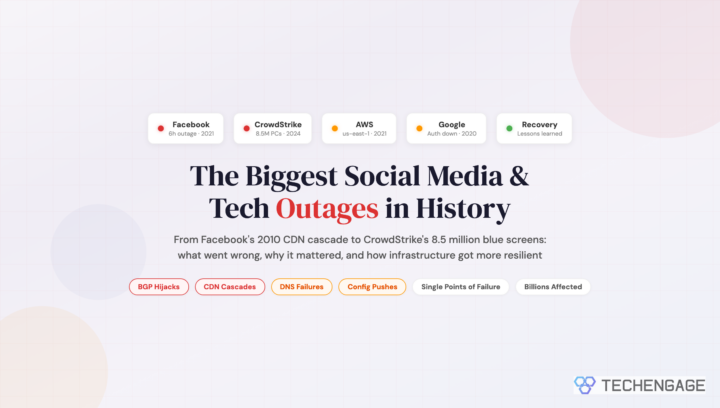
In September 2010, Facebook went down for two and a half hours. The tech press treated it as a punchline. The cause? An automated error-correction system malfunctioned, duplicated a fault across Facebook’s content distribution network, and generated a flood of callback requests that overwhelmed the main servers. The fix was equally crude: engineers pulled the plug and rebooted the entire system. “Facebook is the new Microsoft,” the joke went. Just reboot it.
Fourteen years later, that incident looks quaint. The platforms we depend on have grown so vast, so deeply embedded in commerce, communication, and daily life, that a single outage can ground airlines, freeze financial transactions, and leave billions of people unable to contact their families. The consequences are no longer funny.
Here is a comprehensive look at the most significant social media and tech infrastructure outages from 2010 through 2026, what caused each one, and what the industry has (and hasn’t) learned about building systems that don’t fail catastrophically.
Facebook’s CDN Cascade (September 2010)
The 2010 outage was Facebook’s worst in four years at the time, and it introduced a failure pattern that would recur across the industry for the next decade: a cascading failure triggered by automation.
Facebook’s CDN (content distribution network) detected an error and attempted to correct it automatically. The correction itself was faulty, propagating across CDN nodes instead of isolating the problem. Each affected node then sent callback requests to Facebook’s primary servers, effectively creating a self-inflicted DDoS attack. The volume was so extreme that the only recovery path was a full system restart.
This established a theme that appears in almost every major outage since: automated systems designed to improve reliability can become the mechanism of failure when they encounter edge cases their designers didn’t anticipate. The automation doesn’t just fail to fix the problem; it actively makes it worse.
Facebook’s BGP Outage (October 4, 2021)
If the 2010 outage was a punchline, the October 2021 outage was a global emergency. Facebook, Instagram, WhatsApp, and Messenger all went completely offline for approximately six hours, affecting an estimated 3.5 billion users worldwide.
The cause was a configuration change to Facebook’s backbone routers that accidentally withdrew all BGP (Border Gateway Protocol) routes for Facebook’s network. BGP is the protocol that tells the internet’s routers how to reach specific networks. When Facebook’s BGP routes disappeared, every router on the internet effectively forgot that Facebook existed. DNS servers couldn’t resolve facebook.com because they couldn’t reach Facebook’s authoritative nameservers.
The cascading effects went far beyond social media. In countries where WhatsApp functions as primary communication infrastructure (Brazil, India, Indonesia, much of Africa), people couldn’t contact family, businesses couldn’t process orders, and emergency coordination was disrupted. Facebook estimated the outage cost approximately $60-65 million in lost ad revenue alone; the broader economic impact across WhatsApp-dependent economies was orders of magnitude larger.
Recovery was complicated by an ironic detail: Facebook’s internal communication tools, including its corporate Workplace platform and building access systems, also ran on the same network. Engineers reportedly couldn’t badge into data centers and had to physically cut locks to reach the servers that needed manual BGP reconfiguration. The post-mortem, published on Facebook Engineering, described a routine maintenance operation that went wrong because a command audit tool contained a bug that failed to catch the error before execution.
The CrowdStrike/Windows Global Outage (July 19, 2024)
This wasn’t a social media outage, but its scale dwarfed every other incident on this list. On July 19, 2024, a faulty sensor configuration update pushed by CrowdStrike to its Falcon endpoint security agent caused an estimated 8.5 million Windows computers worldwide to crash with blue screen of death (BSOD) errors and enter boot loops.
The impact was staggering. Airlines grounded flights globally (Delta alone cancelled over 5,000 flights). Hospitals reverted to paper records. Banks couldn’t process transactions. 911 dispatch centers went down in multiple US states. The UK’s National Health Service experienced disruptions to appointment systems and GP records.
Microsoft estimated the financial damage at over $10 billion across affected organizations. The root cause was mundane: a content update to CrowdStrike’s threat detection definitions contained a logic error that triggered a null pointer exception in a kernel-level driver. Because Falcon runs at the kernel level (required for deep threat monitoring), the crash was unrecoverable without manual intervention on each affected machine. There was no remote fix. Every single one of those 8.5 million computers needed hands-on remediation.
The CrowdStrike incident crystallized a concern that security professionals had raised for years: endpoint security tools that run with kernel-level privileges represent a single point of failure for entire enterprises. One bad update from one vendor can simultaneously disable millions of machines worldwide, something no cyberattack has ever achieved at that scale.
AWS us-east-1 Failures (2017, 2020, 2021)
Amazon Web Services runs approximately a third of the world’s cloud infrastructure, and its us-east-1 region (based in Northern Virginia) is the oldest, largest, and most heavily used. It’s also been the source of the most consequential cloud outages.
In February 2017, a typo in a command during routine maintenance of S3 (Amazon’s object storage service) in us-east-1 accidentally removed a larger set of servers than intended. Because hundreds of thousands of websites and services use S3 for hosting images, files, and entire web applications, the incident took down large portions of the internet for several hours. Slack, Quora, Trello, and the SEC’s EDGAR filing system were all affected.
The November 2020 outage hit Amazon’s Kinesis data streaming service in us-east-1, cascading into CloudWatch (monitoring), Lambda (serverless compute), and dozens of dependent services. The December 2021 outage disrupted us-east-1 networking for over seven hours, affecting Disney+, Netflix, Slack, Venmo, and Amazon’s own retail and logistics operations.
Each incident highlighted the same architectural concern: too many services, including Amazon’s own, concentrate in us-east-1 because it was the first AWS region and has the broadest service availability. Multi-region architecture is well understood in theory but expensive and complex in practice, so many companies default to single-region deployments and accept the risk.
Google’s Authentication Meltdown (December 2020)
On December 14, 2020, Google‘s authentication service went down for approximately 47 minutes. The duration was short, but the blast radius was enormous: Gmail, YouTube, Google Drive, Google Cloud Platform, Google Maps, and every service requiring a Google account became inaccessible simultaneously. Nest smart home devices, Google Home speakers, and Android phones that relied on Google services for basic functionality were all affected.
Google’s post-mortem attributed the cause to a storage quota issue in the authentication system’s internal database. The system that validates user identities ran out of allocated storage space, and instead of degrading gracefully, it failed hard. No authentication meant no access to anything.
The 47-minute duration was remarkably short for the severity of the failure, a testament to Google’s incident response capabilities. But the episode demonstrated how a single authentication service becomes the skeleton key for an entire ecosystem. When identity verification goes down, everything goes down.
Twitter/X Post-Acquisition Instability (2022-2024)
Twitter’s reliability problems after Elon Musk’s October 2022 acquisition were different from the other outages on this list. Rather than a single catastrophic event, the platform experienced chronic degradation: intermittent failures, delayed notifications, broken features, API rate limiting that locked out legitimate users, and repeated service interruptions that individually were minor but collectively undermined trust.
The cause was straightforward: Musk laid off approximately 80% of Twitter’s engineering staff, including significant portions of the infrastructure, site reliability, and security teams. The remaining engineers were spread thin across a platform that was simultaneously being rebranded (to X), rebuilt (with new features like paid verification), and cost-cut (data center consolidations, reduced cloud spending).
The X situation illustrates a different kind of infrastructure risk: institutional knowledge loss. Modern platforms are too complex for any small team to fully understand. When the people who built and maintained specific systems leave (or are fired), the organization loses the ability to diagnose and fix problems quickly. Technical debt accumulates, and reliability degrades not through one dramatic failure but through thousands of small ones.
How Outages Propagate: CDN, DNS, and BGP
Understanding why these outages are so devastating requires understanding three technologies that most users never think about.
CDN (Content Distribution Network): Companies like Cloudflare, Akamai, and Fastly operate global networks of servers that cache and deliver content close to users. When a CDN fails, websites don’t just load slowly; they can disappear entirely if the origin server isn’t configured to handle direct traffic. Fastly’s June 2021 outage took down Amazon, Reddit, the UK government website, and major news outlets for nearly an hour because of a single software bug triggered by a customer configuration change.
DNS (Domain Name System): Translates domain names (google.com) to IP addresses. When DNS fails, browsers literally cannot find websites even if the servers are running perfectly. The October 2016 attack on DNS provider Dyn (a massive DDoS via the Mirai botnet) took down Twitter, Netflix, Reddit, GitHub, and CNN simultaneously because they all relied on the same DNS provider.
BGP (Border Gateway Protocol): The routing protocol that directs traffic between networks on the internet. BGP has no built-in authentication in its original design, meaning a single misconfiguration (as in Facebook’s 2021 outage) or malicious announcement can reroute or black-hole traffic for entire networks. BGP is often called “the internet’s biggest single point of failure.”
What Has Actually Improved
The industry has made genuine progress on reliability since 2010, even if spectacular failures still occur.
Chaos engineering is now mainstream. Pioneered by Netflix’s “Chaos Monkey” (which randomly kills production servers to test resilience), chaos engineering is now practiced by most major platforms. Facebook specifically invested heavily in fault injection testing after the 2021 BGP incident.
Multi-region and multi-cloud architectures have improved. After repeated us-east-1 failures, more companies distribute workloads across multiple AWS regions or use multi-cloud strategies with backup providers. This is expensive and adds complexity, but the cost of a major outage often exceeds the cost of redundancy.
Canary deployments are standard practice. Rather than pushing updates to all servers simultaneously (which caused both the Facebook BGP and CrowdStrike incidents), most companies now deploy changes to a small percentage of servers first, monitor for errors, and gradually expand. CrowdStrike’s failure to follow this practice for its sensor updates was a central finding of post-incident analyses.
BGP security is slowly improving. Resource Public Key Infrastructure (RPKI), which cryptographically validates BGP route announcements, has seen increasing adoption. Cloudflare, Google, and major ISPs now validate routes, though global adoption remains incomplete.
The honest assessment: infrastructure is more resilient than it was in 2010, but the blast radius of failures has grown proportionally with the scale of services. A 2010 Facebook outage inconvenienced social media users. A 2024 CrowdStrike outage grounded aircraft and disabled hospitals. The stakes keep rising faster than our ability to prevent every failure.
Related reading on TechEngage:
- Facebook’s Like Button Bait and Switch: A History of Meta’s Dark Patterns
- How to Protect Your Digital Identity and Social Media Accounts
- Meta’s Acquisition Strategy: What Facebook Bought and Missed




Share Your Thoughts