

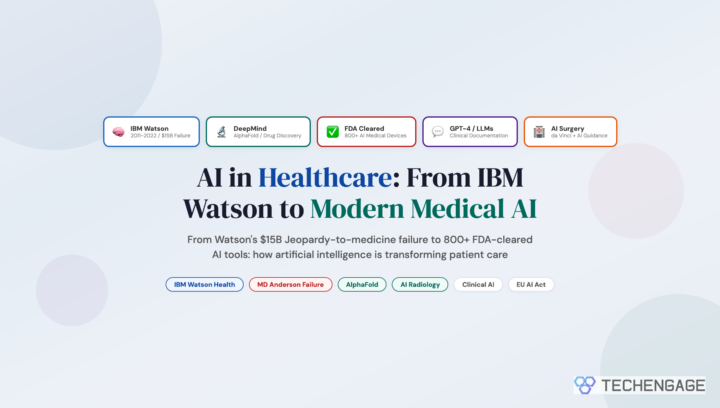
In September 2011, IBM announced that its Jeopardy-winning supercomputer Watson would partner with WellPoint to revolutionize healthcare decision-making. The promise was staggering: a system capable of processing 200 million pages of medical data in three seconds would help doctors diagnose diseases, recommend treatments, and reduce costs. Fifteen years later, Watson Health is a cautionary tale that paved the way for AI systems that actually deliver on that original vision.
The story of AI in healthcare is not a straight line from failure to success. It is a complex evolution from overhyped rule-based systems to genuinely transformative machine learning tools that are saving lives today. Here is the complete history, from Watson’s spectacular rise and fall through the modern medical AI revolution reshaping patient care worldwide.
IBM Watson Health: The $15 Billion Cautionary Tale
The Promise (2011-2015)
When IBM Watson defeated Jeopardy! champions Ken Jennings and Brad Rutter in February 2011, the achievement captured global imagination. IBM quickly pivoted to commercialize the technology, and healthcare became the flagship use case. The partnership with WellPoint (now Anthem) in September 2011 was just the beginning.
IBM invested heavily, spending over $15 billion on acquisitions including Truven Health Analytics ($2.6B), Merge Healthcare ($1B), and Phytel ($undisclosed). The vision was comprehensive: Watson would analyze patient records, medical literature, and clinical trial data to provide treatment recommendations that no human doctor could match in speed or breadth. IBM’s marketing positioned Watson as the future of personalized medicine.
The original 2011 announcement with WellPoint outlined a phased approach. Phase one would assist nurses managing complex patient cases. Phase two would deploy Watson to oncology practices, where doctors could input symptoms and receive evidence-based treatment suggestions. WellPoint’s Chief Medical Officer called it an “invaluable resource” that would “dramatically enhance the quality and effectiveness of medical care.”
The Spectacular Failure (2015-2022)
The cracks appeared early. The most damaging failure was Watson’s partnership with MD Anderson Cancer Center at the University of Texas. Launched in 2013 to build an “Oncology Expert Advisor,” the project consumed $62 million before being shelved in 2017 after a university audit found it had not met its goals. Internal documents revealed that Watson frequently generated incorrect and sometimes dangerous treatment recommendations.
The fundamental problem was architectural. Watson was not a learning system in the way modern AI operates. It relied heavily on rules programmed by human experts and struggled to generalize from limited training data. Oncology, with its vast complexity and constant stream of new research, exposed Watson’s inability to keep pace with evolving medical knowledge. Doctors reported that Watson’s recommendations often matched what they already knew, adding no value, or worse, suggested treatments that contradicted established guidelines.
By 2018, IBM had quietly scaled back Watson Health, laying off staff and narrowing its focus. Multiple hospital systems abandoned Watson partnerships. In January 2022, IBM sold Watson Health to private equity firm Francisco Partners for an estimated $1 billion, a fraction of the $15+ billion IBM had invested in building the division. The sale effectively ended the most ambitious, and most publicly visible, attempt to bring AI to healthcare.
Why Watson Failed: Lessons for Modern AI
Watson’s failure was not a failure of the concept but of execution and timing. Several factors contributed. First, IBM overpromised. Marketing materials positioned Watson as near-human in its reasoning capabilities when it was fundamentally a sophisticated search and matching system. Second, Watson’s training approach required extensive manual curation by medical experts, making it expensive to scale and slow to update. Third, healthcare data is messy. Electronic health records use inconsistent formats, abbreviations vary between institutions, and critical information is often buried in unstructured clinical notes. Watson was not equipped to handle this reality at scale.
These lessons directly shaped how the next generation of healthcare AI was built. Modern systems use deep learning trained on vastly larger datasets, can process unstructured data natively, and improve continuously without manual rule programming.
Google DeepMind and the Drug Discovery Revolution
While Watson was failing, Google DeepMind was quietly achieving breakthroughs that would fundamentally change biomedical science. In 2020, DeepMind’s AlphaFold system solved one of biology’s grand challenges: predicting the three-dimensional structure of proteins from their amino acid sequences. This problem had stumped researchers for 50 years.
AlphaFold’s predictions were so accurate that the scientific community was genuinely stunned. In 2022, DeepMind released AlphaFold’s predicted structures for virtually every known protein, over 200 million structures, for free through the AlphaFold Protein Structure Database. By 2024, the system’s successors were being used to accelerate drug discovery timelines from years to months. Pharmaceutical companies including Pfizer, Novartis, and dozens of biotech startups integrated AlphaFold into their research pipelines.
The contrast with Watson is instructive. Where Watson tried to replicate broad clinical reasoning and failed, AlphaFold focused on a specific, well-defined scientific problem and solved it definitively. This pattern of narrow excellence over broad ambition became the defining approach for successful healthcare AI.
FDA-Approved AI: 800+ Cleared Medical Devices
The U.S. Food and Drug Administration has cleared over 800 AI-enabled medical devices as of early 2026, with the pace accelerating year over year. The majority fall into radiology and cardiology, but AI-cleared devices now span pathology, ophthalmology, dermatology, gastroenterology, and neurology.
AI in Radiology: Seeing What Humans Miss
Radiology has become the proving ground for medical AI. Systems from companies like Viz.ai, Aidoc, and RADLogics can analyze medical images in seconds, flagging potential cancers, strokes, and fractures that human radiologists might overlook during long reading sessions.
A landmark 2024 study published in The Lancet Digital Health demonstrated that AI-assisted mammography screening reduced false negatives by 20% compared to standard double-reading by human radiologists. The system identified cancers that were missed on initial human review, particularly in dense breast tissue where tumors are hardest to detect visually.
By 2026, AI-assisted reading has become standard at major radiology practices in the United States, Europe, and parts of Asia. The technology does not replace radiologists. Instead, it functions as a tireless second reader that prioritizes urgent cases, flags abnormalities, and reduces the cognitive burden on physicians processing hundreds of scans per day.
AI-Assisted Surgery
Surgical AI has moved beyond science fiction into clinical reality. Intuitive Surgical’s da Vinci system, already the dominant robotic surgery platform, has integrated AI capabilities for real-time tissue identification and surgical guidance. The system can now identify critical anatomical structures during procedures, reducing the risk of accidental damage to nerves and blood vessels.
Johnson & Johnson’s Ottava surgical platform and Medtronic’s Hugo system both incorporate AI-powered planning and intraoperative guidance. Research published in 2025 showed that AI-assisted surgical planning reduced operative times by 15-20% for complex procedures and decreased complication rates. While fully autonomous surgery remains years away, AI augmentation of human surgeons is already improving patient outcomes.
LLMs in Clinical Practice: GPT-4 and Beyond
The arrival of large language models transformed healthcare AI’s potential for clinical documentation and decision support. In 2023, OpenAI’s GPT-4 passed the United States Medical Licensing Examination (USMLE) with scores well above the passing threshold, demonstrating broad medical knowledge that Watson never achieved.
However, the most impactful LLM application in healthcare has not been diagnosis but documentation. Physicians spend an estimated two hours on paperwork for every hour of direct patient care. Microsoft’s Nuance DAX Copilot (Dragon Ambient eXperience) uses ambient AI to listen to doctor-patient conversations and automatically generate clinical notes. By 2026, DAX is deployed across thousands of healthcare organizations, reportedly saving physicians an average of seven minutes per patient encounter.
Other ambient documentation tools, including Nabla, Abridge, and DeepScribe, compete in this space. The collective impact is significant: doctors report less burnout, more face time with patients, and faster documentation turnaround. This is perhaps the least glamorous but most immediately impactful application of AI in healthcare today.
Mental Health and AI Chatbots
AI-powered mental health support has grown rapidly, driven by a global shortage of therapists and increasing demand for accessible care. Apps like Woebot and Wysa use conversational AI to deliver cognitive behavioral therapy techniques, mood tracking, and crisis support. Clinical trials have shown measurable reductions in anxiety and depression symptoms for users of these platforms.
The category remains controversial. Critics argue that AI chatbots cannot replace the human therapeutic relationship, and concerns about safety during acute mental health crises are valid. A 2025 incident involving a general-purpose AI chatbot providing harmful advice to a vulnerable user intensified calls for regulation. Most healthcare-focused mental health AI platforms now include human escalation protocols and crisis detection systems as standard safety features.
The Regulatory Landscape: EU AI Act and FDA Framework
Regulation of healthcare AI is evolving rapidly to catch up with the technology. The European Union’s AI Act, which began enforcement in phases starting 2024, classifies most medical AI systems as “high-risk,” requiring conformity assessments, human oversight mechanisms, and transparency about training data and system limitations.
The FDA has adapted its regulatory framework to address the unique characteristics of AI medical devices, particularly systems that learn and change over time. The agency’s predetermined change control plan allows manufacturers to describe anticipated modifications in advance, enabling AI systems to improve without requiring entirely new regulatory submissions for each update. By 2026, the FDA has also increased scrutiny of AI training data for demographic bias, requiring evidence that systems perform equitably across racial, ethnic, and age groups.
China, the UK, and several other nations have developed their own regulatory frameworks for medical AI, creating a complex patchwork that multinational companies must navigate. Harmonization efforts are underway through the International Medical Device Regulators Forum, but significant differences remain across jurisdictions.
Ethical Concerns: Bias, Liability, and Consent
Healthcare AI raises profound ethical questions that technology alone cannot answer. Bias in training data remains a persistent concern. Studies have documented AI systems that perform significantly worse for patients from minority racial and ethnic groups, often because training datasets disproportionately represent white patients from well-resourced healthcare systems.
Liability presents another unresolved challenge. When an AI system contributes to a misdiagnosis, the question of legal responsibility, whether it falls on the developer, the hospital, or the physician who relied on the recommendation, lacks clear legal precedent in most jurisdictions. Patient consent for AI involvement in their care is inconsistently addressed, with many patients unaware that AI systems influence their diagnoses or treatment plans.
Transparency is a growing demand from both regulators and patient advocates. The “black box” nature of many deep learning systems makes it difficult to explain why a particular recommendation was made. Explainable AI (XAI) research is working to address this, but the field is still maturing. Healthcare providers increasingly recognize that earning patient trust requires clear communication about when and how AI is involved in their care.
Where Healthcare AI Is Heading (2026-2030)
The trajectory is clear even if the specifics remain uncertain. Multimodal AI systems that combine medical imaging, lab results, genomic data, and clinical notes into unified assessments are entering clinical trials. Personalized treatment recommendations based on a patient’s complete data profile, the original promise Watson could not deliver, are becoming technically feasible through modern deep learning architectures.
AI-driven drug discovery is expected to produce its first fully AI-discovered drugs to reach market by 2027-2028, with companies like Insilico Medicine, Recursion Pharmaceuticals, and Isomorphic Labs (a DeepMind spinoff) leading the charge. Remote patient monitoring powered by AI, using data from wearable devices, is enabling earlier intervention for chronic conditions like heart failure and diabetes.
The fundamental lesson from Watson’s failure and modern AI’s success is that healthcare AI works best when it augments human expertise rather than attempting to replace it. The most impactful systems today are tools that make doctors faster, more accurate, and less burdened by administrative work. That is not the science fiction vision IBM sold in 2011, but it is saving real lives in real hospitals around the world right now.
Why did IBM Watson Health fail?
IBM Watson Health failed primarily because it was a rule-based search and matching system marketed as artificial intelligence. It required expensive manual curation by medical experts, could not process messy real-world healthcare data effectively, and could not keep pace with rapidly evolving medical research. The MD Anderson Cancer Center partnership consumed $62 million before being abandoned in 2017. IBM sold Watson Health to Francisco Partners in 2022 for roughly $1 billion after investing over $15 billion.
How many AI medical devices has the FDA cleared?
The FDA has cleared over 800 AI-enabled medical devices as of early 2026, with the majority focused on radiology and cardiology. The pace of clearances has accelerated year over year, and AI devices now span pathology, ophthalmology, dermatology, gastroenterology, and neurology. The FDA has also adapted its regulatory framework to allow AI systems that learn and improve over time.
How is AI being used in radiology?
AI systems from companies like Viz.ai, Aidoc, and RADLogics analyze medical images in seconds, flagging potential cancers, strokes, and fractures. A landmark 2024 study showed AI-assisted mammography screening reduced false negatives by 20%. By 2026, AI-assisted reading has become standard at major radiology practices, functioning as a tireless second reader that prioritizes urgent cases and reduces physician cognitive burden.
Can GPT-4 practice medicine?
GPT-4 passed the U.S. Medical Licensing Examination with scores well above the passing threshold, demonstrating broad medical knowledge. However, its most impactful healthcare application has been clinical documentation rather than direct diagnosis. Tools like Microsoft’s Nuance DAX Copilot use LLM technology to automatically generate clinical notes from doctor-patient conversations, saving physicians an average of seven minutes per encounter.
Is AI being used in surgery?
Yes. Intuitive Surgical’s da Vinci system now integrates AI for real-time tissue identification and surgical guidance. Johnson & Johnson’s Ottava and Medtronic’s Hugo platforms both incorporate AI-powered planning. Research from 2025 showed AI-assisted surgical planning reduced operative times by 15-20% and decreased complication rates. Fully autonomous surgery remains years away, but AI augmentation of human surgeons is improving outcomes.
What are the main ethical concerns with healthcare AI?
Key ethical concerns include bias in training data (AI systems performing worse for minority patients), unresolved liability questions when AI contributes to misdiagnoses, inconsistent patient consent practices, and the black box nature of deep learning systems that makes recommendations difficult to explain. The EU AI Act classifies most medical AI as high-risk, requiring conformity assessments and human oversight.



that actually looks like a lot of fun dude. Wow.
anonymize.it.tc
that actually looks like a lot of fun dude. Wow.
anonymize.it.tc
excellent article! thanks for point this out… watson is one smart pc
excellent article! thanks for point this out… watson is one smart pc
Hope it really makes no mistake.
Hope it really makes no mistake.