

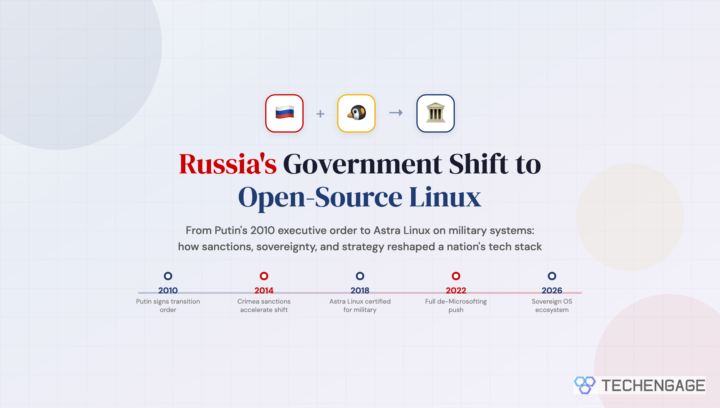
In late December 2010, then-Prime Minister Vladimir Putin signed a 17-page document titled “Transition Plan of the Federal Authorities and Federal Budgetary Institutions to Free Software.” The order laid out a timeline for moving Russia’s entire government apparatus off proprietary software (primarily Microsoft Windows and Office) and onto GNU/Linux and open-source alternatives by 2015.
That deadline came and went without full implementation. But the order itself was far from meaningless. It kicked off a fifteen-year transformation that, accelerated by Western sanctions, geopolitical isolation, and genuine security concerns, has made Russia one of the most aggressive adopters of sovereign open-source operating systems on the planet.
This is the story of what actually happened after Putin said “make it so.”
The 2010 Order and Why It Mattered
Putin’s executive order wasn’t Russia’s first attempt at an open-source transition. Reports recommending the shift surfaced as early as 2007, and a formal plan appeared briefly in 2008 before getting shelved after pushback from government ministries that had deep Microsoft dependencies.
What made the 2010 order different was political weight. Putin personally signed it. The document established five concrete milestones: pilot deployments in Q2 2011, approval of supported data formats by Q3 2011, creation of a national software repository by Q2 2012, and full rollout across government and fiscal institutions by Q3 2014. Deputy Communications Minister Ilya Massuh described the repository as something resembling an app store for government-approved Linux software.
The motivations were threefold. First, licensing costs: Russia was spending hundreds of millions of dollars annually on Microsoft licenses across its sprawling federal bureaucracy. Second, security: the Russian intelligence community had long been uneasy about running classified operations on American-made software with code they couldn’t audit. Third, sovereignty: dependence on a foreign company for critical government infrastructure created a strategic vulnerability that Russia’s leadership found increasingly unacceptable.
The First Failures (2011-2013)
Almost immediately, the transition ran into the same walls that had killed previous attempts. Government workers trained on Windows resisted retraining. Specialized software used by tax authorities, customs agencies, and the military had no Linux-compatible equivalents. Procurement contracts with Microsoft and its Russian partners had years left on them, with termination penalties that made switching expensive in the short term.
The education sector, which was supposed to be the easiest win (schools running basic office software and web browsers), saw spotty adoption. Some regions installed ALT Linux, a Russian distribution, on classroom computers. Others simply renewed their Microsoft licenses and filed paperwork claiming compliance.
By 2013, independent observers estimated that fewer than 5% of federal agencies had meaningfully transitioned. The plan wasn’t dead, but it was on life support. Russia needed an external shock to revive it.
Crimea Changed Everything (2014)
Russia’s annexation of Crimea in March 2014 triggered Western sanctions that fundamentally altered the calculus. Microsoft, along with other American tech companies, began restricting sales and support to sanctioned Russian entities. The theoretical risk of depending on foreign software became a practical problem overnight.
Putin signed a new decree in November 2015 requiring all government agencies to prioritize domestically produced software. The Unified Register of Russian Software was established, creating an approved list of domestic alternatives that government procurement officers were legally required to consider before purchasing foreign products.
This wasn’t just about Linux anymore. The sanctions-era policy encompassed databases (PostgreSQL-based Russian forks replacing Oracle), office suites (MyOffice and OnlyOffice replacing Microsoft 365), email systems, and even antivirus software. Kaspersky Lab, already Russia’s dominant cybersecurity firm, saw government contracts surge.
The shift happened faster than anyone expected. When switching costs drop to zero because the vendor cuts you off anyway, institutional resistance evaporates.
Astra Linux: Russia’s Sovereign Operating System
The single most important development in Russia’s open-source journey is Astra Linux, a Debian-based distribution developed by the Scientific and Production Association “RusBITech.” Two editions exist: Astra Linux Common Edition for general government and commercial use, and Astra Linux Special Edition, which holds certification from Russia’s FSB (Federal Security Service), FSTEC (Federal Service for Technical and Export Control), and the Ministry of Defense for processing classified information up to “top secret” level.
That last point is significant. Running a domestic Linux distribution on military networks isn’t a cost-saving measure. It’s a national security decision. The Russian military’s adoption of Astra Linux Special Edition, which began in earnest around 2018, means that Russia’s defense infrastructure now runs on code that Russian engineers can audit line by line, with no American company holding update servers or telemetry endpoints.
Astra Linux ships with mandatory access control (based on the PARSEC security module), integrated encryption compliant with Russian GOST cryptographic standards, and a hardened kernel. It runs on everything from desktop workstations to embedded military systems. The Russian armed forces use it on command-and-control terminals, and reports from Russian tech media indicate deployment on systems associated with the Iskander missile complex and naval fleet management.
The 2022 Sanctions Wave and Full De-Microsofting
If the 2014 sanctions were a push, the 2022 sanctions following Russia’s invasion of Ukraine were a shove off a cliff. Microsoft suspended all new sales in Russia in March 2022. Oracle, SAP, and Adobe followed. Cloud services from Amazon Web Services, Google Cloud, and Microsoft Azure restricted access for Russian organizations.
This time there was no ambiguity. Existing licenses wouldn’t be renewed. Security patches would stop. Support contracts were void. The Russian government issued emergency directives accelerating domestic software adoption, and the Ministry of Digital Development set a hard deadline of January 1, 2025, for all government systems to run exclusively on software from the Unified Register.
The private sector followed, not always voluntarily. Russian banks, energy companies, and telecom operators that had relied on Western enterprise software scrambled for alternatives. Sber (Russia’s largest bank) accelerated development of its own SberLinux distribution. Yandex expanded its cloud infrastructure to fill gaps left by departing Western providers.
How Russia Compares to China’s Open-Source Strategy
Russia’s Linux transition invites comparison with China, which has pursued a parallel but distinct path. China’s sovereign OS efforts center on openKylin (backed by the Ministry of Industry and Information Technology), openEuler (originated at Huawei), and several others. China’s approach has been more coordinated and better funded, with state-backed semiconductor initiatives (like RISC-V adoption) running alongside the software transition.
Russia, by contrast, has a smaller tech sector and less manufacturing capability. It cannot produce its own processors at scale (Russia’s Elbrus and Baikal chips exist but are manufactured at foreign fabs, creating a circular dependency). Where China can realistically aim for a fully sovereign hardware-software stack, Russia’s open-source transition is primarily a software-layer play running on whatever hardware it can acquire.
The two countries have explored cooperation. Russian and Chinese officials have discussed shared repository infrastructure and joint development of open-source tools, though concrete results remain limited as of 2026. Both nations participate in global open-source communities while simultaneously building walled gardens for government use, a tension that mirrors broader geopolitical dynamics.
The EU’s Parallel Open-Source Movement
Russia’s motivations are unique (sanctions compliance and adversarial posture toward the West), but the underlying logic of government open-source adoption is not. The European Union has its own growing movement.
Germany’s state of Schleswig-Holstein announced in 2024 a full migration from Microsoft Office to LibreOffice across all 25,000 government workstations. France’s government has mandated open-source preferences in procurement since 2012 through the Ayrault Directive, and the French gendarmerie completed a migration of 72,000 desktops to a custom Ubuntu-based distribution years ago. The European Commission’s Open Source Software Strategy for 2020-2023 explicitly encouraged member states to adopt open-source solutions for digital sovereignty.
The difference: EU open-source adoption is driven by cost savings, interoperability, and philosophical commitment to digital independence. Russia’s is driven by those factors plus the reality that proprietary vendors left the country and aren’t coming back.
Current State in 2026
Sixteen years after Putin’s original order, where does Russia actually stand?
Military and intelligence: Essentially complete. Astra Linux Special Edition is the standard across classified networks. The transition here has been the most successful because the security argument was always the strongest, and military organizations follow orders.
Federal government agencies: Majority transitioned. The Ministry of Digital Development reports compliance rates above 80% for core workstation software, though definitions of “compliance” vary. Many agencies run Astra Linux or RED OS on desktops but still depend on Windows for legacy specialized applications via virtualization.
Regional and municipal government: Patchy. Moscow and St. Petersburg have high adoption rates. Remote regions with limited IT staff lag significantly. The familiar pattern of underfunded local government struggling with IT modernization isn’t unique to Russia.
Education: Officially transitioned. In practice, many schools use pirated Windows alongside their official Linux installations. Enforcement is inconsistent.
Private sector: Mixed. Large companies with government contracts have adopted domestic software. Small and medium businesses largely continue using whatever works, which often means gray-market Microsoft licenses.
Lessons for the Rest of the World
Russia’s experience offers several lessons that apply regardless of geopolitics.
Executive orders alone don’t change IT infrastructure. Putin signed the 2010 order with full authority, and it still took sanctions, vendor departures, and security crises to achieve meaningful adoption. The technical and human challenges of migrating entrenched systems are enormous, and political will evaporates quickly when budgets are tight and retraining is painful.
Sanctions are a more effective motivator than policy. Nothing accelerated Russia’s open-source adoption like having proprietary vendors leave. Forced migration, while chaotic and expensive, gets results that voluntary migration rarely achieves.
Security is the strongest argument for sovereign operating systems. Cost savings and philosophical commitments to open source are nice talking points, but the real driver is the ability to audit every line of code running on critical infrastructure. That argument resonates with military and intelligence agencies everywhere, not just in Russia.
No country has achieved full software sovereignty yet. Russia still depends on foreign hardware. China is closest, but even its Loongson processors and openKylin stack have gaps. Complete technological independence may not be achievable in a globalized supply chain, but reducing single-vendor dependencies is both achievable and strategically wise.
Related reading on TechEngage:
- Google Censorship: The Search Giant’s History of Content Control
- How to Protect Your Digital Identity and Social Media Accounts
- Facebook’s Like Button Bait and Switch: A History of Meta’s Dark Patterns
Frequently Asked Questions
What was Putin’s 2010 open-source order?
In December 2010, then-Prime Minister Vladimir Putin signed a 17-page document called the ‘Transition Plan of the Federal Authorities and Federal Budgetary Institutions to Free Software.’ It mandated moving all Russian federal government systems from proprietary software (mainly Microsoft Windows and Office) to GNU/Linux and open-source alternatives between 2011 and 2015.
What is Astra Linux and why does Russia use it?
Astra Linux is a Debian-based operating system developed by RusBITech. It comes in two editions: Common Edition for general use and Special Edition certified by Russia’s FSB, FSTEC, and Ministry of Defense for processing classified information up to ‘top secret’ level. Russia’s military and intelligence agencies use it because the code can be fully audited by Russian engineers with no foreign company controlling updates or telemetry.
How did Western sanctions affect Russia’s Linux transition?
Western sanctions were the biggest accelerator of Russia’s open-source adoption. The 2014 sanctions after Crimea prompted Russia to establish the Unified Register of Russian Software and prioritize domestic alternatives. The 2022 sanctions after the Ukraine invasion were even more impactful: Microsoft, Oracle, SAP, and major cloud providers suspended operations in Russia entirely, forcing emergency migration to domestic software with a hard deadline of January 1, 2025.
How does Russia’s open-source strategy compare to China’s?
Both countries pursue sovereign operating systems, but China’s approach is more coordinated and better funded. China has openKylin, openEuler, and domestic processors like Loongson, aiming for a full hardware-software stack. Russia has Astra Linux and RED OS but lacks domestic chip manufacturing capability, making its transition primarily a software-layer effort running on imported or acquired hardware.
Has Russia fully completed its transition to Linux in %currentyear%?
Not entirely. Military and intelligence systems are essentially fully migrated to Astra Linux. Federal agencies report over 80% compliance, though many still run legacy Windows applications via virtualization. Regional governments, schools, and the private sector have much lower adoption rates. Complete transition remains a work in progress sixteen years after Putin’s original order.
Are other countries also moving to open-source government software?
Yes. Germany’s Schleswig-Holstein announced a full migration from Microsoft Office to LibreOffice across 25,000 workstations in 2024. France’s gendarmerie migrated 72,000 desktops to a custom Ubuntu-based distribution. The European Commission’s Open Source Software Strategy actively encourages member states to adopt open-source solutions for digital sovereignty and cost savings, though motivations differ from Russia’s sanctions-driven approach.



Well, using Linux would allow Russia to disentangle themselves from Microsoft and they are right to be concerned.
Microsoft's system and software "phones home" over the internet.
Linux "phones home" to its "distro" IP address which can be a trusted .ru location.
Not to mention that its free so nobody's got squat to say about what software you run, when and why.
Never thought about it like that before. Wow.
I know there’s a “In Soviet Russia” joke here somewhere, but I’m not feeling creative. Anyone got anything good?
Source open you? No…that’s crap.
EDIT: Guy above me has a decent one.
A smart and strategic decision. Governments needs to get off the Microsoft lock-in. Microsoft is of those mega-corporations that is fully supported by the US Government, and is one of the significant ways to infiltrate, influence and leverage other countries. I hope Putin puts significant resources into the project, and invest big in primary schools.
I always knew there was something about the guy that I liked.
I tried to think of a better one, but it’s a challenge. Actually, “source opens you” would have been better than mine.
In the internet, Windows, or any other software you want can be downloaded for free.
@Tranis
No. Piracy is not a viable solution to a company / government.
Vladimir Vladimirovic is better than anyone when it comes to governing a country, HE ALWAYS DOES WHAT HE SAYS. Not like some Presidents who keep on saying their country will embrace open source but sign secret deals with Microsoft under the table, even worse they’re looking like clowns for having becoming Sales Promotion Guy for Apple, Inc.
With havin so much written content do you ever run into any problems of plagorism or copyright infringement? My blog has a lot of completely unique content I’ve either authored myself or outsourced but it seems a lot of it is popping it up all over the web without my permission. Do you know any solutions to help stop content from being ripped off? I’d certainly appreciate it.
This move by Russia is widely viewed as the continuation of a similar campaign launched in 2008 focusing schools. By 2009, Russia had aimed to rid schools of all paid proprietary software and encourage free software.