

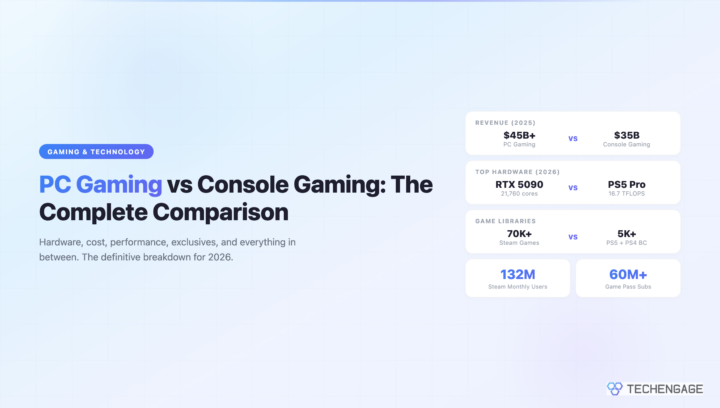
The PC vs console debate has raged since the early 1990s, and three decades later, gamers are still arguing about it in Reddit threads, Discord servers, and comment sections. But something fundamental shifted over the past fifteen years. The battle lines that seemed so clear in 2011 have dissolved into something far more complex, more nuanced, and frankly more interesting. By 2026, you can play AAA PlayStation titles on a gaming PC, run your Steam library on a handheld device the size of a Switch, and stream console-quality games to a phone with a $10/month subscription. The old war cries of “PC Master Race” and “consoles just work” feel increasingly like arguing about whether a Swiss Army knife is better than a chef’s knife. They’re different tools, and the overlap has never been greater.
This is not a hit piece on either platform. Both ecosystems are genuinely thriving in 2026, and the truth is that most serious gamers own multiple devices across both camps. What follows is the most complete, data-grounded comparison of PC and console gaming available, covering hardware, cost, performance, exclusives, esports, cloud gaming, and everything in between. We’re also revisiting a 2011 infographic that captured the debate at a very different moment in gaming history, because looking at where things stood then makes the current landscape all the more remarkable.
Where Things Stood in 2011
In 2011, the dominant narrative was unambiguous: consoles had won. The PlayStation 3 and Xbox 360 were in the middle of one of the longest and most commercially successful console generations in history. The Xbox 360 had sold over 55 million units by mid-2011. The PS3 was closing in on 60 million. Together, these two machines were the defining gaming platforms of their era, sitting in living rooms across the world and generating billions in software revenue annually.
PC gaming, meanwhile, was widely declared dead or dying. Executives at major publishers said it publicly. Game developers shifted resources toward console ports. EA, Activision, and Ubisoft were all treating PC as a secondary platform, if they treated it as a platform at all. Piracy concerns were the go-to explanation, though the reality was more complicated. The truth was that the PC gaming market had fractured, distribution was a mess, and no single storefront had pulled it together yet. Steam existed, but it was still finding its footing. In 2011, Steam had approximately 30 million registered accounts and was still primarily known as the place you were forced to install to play Half-Life 2.
The infographic below captures the state of the debate as it existed in 2011, a historical artifact worth examining not because it was wrong, but because it shows exactly what kind of assumptions the industry was operating under before everything changed.

Notice what the 2011 data emphasized: console install bases, living room dominance, ease of use as a decisive console advantage. The framing treated PC gaming as the complicated, expensive outlier. And from a certain angle, that framing was reasonable. Buying a gaming PC in 2011 that matched console performance required meaningful technical knowledge and a budget that most casual players didn’t have. The console value proposition, buy one box, plug it in, play anything, was genuinely compelling in a way it isn’t quite as decisive today.
What Actually Happened: PC Gaming’s Revenue Surge
Steam changed everything. Not immediately, not in a single year, but systematically and irreversibly. Valve’s digital storefront solved the PC gaming distribution problem that had plagued the platform throughout the 2000s. By offering a unified library, automatic updates, sales that made games almost comically cheap, and eventually a social ecosystem that rivaled Xbox Live and PSN, Steam turned PC gaming into a coherent platform rather than a collection of individual publishers doing their own thing.
The numbers tell the story clearly. Steam grew from roughly 30 million registered users in 2011 to over 132 million monthly active users by 2024. That’s not registered accounts, that’s people actively launching the client every month. Total Steam library size crossed 100,000 games. The platform generates an estimated $8-10 billion annually for Valve alone, with developers taking the majority of that through revenue splits.
Total PC gaming revenue hit approximately $45 billion globally in 2025 compared to roughly $35 billion for dedicated console gaming. This isn’t cherry-picking a good year for PC. PC has outpaced console software revenue consistently since around 2016, and the gap has been widening. Free-to-play titles drove a significant portion of this growth. League of Legends, Fortnite (which launched on PC before consoles), Dota 2, Counter-Strike, and later Valorant generated billions in microtransaction revenue from PC players who paid nothing upfront to download the game.
Esports also delivered enormous visibility for PC gaming throughout the 2010s and into the 2020s. The International, Riot Games’ World Championship, and CS2 Majors consistently drew millions of concurrent viewers. These weren’t console games. They were keyboard-and-mouse games designed from the ground up for PC play, and they became cultural touchstones for an entire generation of gamers.
The Hardware Evolution
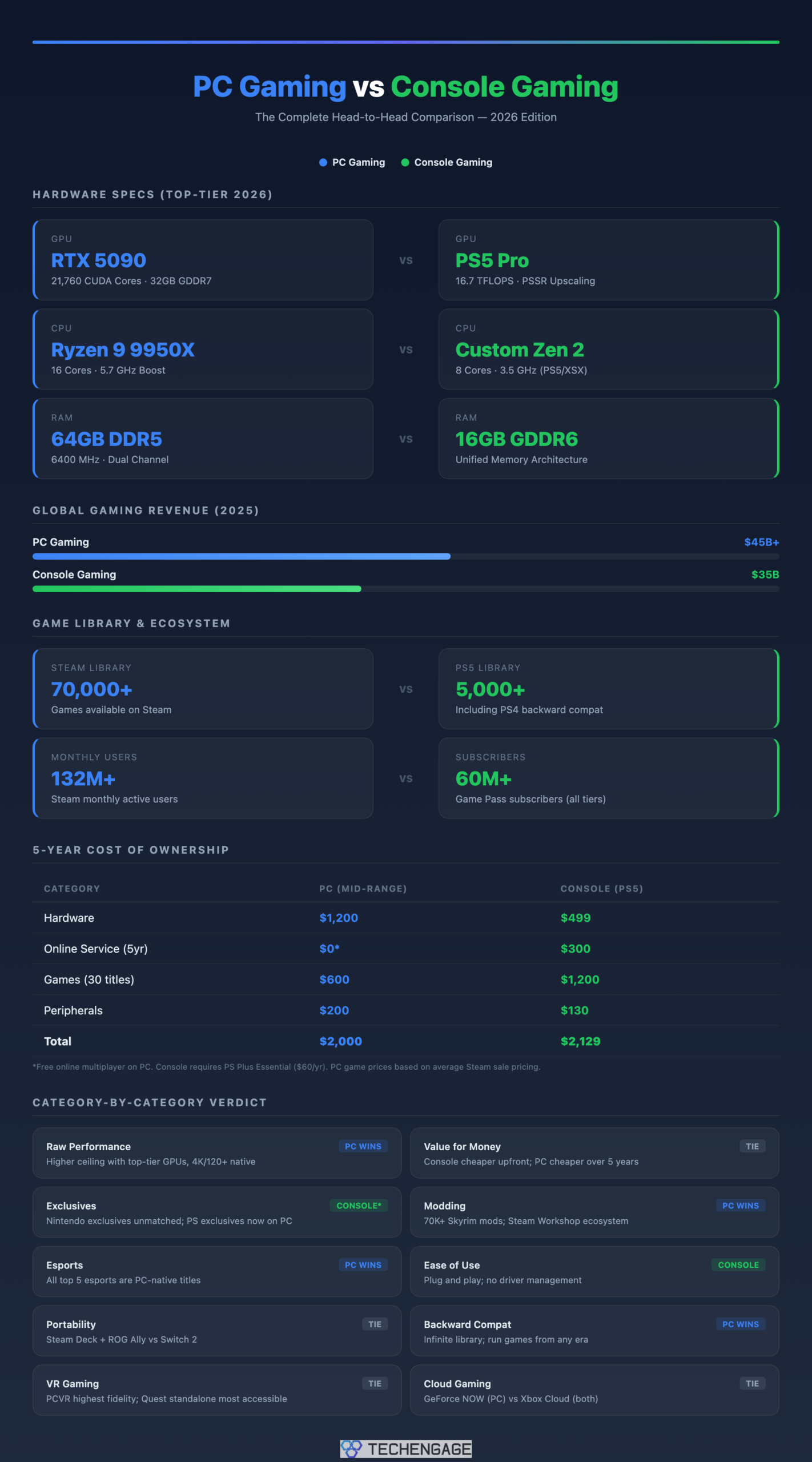
The PlayStation 5 and Xbox Series X launched in late 2020 with genuinely impressive specs: custom AMD RDNA 2 GPUs, ultra-fast NVMe SSDs, and dedicated hardware for ray tracing. By 2026, these consoles are in the middle of their generation, still delivering excellent performance at their original price points of $499 (PS5) and $499 (Series X), with the refreshed PlayStation 5 Pro sitting at $699 for players who want additional performance headroom.
On the PC side, NVIDIA’s RTX 50 series launched in early 2025 with the RTX 5090 and RTX 5080, delivering performance that makes even the Pro consoles look modest. AMD’s Ryzen 9000 series CPUs, paired with RX 9000 series graphics cards, offer competitive alternatives. A high-end gaming PC in 2026 is operating in a genuinely different performance bracket than any console, but so is its price tag, often exceeding $2,000-3,000 for top-tier builds.
The real hardware story of 2026, though, is handheld PCs. The Steam Deck launched in February 2022 and fundamentally changed what it meant to own a “gaming PC.” Valve’s handheld ran a full desktop Linux OS, accessed your entire Steam library, and played titles ranging from indie darlings to AAA blockbusters in a form factor smaller than a laptop. The Steam Deck OLED revision in late 2023 addressed most of the original’s weaknesses with a stunning display upgrade and improved battery life.
Then the competition arrived. ASUS’s ROG Ally and ROG Ally X run full Windows 11, making every PC game you own playable in handheld form. Lenovo’s Legion Go introduced a removable controller design with a large 8.8-inch display. MSI’s Claw brought Intel’s Arc GPU architecture to the handheld space. By 2026, there are half a dozen credible handheld gaming PCs at various price points, with the Ally X and Legion Go 2 trading benchmark leads depending on the game being tested.
This matters enormously for the PC vs console argument. The “consoles win on form factor because you can play on the couch or on the go” argument evaporated when Steam Deck sold millions of units to players who wanted exactly that convenience without giving up their PC game library.
The Cost Debate: Updated for 2026
The cost comparison between PC and console is frequently oversimplified in ways that mislead both sides. Let’s be specific about what you actually spend across each platform over a realistic five-year ownership window.
A PS5 costs $499. A Series X costs $499. After that, a PlayStation Plus subscription runs $59.99/year for the Essential tier (required for online multiplayer) and $99.99/year for the Extra tier (which includes the games catalog). Xbox Game Pass Ultimate runs $19.99/month as of 2026, or roughly $240/year. New first-party games typically cost $69.99 at launch and rarely drop below $39.99 in their first year. Over five years, a console owner spending moderately on games and paying for online services has typically spent $2,000-2,500 total.
A capable gaming PC in 2026 starts at roughly $800-1,000 for a build that plays most games at 1080p/60fps respectably. A mid-range build that delivers 1440p gaming with good frame rates costs $1,200-1,500. There’s no mandatory online subscription fee on PC. You pay for individual services like Game Pass PC ($14.99/month) if you want them, but online multiplayer in games like CS2, Valorant, and most other PC titles is completely free. Steam sales routinely discount games 50-75%, and Epic Games Store has run weekly free game promotions since 2018 that have given away hundreds of titles.
The honest math: over five years, total PC gaming costs converge surprisingly close to console costs for moderate spenders, and come out ahead for heavy gamers who buy many titles, because PC game prices are structurally lower than console game prices. The PC upfront cost disadvantage is real, but the ongoing operating cost advantage is also real, and it compounds over time.
Performance: 4K, Ray Tracing, and Frame Rates
Console marketing has leaned heavily on “4K gaming” as a selling point since the PS4 Pro launched in 2016. The reality has always been more complicated. The PS5 and Xbox Series X achieve native 4K in some titles, but many games run at dynamic resolution (dropping below 4K under load) or use reconstruction techniques to present an image that looks like 4K without the full rendering cost. This is not a knock on consoles; dynamic resolution and image reconstruction are legitimate and effective techniques used across all gaming hardware.
PC’s performance ceiling, however, is simply higher. An RTX 5080 can render games natively at 4K/120fps in titles that PS5 runs at 4K/60fps with dynamic resolution. The gap narrows considerably at the mid-range, where a $600 GPU in a mid-range build delivers performance that’s comparable to or slightly above PS5 Pro. The “PC is always better” claim is true at the top end and increasingly questionable as you move down the price range.
NVIDIA’s DLSS 4 with Multi Frame Generation can effectively double or triple rendered frame rates with minimal visual quality loss. AMD’s FSR 4 brings similar capabilities to both PC and consoles. Intel’s XeSS provides a third option on Arc-powered PCs and handheld devices. These upscaling technologies mean that raw GPU performance numbers tell only part of the story. A mid-range RTX 5060 hitting 144fps in a competitive shooter at 1440p via DLSS 4 is a genuinely excellent experience that no console matches for that specific use case.
For the vast majority of players, though, the “good enough” factor is decisive. Playing a well-optimized console title at locked 60fps on a PS5 with HDR on a good display is an objectively excellent experience. The marginal gains from a high-end gaming PC are real, but they’re also genuinely marginal for players who aren’t competitive gamers or enthusiasts chasing maximum fidelity.
The Exclusives Landscape in 2026
This section represents perhaps the most dramatic shift in the entire PC vs console debate since 2011. Exclusives were once the decisive argument for console ownership. God of War, Spider-Man, Horizon Zero Dawn, The Last of Us, Ghost of Tsushima: these PlayStation titles generated enormous console sales by being unavailable anywhere else. That exclusivity is largely over.
Sony began releasing PlayStation titles on PC starting with Horizon Zero Dawn in 2020. Since then, God of War (2018), Spider-Man: Miles Morales, Ghost of Tsushima, Returnal, Ratchet & Clank: Rift Apart, and The Last of Us Part I have all received PC releases, typically 1-2 years after their PlayStation launches. By 2026, the question isn’t whether PlayStation games come to PC. It’s only when.
Microsoft went further. Xbox’s strategy under Phil Spencer has been explicit multiplatform since 2020. Every Xbox first-party title releases simultaneously on Xbox consoles, PC via the Microsoft Store and Steam, and Xbox Cloud Gaming. Titles like Starfield, Indiana Jones and the Great Circle, and Avowed released day-one across all platforms. There are no Xbox exclusives in any meaningful sense.
Nintendo remains the last holdout with genuine platform exclusivity. The Nintendo Switch 2, which launched in 2025, houses Mario, Zelda, Pokémon, and Metroid in a first-party portfolio that remains entirely unavailable on any other platform. For players who want Zelda or the new 3D Mario, there is no PC alternative.
Meanwhile, PC maintains exclusive access to entire genres that consoles don’t meaningfully compete in. Grand strategy titles from Paradox Interactive (Crusader Kings III, Victoria 3, Hearts of Iron IV, Stellaris) are PC-native games with complexity that doesn’t translate to controller play. City-building games, complex 4X titles, hardcore simulation games (MSFS 2024, DCS World), and the vast majority of indie games either launch PC-first or PC-only.
Modding: PC’s Unmatched Advantage
Fourteen years after release, Skyrim’s modding community on PC is still actively releasing content. The Nexus Mods page for The Elder Scrolls V: Skyrim Special Edition has over 70,000 uploaded mods, with new ones appearing weekly. Total conversion mods have turned Skyrim into entirely different games with different combat systems, questlines, and completely redesigned world areas. Some of Skyrim’s most downloaded mods have hundreds of thousands of downloads each.
Baldur’s Gate 3 launched with robust modding support and a passionate community that began releasing gameplay overhauls, new classes, visual improvements, and expanded dialogue within weeks of release. Cities: Skylines 2’s mod community is filling gaps that the base game left. Total War: Warhammer III has player-created factions and campaigns that are, by community consensus, better than some official DLC.
Steam Workshop has been the key infrastructure enabler. One-click mod installation, automatic updates, and curated community ratings transformed PC modding from a hobbyist activity requiring technical knowledge into something accessible to anyone who can click “Subscribe.” The barrier to entry for modding a supported PC game in 2026 is effectively zero.
Console modding exists in a limited form. Bethesda’s Creations service brings curated, approved mods to PlayStation and Xbox for Skyrim, Fallout 4, and Starfield. These are sanitized, limited, and reviewed by Bethesda before publishing. The console mod catalogs contain hundreds of entries; the PC catalogs contain tens of thousands. For any player who cares about extending the life of games through community content, PC has no real competition.
Esports and Competitive Gaming
Professional esports infrastructure in 2026 runs almost entirely on PC. The five most-watched esports titles globally (League of Legends, Counter-Strike 2, Valorant, Dota 2, and PUBG) are all PC-native games played competitively with keyboard and mouse. The prize pools are staggering: The International 2024 distributed over $20 million. CS2 Majors routinely carry $1.25 million prize pools. Riot’s Valorant Champions Tour has distributed tens of millions annually since its inception.
Mouse and keyboard input remains the gold standard for competitive first-person and real-time games. The precision ceiling for mouse aiming is higher than analog stick aiming, which is why every serious competitive shooter operates PC-only tournaments or separates PC and console players in crossplay matchmaking. High-refresh-rate gaming monitors (240Hz, 360Hz) are standard equipment for professional players because the input latency and motion clarity advantages at those refresh rates are measurable and meaningful.
Console esports aren’t absent. FIFA/EA FC competitive play draws significant viewership. Fighting game tournaments (EVO, Combo Breaker) compete across both PS5 and PC depending on the title. Call of Duty League operates on PC using controllers. Rocket League’s competitive scene includes both PC and console players through crossplay pools. Crossplay has genuinely complicated the competitive landscape in interesting ways, with casual modes allowing cross-platform play while competitive modes often segment by input type.
Cloud Gaming: The Great Equalizer?
The promise of cloud gaming, playing any game on any device without owning expensive hardware, has been the subject of industry hype since OnLive launched in 2010 and promptly collapsed. The technology has matured considerably, and in 2026, cloud gaming is a real product that real players use regularly, even if it hasn’t replaced hardware ownership at scale.
NVIDIA GeForce NOW streams PC games from Nvidia’s data centers to subscribers’ devices. The service works remarkably well on fast, low-latency connections, letting players run their existing Steam library on a MacBook, Android tablet, or Chromebook. Xbox Cloud Gaming lets Game Pass Ultimate subscribers stream Xbox and PC games to phones, tablets, and browsers. PlayStation Portal offers remote play streaming from a PS5 to a dedicated handheld screen.
The limitations are real and honest. Cloud gaming requires a stable, low-latency internet connection, ideally fiber or cable with under 20ms latency and 25+ Mbps downstream. In practice, this means cloud gaming works excellently for players in urban areas with good ISP infrastructure and poorly or not at all for players in rural areas, on congested networks, or with unreliable connections. Input latency, even on best-in-class implementations, adds a perceptible delay that competitive players notice immediately.
Will cloud gaming make the PC vs console debate irrelevant eventually? Possibly, but not soon. Internet infrastructure buildout globally is measured in decades, not years. The installed base of gaming hardware is enormous and self-sustaining. Cloud gaming is an addition to the ecosystem, not a replacement for it.
The Steam Deck Effect
Steam Deck’s cultural impact on the PC vs console debate is underappreciated by people who haven’t used one. Before Steam Deck, the argument often came down to lifestyle: consoles are living room devices you play on the couch or take to a friend’s house; PCs are desk-bound machines. Steam Deck shattered that framing so completely it’s now difficult to reconstruct why it seemed so decisive.
The original Steam Deck launched at $399-649 depending on storage tier. The Steam Deck OLED launched in November 2023 at $549-649 with a dramatically improved screen, better battery life, and slightly improved thermals. By 2026, Valve has shipped millions of units globally and SteamOS has become a mature, well-supported platform that runs the vast majority of the Steam catalog through Proton compatibility.
The ROG Ally X runs full Windows 11 with an AMD Ryzen Z1 Extreme chip, offering stronger raw performance than the Steam Deck at a higher price point ($799). The Legion Go 2 from Lenovo features detachable controllers and an 8.8-inch display, borrowing design elements from Nintendo Switch while running a full Windows environment. These aren’t toys or compromised experiences. They’re genuinely capable gaming devices that fit in a bag, connect to a monitor via USB-C dock, and access your entire PC game library.
The docking use case deserves more attention. Every major handheld gaming PC supports video output via USB-C, meaning you can sit down at a desk or living room TV, dock the device, connect a keyboard and mouse or controller, and have a full desktop gaming experience. The handheld PC functions as a home console, a portable gaming device, and a lightweight PC, all in one purchase.
VR Gaming Landscape
Virtual reality gaming in 2026 has settled into three distinct camps, each with meaningful advantages and trade-offs. PC VR, console VR through PSVR2, and standalone VR through Meta Quest represent genuinely different product philosophies rather than simply different price points of the same experience.
PC VR, using a headset like the Valve Index, Bigscreen Beyond, or Pimax Crystal Light tethered to a gaming PC, delivers the highest visual fidelity available in consumer VR. Displays running at 90-120Hz with resolutions exceeding 2000×2000 per eye, combined with PC-class processing, produce experiences that standalone headsets can’t match. Half-Life: Alyx remains the genre’s benchmark for design quality.
Sony’s PSVR2 offers a more polished, living-room-friendly VR experience at $549, leveraging the PS5’s processing power. The headset features eye tracking, adaptive triggers, and haptic feedback through its Sense controllers. Sony brought PSVR2 PC compatibility in late 2024, effectively making it a hybrid headset usable on both platforms.
Meta Quest 3 changed the standalone VR conversation permanently. At $499, the Quest 3 runs games natively without any external hardware, offers passthrough mixed reality, and provides a library of hundreds of games. Its processing capabilities don’t match PC VR fidelity, but for most players, the convenience of untethered standalone VR outweighs raw performance differences. Meta also supports PC streaming through Air Link, giving Quest 3 access to the PCVR Steam catalog.
The 2026 Verdict
Anyone who tells you definitively that PC is better than console, or console is better than PC, in 2026 is either selling something or hasn’t thought carefully about what “better” means. The answer depends entirely on who you are, what you play, how you play, and what you’re willing to spend.
PC gaming is the better choice if you play competitive multiplayer games, care deeply about performance ceilings and visual fidelity, want to mod games, prefer a massive back catalog with frequent sales, value flexibility of use (gaming, work, creative software, all from the same machine), or want to play strategy and simulation genres that don’t exist meaningfully on consoles.
Console gaming is the better choice if you want the least friction possible between you and playing games, prefer a fixed, known hardware configuration that developers optimize for specifically, primarily play single-player narrative games, care about Nintendo’s first-party library, or share a gaming setup with non-technical family members who shouldn’t have to manage drivers or configuration. At $499 with a guaranteed 7-10 year software support lifecycle, a PS5 or Series X remains an exceptional value.
The real story of 2026 is that both camps are healthier than they’ve ever been. PC gaming revenue at $45B+ proves the platform that was “dying” in 2011 is now the industry’s largest revenue generator. PlayStation’s continued dominance in single-player narrative gaming proves that dedicated game consoles aren’t going anywhere. Nintendo Switch 2’s massive launch sales proved that a unique hardware concept with excellent first-party software can create an entirely separate market segment simultaneously. These platforms aren’t cannibalizing each other. They’re collectively growing the gaming audience.
The infographic below maps the current landscape across all the dimensions we’ve covered for a side-by-side view of where PC and console stand heading into the back half of the 2020s.
Is PC gaming more expensive than console gaming?
The upfront cost for a gaming PC is higher — a capable mid-range build runs $1,000-1,500 compared to $499 for a PS5 or Xbox Series X. Over five years, however, the total cost of ownership converges significantly. PC games are structurally cheaper due to Steam sales, Epic free games, and no mandatory online subscription fees. Console players pay $60-100/year for PlayStation Plus or Game Pass on top of hardware and software costs. Heavy game buyers often find PC gaming cheaper in the long run.
Are PlayStation exclusives available on PC?
Yes, and the list is growing rapidly. Sony began releasing PlayStation first-party titles on PC starting with Horizon Zero Dawn in 2020. As of 2026, God of War, Spider-Man: Miles Morales, Ghost of Tsushima, Returnal, The Last of Us Part I, Ratchet and Clank: Rift Apart, and several others have received PC releases through Steam and the PlayStation PC launcher. Sony’s current policy involves releasing first-party titles on PC within 12-18 months of their console launch.
What is the Steam Deck?
Steam Deck is a handheld gaming PC made by Valve that launched in February 2022. It runs SteamOS (a Linux-based operating system) and gives players access to their full Steam library in a portable form factor similar to a Nintendo Switch. The Steam Deck OLED revision, released in late 2023, improved the display, battery life, and overall build quality. Unlike the Nintendo Switch, Steam Deck is a full PC that can be docked to a monitor with a keyboard and mouse, and it runs a broad range of PC games through Valve’s Proton compatibility layer. It starts at $399 for the base model and $549 for the OLED version.
Is PC gaming better for competitive and esports play?
For most competitive titles, yes. The top five esports by viewership globally (League of Legends, Counter-Strike 2, Valorant, Dota 2, and PUBG) all run on PC with keyboard and mouse as the standard competitive input. Mouse aiming provides a higher precision ceiling than analog stick aiming, which is why competitive FPS and RTS tournaments are PC-exclusive at the professional level. High-refresh-rate monitors at 240Hz and 360Hz give PC players measurable input latency advantages in competitive scenarios.
Can cloud gaming replace a gaming PC or console?
Not yet, and not for everyone. Services like NVIDIA GeForce NOW, Xbox Cloud Gaming, and PlayStation’s remote play work well on fast, low-latency internet connections (fiber or cable, under 20ms latency), but they add perceptible input lag that competitive players notice immediately. For casual single-player gaming on a good connection, cloud gaming is a viable option. For rural players, players on congested networks, or anyone playing competitive multiplayer, owned hardware still delivers a significantly better experience.
Which platform has better graphics in 2026?
High-end gaming PCs deliver better graphics than any console in 2026. A system with an RTX 5080 or RTX 5090 renders games natively at 4K/120fps with full ray tracing in scenarios where consoles use dynamic resolution and reduced ray tracing effects. The gap narrows considerably at mid-range price points, where a $600-700 GPU delivers performance broadly comparable to the PS5 Pro. Consoles have a genuine optimization advantage since developers build specifically for known hardware, extracting performance that equivalent PC specs might not always match in multiplatform titles.


More facepalming due to more retards that think they have ground for an argument coming your way… [i.e. the author of this article who does not have the proper qualifications to even stand on the same stage]nnYou seem to forget that gaming started on consoles infront of the tv.nYou don’t understand that not many games are GPU intensive and a lot run based upon the CPU. Coloured persons don’t know bout my 4GHz GPU, and for you to think that GHz = everything, you seem to forget the fact that even a 8800 from ~6 years ago still has 3x the stream and core processors.nn”Now that PCs have developed better graphics” /fuckingfailnAny “gaming” PC has had superior graphics to any console since the introduction of Windows 98.nAlso, you don’t include the monthly fees for P2P games in the projected outcomes, nor do you include that fact of game lifetimes: e.g. CS still running strong since 1999 [1.6 since 2003], where as the next terrible adaptation of call of duty will not last more than 3 years.nnNor do you weigh the differences of gaming experiences. Even consoles with games that are designed for 1 set of hardware still have framerate lag. nConsole: Service like XBL or PSN goes down? There goes your online experience, or single-player for new games with terrible DRM.nPC: Server goes down, a. goto another dedicated server if fps/rts/etc, or b. there is a listed down-time so I planned around said gap and I went to play another game as I can b/c I don’t have a single service monitoring the entirety of my gaming experience.nNot to mention the registry issues due to use of P2P (peer-to-peer) network over a dedicated server system. In simple terms which looks more efficient: computer server or peer3 peer1 peer2 peer3, where 1 terrible connection = crap. P2P networks are fine for file transfer but not for gaming.nnEveryone will most likely have a computer anyway as they are used for much more than gaming. There is the argument that console is cheaper, but in reality it is not. Would it not make more sense to spend more money on a better computer (built/bought) and have a better experience with hardware that will last longer and actually do something, or half ass both your gaming experience and buy a sub-par $250-500 computer and complain about how slow/crappy it is and replace it within a year. The choice is clear.
PC gaming is nice for serious gaming ( MMO, FPS-stats) but for pure entertainment, console on a 3D TV is the way to go. I have a LG LW6500 65″ hooked up to my xBOX and ps3 and the gaming is CRAZY. I don’t even have any 3D titles, i just use my 2D to 3D conversion feature and its insanely awesome.
You could not be more wrong with what you just said. nnPeople who actually know how to us a computer can control them. Clearly you don’t have these skills if you can’t postpone a simple update while trying to game. nnCounsels are fine for those that don’t have the time to dedicate to a PC but a PC is by far a better machine. You fail to even acknowledge that as a Xbox community member you have to pay just to play your games with others.nnIf you add up the current rates for a Xbox360 on a yearly subscription and the initial price for the system with an extra controller thrown in the price difference after four years is under $300 difference of a $1000 gaming rig. Your Xbox lasting longer than most doesn’t mean anything because that is an average and on average a significant percent of them die between two to three years of age. On the other hand the fact that your supposed $1000 gaming computer only lasted you 3 months only proves that you are out of your league here. I spent under $1000 almost three years ago on my gaming rig and it is STILL able to play any game out with nearly maxed out settings.. Your failure to spend correctly should not represent the PC’s abilities.nnI can do anything on my PC.. what can you do on your Xbox? Play games? Watch movies? Listen to music? Not much more than that.. nnAn Xbox can do nothing a computer (PC) can’t do better.
PC gaming is more real than console gaming cause of
nBut If you wanna go with entertainment and even more fun then you have to with a console. Play on an nice tv with sorround system and 3D feature is much more fun. Also on a console you can easily play with friends.
nThe biggest disadvantage of consoles is that you can’t tune them, so their hardware are too fast outdated.
n
nIn my opinion PC is even better cause their hardware won’t get outdated.
nSorry for my bad english I’m german.
n
nHave a nice Day 😛