• Skip to primary navigation
  • Skip to main content
  • Skip to primary sidebar
  • Skip to footer
TechEngage

TechEngage®

Technology Reviews, Guides & Analysis

  • News
  • AI
  • Mobile
  • Apps
  • Security
  • Reviews
  • More
    • Internet & Social
    • Computing
    • Gadgets
    • Gaming
    • Car Tech
    • Business
    • Science & Health
TechEngage » Apps & Software

How to secure WhatsApp with fingerprint lock on Android and iOS

Avatar for Muhammad Abdullah Muhammad Abdullah Follow Muhammad Abdullah on Twitter Updated: July 31, 2026

WhatsApp fingerprint lock android and iOS
FacebookTweetPinLinkedInPrint

Your phone’s lock screen protects the whole device — but it does nothing once the phone is already unlocked and sitting on a desk, handed to a child, or passed around to show a photo. That is the gap WhatsApp’s biometric lock closes. With it switched on, anyone who opens WhatsApp has to prove it’s you with a fingerprint, Face ID or Touch ID before a single chat appears.

WhatsApp has offered this on both platforms since 2019 — Face ID and Touch ID landed on iPhone first, followed by fingerprint lock on Android — and the feature has grown a lot since. Today you can lock the entire app, lock individual conversations, and even hide the locked-chat folder behind a secret code so nobody knows it exists. This guide walks through all of it, plus what biometric lock genuinely protects and what it doesn’t.

What WhatsApp’s biometric lock actually does

App Lock sits between the home screen and your chat list. Open WhatsApp and you get a biometric prompt instead of your conversations. It is a privacy layer, not an encryption layer — your messages are already end-to-end encrypted in transit either way. What the lock adds is protection against the most common real-world threat: someone with physical access to an unlocked phone.

  • It blocks casual snooping. Partners, colleagues, kids, repair technicians — anyone who picks up your handset.
  • It still lets you reply from notifications. By design, you can answer a message from the notification shade without unlocking, so the lock doesn’t get in the way of quick replies.
  • Calls still come through. You can answer an incoming WhatsApp call even while the app is locked.
  • It doesn’t cover linked devices. WhatsApp Web and the desktop apps have their own separate screen-lock setting.

How to enable fingerprint lock on WhatsApp for Android

You need a phone running Android 6.0 or newer with at least one fingerprint (or a registered face, on devices that support biometric face unlock) already enrolled in the system settings. If you have never set up a fingerprint on the phone itself, do that first in Settings → Security → Fingerprint — WhatsApp can only borrow a biometric that already exists.

  1. Open WhatsApp and tap the three-dot menu in the top-right corner.
  2. Go to Settings → Privacy.
  3. Scroll to the bottom and tap App Lock (on older builds this is labelled Fingerprint lock).
  4. Turn on Unlock with biometric.
  5. Confirm with your fingerprint when the system prompt appears.
  6. Pick how quickly the app should re-lock: Immediately, After 1 minute or After 30 minutes.
Steps To Enable Fingerprint Unlock For Whatsapp On An Android Phone
Enabling biometric App Lock on Android

While you are on that screen, look at the Show content in notifications toggle. Leave it on and message previews still appear on your lock screen — which rather defeats the point. Switch it off if you want the lock to be meaningful.

How to enable Face ID or Touch ID on WhatsApp for iPhone

The path on iOS is almost identical, and WhatsApp simply uses whichever biometric your iPhone or iPad has.

  1. Open WhatsApp and tap Settings in the bottom-right corner.
  2. Tap Privacy.
  3. Scroll down and tap App Lock (older versions call this Screen Lock).
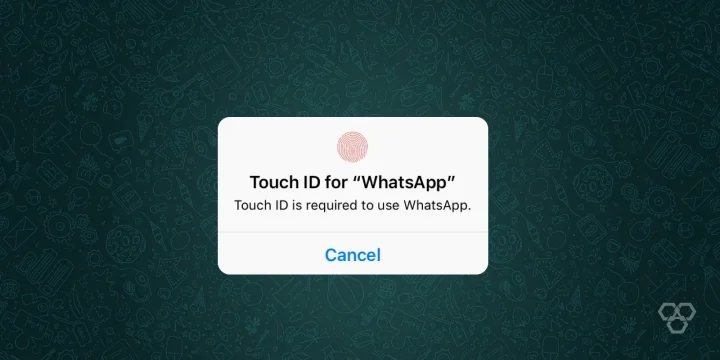
  4. Turn on Require Face ID or Require Touch ID, depending on your model.
  5. Choose the delay before the lock kicks in — immediately, after one minute, after 15 minutes or after one hour.
Steps To Enable Touch Id And Face Id Lock For Whatsapp On Ios
Turning on Face ID or Touch ID for WhatsApp on iPhone

Choosing Immediately is the strictest setting but also the most tiring — every time you switch to another app and back, you re-authenticate. One minute is the sweet spot for most people: long enough to copy a link from your browser and return, short enough that a phone left on a table locks itself again quickly.

Lock a single conversation with Chat Lock

Locking the whole app is blunt. If you only want a handful of conversations shielded — a doctor, a lawyer, a family thread — Chat Lock is the better tool. Locked chats move out of your main list into a separate Locked chats folder, and their notifications stop showing the sender’s name and message content.

How to lock an individual chat

  1. Open the conversation you want to protect.
  2. Tap the contact or group name at the top to open the chat info screen.
  3. Scroll down and tap Chat lock.
  4. Toggle it on and confirm with your fingerprint, Face ID or device passcode.

To read it later, pull down on your chat list — the Locked chats folder appears at the top — and authenticate.

Hide the folder completely with a Secret Code

A visible “Locked chats” folder still tells anyone holding your phone that you have something hidden. Secret Code removes even that hint. You set a password that is different from your phone’s unlock code — it can mix letters, numbers, symbols and even emoji — and the folder disappears from the chat list entirely. It only reappears when you type that code into the WhatsApp search bar.

  1. Open the Locked chats folder.
  2. Tap the three-dot overflow menu in the top-right corner.
  3. Choose Chat lock settings.
  4. Tap Secret code and set your code.
  5. Turn on Hide locked chats so the folder no longer appears in the chat list.

Write the code down somewhere safe. If you forget it and the folder is hidden, there is no reset button — you have to go through WhatsApp’s recovery flow, and that is far more painful than remembering a password.

Protect the backup too

A locked app with an unprotected cloud backup is a locked front door next to an open window. WhatsApp supports end-to-end encrypted backups, and you can now secure that backup with a passkey — your fingerprint, face or device screen lock — instead of memorising a 64-digit key. Find it under Settings → Chats → Chat backup → End-to-end encrypted backup.

Pair that with two-factor authentication on your WhatsApp account (Settings → Account → Two-step verification) and you have covered the three routes into your messages: the phone, the cloud, and the account itself.

If the App Lock option isn’t there

  • No biometric enrolled. WhatsApp hides the option entirely until the phone itself has a fingerprint or face registered. Set that up in your system settings first.
  • Old app version. Update WhatsApp from the Play Store or App Store — menu labels moved from “Fingerprint lock” and “Screen Lock” to a unified “App Lock”, and older builds simply won’t have it.
  • Android below 6.0. The feature requires Android 6.0 Marshmallow or later.
  • Business accounts. WhatsApp Business has the same setting in the same place; if you run both apps, you must enable it in each one separately.
  • Work profile or MDM. On company-managed devices, an administrator policy can block biometric prompts inside third-party apps.

What biometric lock will not protect you from

It is worth being clear-eyed about the limits, because a false sense of security is worse than none.

  • Linked devices. If someone has already paired WhatsApp Web or a desktop app to your account, App Lock on the phone does nothing to them. Audit this regularly under Settings → Linked devices and log out anything you don’t recognise.
  • Notification previews. Unless you turn off message previews, the content still lands on your lock screen.
  • The other person’s phone. Nothing you enable stops the recipient screenshotting or forwarding your messages.
  • A compromised handset. Malware with accessibility permissions or a phone that has been rooted or jailbroken sits underneath app-level protections.

Frequently asked questions

Does WhatsApp store my fingerprint?

No. WhatsApp never sees your fingerprint or face data. It asks the operating system’s biometric API for a yes-or-no answer, and the biometric template itself stays in secure hardware on the device.

Can I use a PIN or password instead of a fingerprint?

App Lock falls back to your device passcode when the biometric fails, so a wet finger or a mask won’t lock you out. For a genuinely separate password, use Chat Lock’s Secret Code, which is independent of your phone’s unlock code.

Will I still get notifications when WhatsApp is locked?

Yes. Notifications keep arriving and you can reply straight from them. Turn off Show content in notifications if you don’t want the message text visible.

Does the lock carry over if I change phones?

No. App Lock is a per-device setting tied to that handset’s biometrics, so you have to switch it back on after moving to a new phone or restoring a backup.

Can I lock WhatsApp Web or the desktop app?

The desktop apps have their own screen-lock option in their settings, separate from the phone. Enable it there if you use WhatsApp on a shared computer.

Is Chat Lock better than locking the whole app?

They solve different problems. App Lock stops anyone opening WhatsApp at all; Chat Lock hides specific conversations even from someone who can open the app — including you, when you hand the phone over to show something. Using both together is perfectly reasonable.

The bottom line

Two taps in Privacy → App Lock is the highest-value privacy change you can make to WhatsApp, and it costs you a fingerprint scan every time you open the app. Add Chat Lock for the conversations that matter most, put a Secret Code on the folder if you want it invisible, and encrypt the backup so the cloud copy is protected too. Together, that closes almost every practical route into your messages short of someone stealing your unlocked phone mid-conversation.

Other WhatsApp guides

  • How to read deleted WhatsApp messages
  • How to control who can add you to WhatsApp groups
  • How to run multiple WhatsApp accounts on Android
  • The most secure private messaging apps
  • The best text messaging apps for Android

Filed Under: Apps & Software Tagged With: Android, How-To, iOS, WhatsApp, WhatsApp Fingerprint, WhatsAppGuide

Related Stories

  • Exploring The Science Behind How A Washing Machine Cleans Your Clothes

    Exploring the Science Behind How a Washing Machine Cleans Your Clothes

  • Android Rooting Guide In 2026: Tools, Risks, And Whether It Still Makes Sense

    Android Rooting Guide in 2026: Tools, Risks, and Whether It Still Makes Sense

  • How Should You Replace Samsung Galaxy Note 7?

    How Should You Replace Samsung Galaxy Note 7?

FacebookTweetPinLinkedInPrint
Avatar for Muhammad Abdullah

Muhammad Abdullah

Senior Tech Correspondent

Muhammad Abdullah is a Senior Tech Correspondent at TechEngage with over 320 published articles spanning social media platforms, mobile apps, operating systems, and industry events. A computer scientist turned tech writer and certified Growth Hacker, Abdullah breaks down complex digital trends into practical insights readers can act on.

Joined October 2018

Reader Interactions

Share Your Thoughts Cancel reply

Please read our comment policy before submitting your comment. Your email address will not be used or published anywhere. You will only receive comment notifications if you opt to subscribe below.

Primary Sidebar

Follow us on Google News

Recent Stories

  • Letter Boxed Hints Today: Clues and Answer for July 30, 2026
  • Spelling Bee Hints Today: Clues and Answer for August 1, 2026
  • Octordle Hints Today: Clues and Answer for August 1, 2026
  • Contexto Hints Today: Clues and Answer for August 1, 2026
  • Waffle Hints Today: Clues and Answer for August 1, 2026

Footer

Discover

  • About TechEngage
  • Newsroom
  • Our Team
  • Advertise
  • Send us a tip
  • Startup Submission Questionnaire
  • Brand Kit
  • Contact us

Legal pages

  • Reviews Guarantee & Methodology
  • Community Guidelines
  • Corrections Policy and Practice
  • Cookies Policy
  • Our Ethics
  • Disclaimer
  • GDPR Compliance
  • Privacy Policy
  • Terms and Conditions

Must reads

  • Best AirPods alternatives on Amazon
  • Best PC monitors for gaming on Amazon
  • Best family board games
  • Best video doorbells without subscription
  • Best handheld video game consoles
  • Best all-season tires for snow
  • Best mobile Wi-Fi hotspots
  • Best treadmills on Amazon

Download our apps

TechEngage app coming soon on App Store

© 2026 TechEngage®. All Rights Reserved. TechEngage® is a project of TechAbout LLC.

TechEngage® is a registered trademark in the United States under Trademark Number 6823709 and in the United Kingdom under Trademark Number UK00003417167. It is also ISSN protected under ISSN 2690-3776 and has OCLC Number 1139335774.