
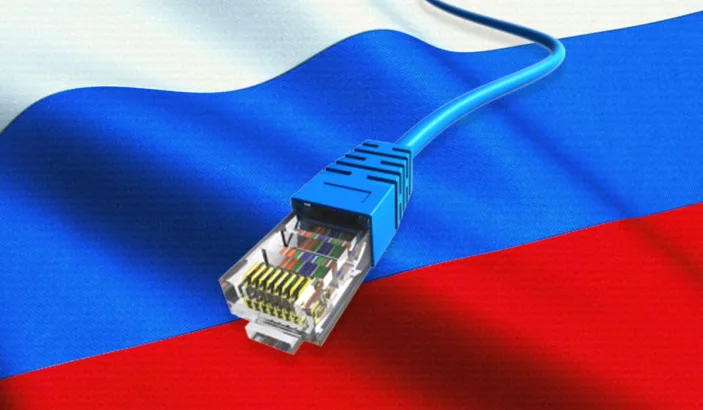
If I asked you to picture the Internet for a moment – the actual, physical Internet – what would you imagine?
Many of us have no idea how this thing we use every day actually works. But in fact, the seemingly magical Internet relies on servers, satellites, cables, and wires that are scattered throughout the world.
Theoretically, no one really controls the Internet, even though they may control some of its infrastructure. And there are ways of disrupting it and censoring it. By now, we all know that China can prevent websites from being accessed by computers in their country. The (not-so-)Democratic Republic of Congo also just shut off their citizens’ access to the Internet and SMS services in January “to preserve public order” during a contested election.
Now, Russian news agency RosBiznesKonsalting (RBK) has announced that Russia will be the latest country to experiment with cutting it’s people off from the Internet. RBK’s February 8th report explains that cybersecurity experts from the country’s Information Security Working Group will perform this experiment in order to see whether or not they can implement a new plan to make Russia’s Internet secure, stable, and sovereign. The test will take place sometime before April.
RBK explained that a bill introduced in Russian Parliament in December called for the creation of an independent Internet. The shut-off will be a way of seeing whether it’s truly possible to create a self-contained Internet infrastructure impervious to hacking or other interference by outside forces. The U.S. and other NATO countries have all accused Russian nationals of state-sponsored hacking in the past and have called for an “offensive defense” in dealing with the security threats. But an independent Russian internet would theoretically be safe from any cyber sanctions imposed by the outside world.
The test will likely be just a few hours long but provide valuable data about how Russia can implement some of their plans as well as give service providers an indication of how their networks would react.
But as many commentators have pointed out, this experiment is likely to have one other payoff for the Russian government. The process could allow the country to implement a web traffic filtering and censoring system just like China’s.
Known as The Great Firewall, China’s independent Internet is managed by the Communist Party and allows them to block access to foreign websites the government deems a potential threat. Established under the presidency of Xi Jinping, it is designed to prevent citizens from communicating with each other and the rest of the world freely, especially those who would use the platform to advocate for social and political reforms in China.
Beginning in 2012, the government began investing in technology to monitor and censor content, including the blockage of over 10,000 sites. Since then, it has passed laws on acceptable content and instituted punishments for those who have defied the regulations. China has banned sites including Google, YouTube, Facebook, Twitter, Instagram, Pinterest, and even Dropbox. News outlets such as The New York Times, Reuters, and the BBC are also blocked.
Whether Russia plans to implement its own version of The Great Firewall remains unclear for now, but it’s worth noting that Putin’s first mention of disconnecting his country from the global Internet came in 2014, when China’s president first started blocking his citizens’ access to social media.
The experiment will be informative for countries all over the world and, frankly, many will be surprised if it is successful. Even though Russia has tried to replicate vast swathes of the web on their own internal servers, the Internet is simply too complex and too global to be contained. It’s likely that many websites will simply stop working because they rely on multiple servers all over the world to function properly.
If the test fails, it could fail miserably, shutting down bank and hospital websites or aviation resources as well as disrupting service in countries that route their traffic through Russia. On the other hand, if it goes well, it will embolden not only Russia but perhaps other countries to censor access to the Internet and resources that encourage free speech.




Share Your Thoughts